Strategist Ken Coulson applies systems thinking to sustainability challenges
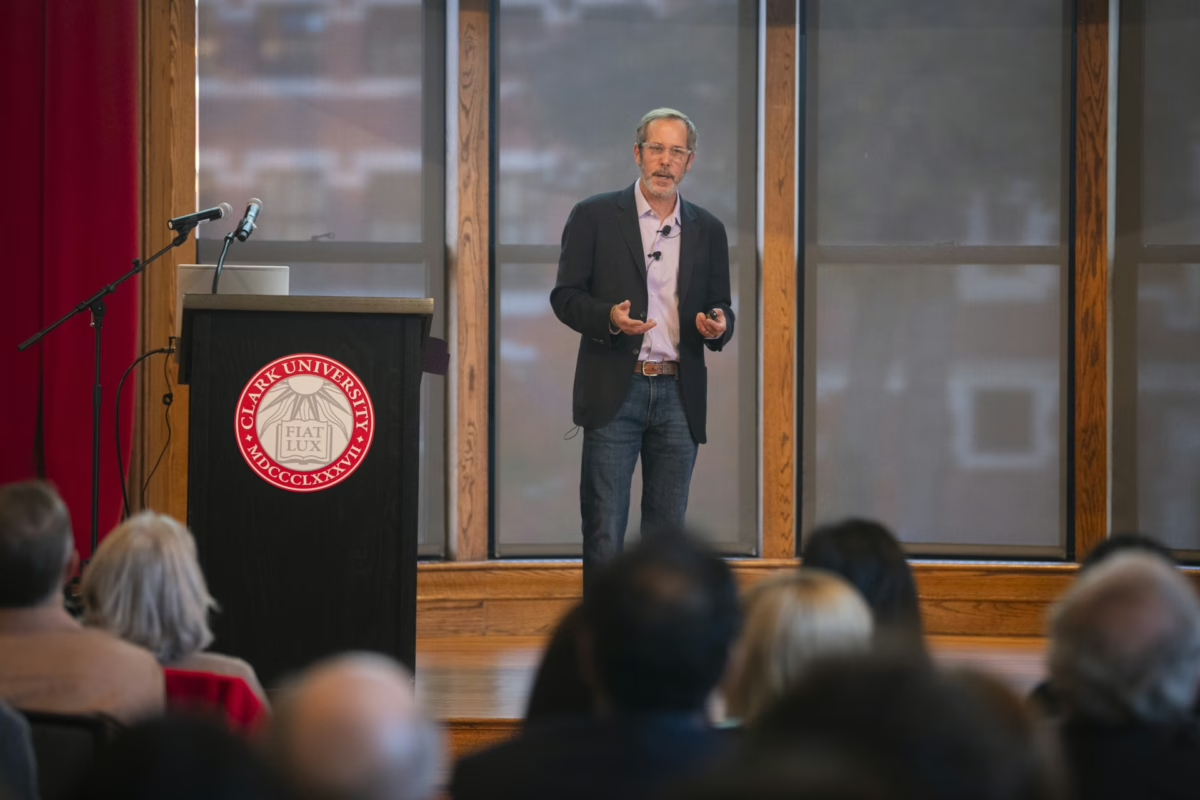
To begin his talk on securing a sustainable future in the face of climate change, Ken Coulson took his Tilton Hall audience back in time — 4.5 billion years, in fact — to the birth of the moon.
“Picture it with me,” he says. “A planet roughly the size of Mars slamming into a young molten Earth. The cataclysm wasn’t an explosion. It was a merger.”
The collision “created the basis for all of our future wealth and prosperity,” gave the Earth its spin, and tilted the planet off its axis to create “the gift of seasons.” The new moon’s gravitational pull created a global tidal bulge in the Earth’s primordial seas, which contained the early building blocks of life.
Coulson’s talk, “Life, Climate Volatility, and What Comes After the Final No,” was sponsored by the School of Climate, Environment, and Society.
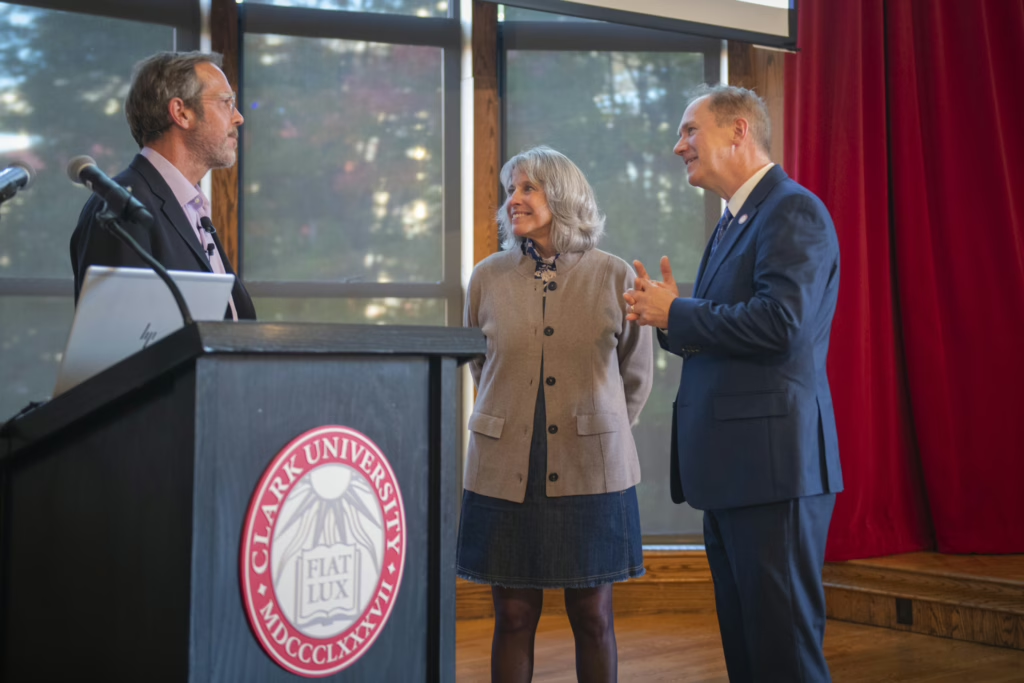
Coulson is a former managing director at Goldman Sachs and UBS turned sustainability strategist, musician, and novelist. He said the story of the Earth’s violent beginnings is a reminder of the balance and beauty born from chaos, and the inheritance that humanity continues to squander.
Coulson’s career in quantitative finance took him from the Chicago Board of Options to trading floors in London and Hong Kong, helping to build global derivatives markets that would eventually double and quadruple in volume. But he recognized that the systems were “optimized for speed and profit — but not for resilience, not for people.”
The 2008 financial crisis shattered his belief that markets were inherently self-correcting. “Overnight, the externalities were glaringly obvious,” he explained. “And our crisis responses always exacerbate inequality. They fix markets, not people.”
That realization set him on a journey to understand how the same systems thinking that drives markets could be applied to hedge climate volatility and build a sustainable, equitable economy, rather than an extractive one.
“Warmer worlds are more volatile worlds,” he says. “Rainfall is becoming bimodal; all at once or nothing at all. The Texas grid freezes and Europe bakes. Thousand-year storms happen weekly.”
Drawing on his trading background, Coulson reimagined familiar financial concepts like equilibrium and volatility in planetary terms. In markets, equilibrium represents a balance between supply and demand; in nature, it’s a state that maintains biological carrying capacity and diversity. Volatility measures the difference between the expected value and the actual outcome. When volatility rises, systems — financial or ecological — start to break.
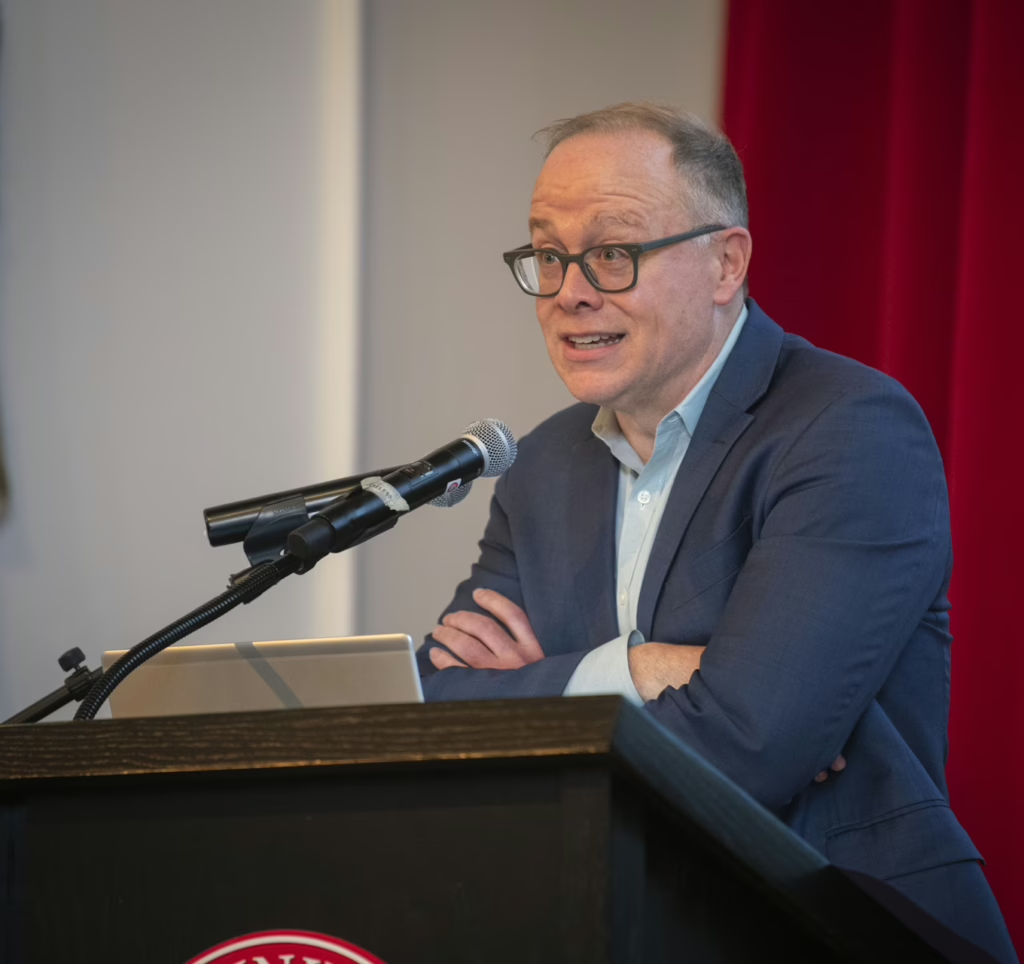
“Our climate problem,” he says, “is a volatility problem.”
Coulson began translating sustainability into formulas. He built models that treat renewable energy assets as stable bonds based on resilience, and adapted financial equations to add variables like future waste liabilities and resource risk adjustments.
“Our system prices extraction, not restoration,” he said. “But the true cost of capital is the restoration rate, the rate at which nature can replenish what we take.
“We’re getting exactly what we designed for,” Coulson warned. “A society that doesn’t value people gets inequality. A society that doesn’t value ecosystems gets floods.”
Coulson’s consulting firm, Future Bright, LLC, works with investors and entrepreneurs to design sustainability projects that “mimic nature,” or circular, waste-free systems that turn byproducts into resources.
The goal is not just efficiency, but resilience, he said. “Our world is optimized for a past that no longer exists. We need systems that can withstand shocks — pandemics, floods, market crashes.”
When helping shape the sustainable investment strategy for UBS, Coulson argued for a global carbon price tied to a universal basic income and shared green infrastructure. “If we price carbon correctly,” he says, “and share the returns equitably, we can hedge climate volatility and social volatility together.”
For Coulson, data represents only half the equation. The other half is art. When he began focusing on sustainability, he also rediscovered his passion for music, and has written and recorded more than a hundred songs in support of climate action. And in March 2024, he published his debut novel, “The Arsonist,” a semi-autobiographical corporate thriller that explores redemption as the world of global finance collides with the climate crisis.
“Art is a heavy term,” he reflects. “But our stories, songs, and paintings — these are the principal components of the future. We have a duty to tell good ones.”
Coulson said that despite the climate prognosis, there are positives. “We have the solution set,” he said. “The thing we need to fix is the cultural and educational inertia.” Global communication means that a powerful idea can be scaled like never before. “And what we need to do is need to figure out how to make it not just about communication, but about participation, about equity.”
Coulson closed his lecture with a quote from Wallace Stevens’ poem “The Well Dressed Man with a Beard.” It’s a line he said has carried him through rejection, creative struggle, and the daunting work of transformation.
After the final no there comes a yes
And on that yes the future world depends.
“Our job,” he said, “is to make the possible probable — one yes at a time.”