Clark prioritizes student mental health in Southbridge Public Schools
“I got you.”
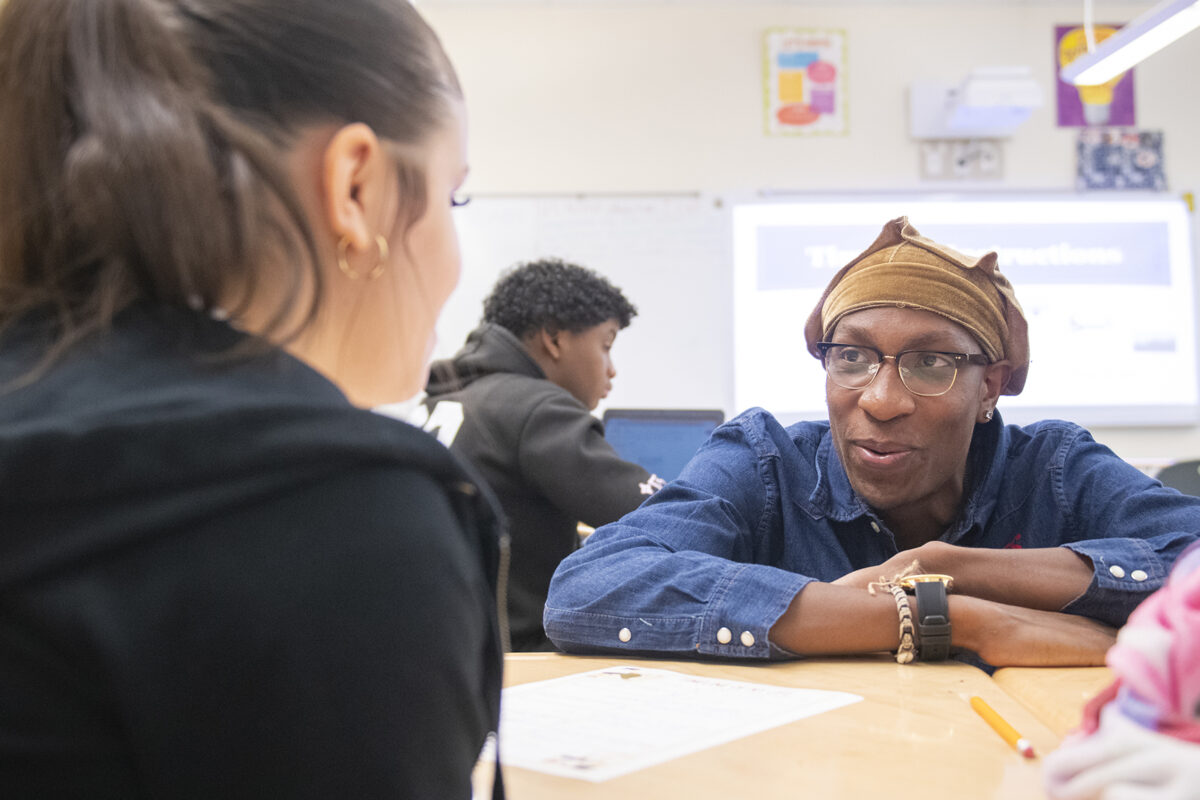
Nate Edwards-Roseney ’26 wants the person he’s speaking with to know that he understands what they’re trying to tell him, even when the words don’t come easily.
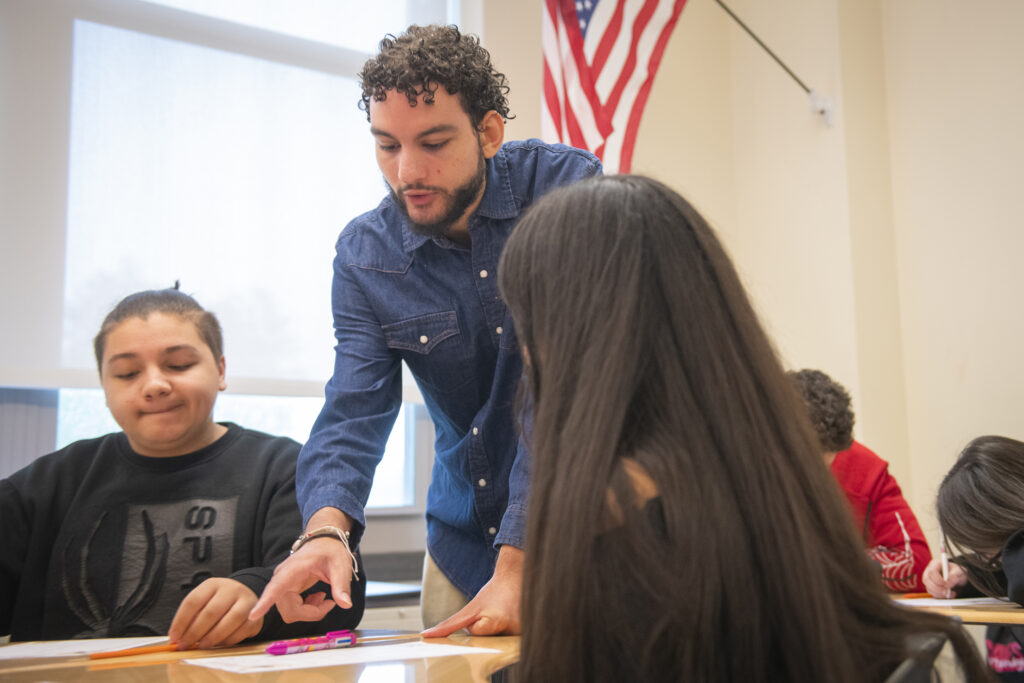
It’s an approach he has refined as a Fellow with the Mosakowski Institute for Public Enterprise at Clark University. Since his junior year, Edwards-Roseney, a psychology major with a minor in education, has served as a student mentor in the Mosakowski Institute’s partnership with the Southbridge (Mass.) Public Schools. He and his fellow mentors have worked with teachers at Southbridge High School to implement the MAAX (Maximizing Adolescent Academic eXcellence) social development curriculum, leading lessons in ninth-grade wellness classes and helping the new high schoolers apply the skills they learn.
The Southbridge CARES project, an innovative, equity-focused initiative supporting students’ mental health, academic achievement, and postsecondary readiness, is supported by a Synergy Initiative grant from The Health Foundation of Central Massachusetts and implemented in partnership with the Mosakowski Institute. The Health Foundation has awarded $675,000 to the project to date.
By partnering with Clark, Southbridge High School is able to use evidence-based services, tools, and technology to meet the emotional, academic, and mental health needs of students. Southbridge CARES includes three different services, two of which — the MAAX curriculum and the MI PEACE mobile app — have already been introduced to the community.
The third debuts Oct. 17 with the opening of a sensory immersion room that delivers intensive, individualized care at school. The room offers a soothing space where students with behavioral health concerns, trauma, or disruptive behavior can regulate their emotions.

‘An absolute commitment’
The MAAX curriculum begins with a module on managing the transition from middle to high school. “There are goals, there are objectives, there are group activities and discussion,” says Nadia Ward, executive director of the Mosakowski Institute for Public Enterprise, whose previous work inspired the creation of the MAAX program.
“Southbridge has made an absolute commitment,” Ward says. “Part of the thing we worry about as academics is whether a program we bring to a district will be adopted or institutionalized. But with teachers and counselors on board, and the fellows being welcomed to the classroom twice a week, this is becoming part of the fabric of the school.”
David Buchanan teaches ninth-grade wellness at Southbridge High School and has been part of the MAAX implementation since the beginning. “The curriculum is fantastic,” he says. “There are a lot of useful lessons that force our kids to be reflective about their academics.”
Southbridge has long been considered a struggling school district. In 2016, underperformance on key indicators, such as attendance, graduation, and MCAS scores, combined with high dropout rates, resulted in state receivership (where the Massachusetts Department of Elementary and Secondary Education took control to support the district’s turnaround). Since that time, Southbridge has seen growth in many areas.
The page is turning, Buchanan says, and he sees more students getting excited about extending their academic careers. Students who once assumed college wasn’t for them are rethinking their futures.
Buchanan recalls a MAAX lesson where students visited the Bureau of Labor Statistics website to research the qualifications needed for certain jobs based on a “dream life map” they had created in an earlier class. “I thought they might find it dry, but they got really into it, and they worked extraordinarily hard. Some of them even kept what they learned in mind when they were planning their class schedules for the subsequent terms.”
Beyond academics, the MAAX program — and the Mosakowski Fellows — helped create a true classroom community. “Every high school in America has different groups of students who socialize outside of the classroom, but not in the classroom,” Buchanan says. “The social-emotional learning curriculum encourages them to step out of their comfort zone and work with students they may not normally interact with, discovering shared experiences. That’s a huge unifier.”
The fact that the MAAX lessons were led by college students who are only six or seven years older than the ninth-graders also helps. “I can give them my experience, but I’m 20 years removed from college,” Buchanan says. “The mentors are in college.”
‘They see themselves in the future’
“We don’t teach math or science,” Edwards-Roseney says. “We teach skills. And we try to teach them in ways students learn best.”
In one lesson, the mentors talked about different types of learners — visual, auditory, or kinetic. Based on their learning style, each student took notes while Edwards-Roseney taught them how to build a paper airplane. Some drew pictures, while others wrote down the steps.
“I don’t remember in high school learning to take notes,” says Kennedy Messado ’25, a Mosakowski Fellow for three of her four years at Clark. “If I had learned from ninth grade, my entire high school career would have been different. I love teaching them what we know as college students and what we had to relearn as college students. There’s also the plus side of being taught by students instead of their regular teachers.”
The mentors’ presence is a tangible reminder to the Southbridge students that college is possible. Fellow Ariel Rodriguez ’26 advocated for community college as an option if cost is a concern. A Worcester native, he graduated from Quinsigamond Community College before transferring to Clark for his junior year. “There’s a QCC branch campus in Southbridge High School,” Rodriguez says, and high school students are eligible to take college courses before graduating. “I told them how special that was, and how they could take advantage of it and get credits they wouldn’t be able to get anywhere else. I tell them about my experience at QCC and how it reinvigorated my passion for education and learning.”
“It’s nice having the opportunity to build relationships with the students,” Edwards-Roseney says. A former Clark basketball player, he competed in the Southbridge teachers-versus-students game. “They enjoyed seeing me dunk,” he says with a laugh, adding that some of the students called him Big Nate or Fro-Zone.
The students were given a glimpse into higher education during a field trip to the Clark campus, where they toured academic buildings, ate in the dining hall, and learned about the college experience.

‘A new way of approaching school mental health’
The second Southbridge CARES tool, MI PEACE, is a customizable app that provides social-emotional learning resources, mental health check-ins and assessments, and insights for school counselors. The school can control access to various widgets, such as breathing techniques and mindfulness exercises, and students get reminders if they should engage with the app. “It’s about supporting young people in their behavioral health and also collecting secure data points for their counselors,” Ward says. The app tracks and monitors care coordination so a school counselor can easily check in.
“They now have more data and information in front of them to help improve their practice and help students feel better. And if kids are feeling better, that means they’re coming to school more often, they’re doing better academically, they’re going to get promoted to the next grade level on time, and on and on and on,” she continues. “That’s the intent — to establish a new way of approaching comprehensive school mental health.”
The soon-to-open Sensory Immersion Room — the first of its kind in Massachusetts — integrates immersive technology, virtual reality, and sensory equipment to create customizable, calming, and therapeutic environments for adolescents, including those experiencing behavioral health challenges or sensory differences, to manage anxiety and decompress.
Clark, local, and state officials will be on hand for a ribbon-cutting ceremony and reception on Friday, Oct. 17, from 9:30 to 11 a.m. at Southbridge High School.