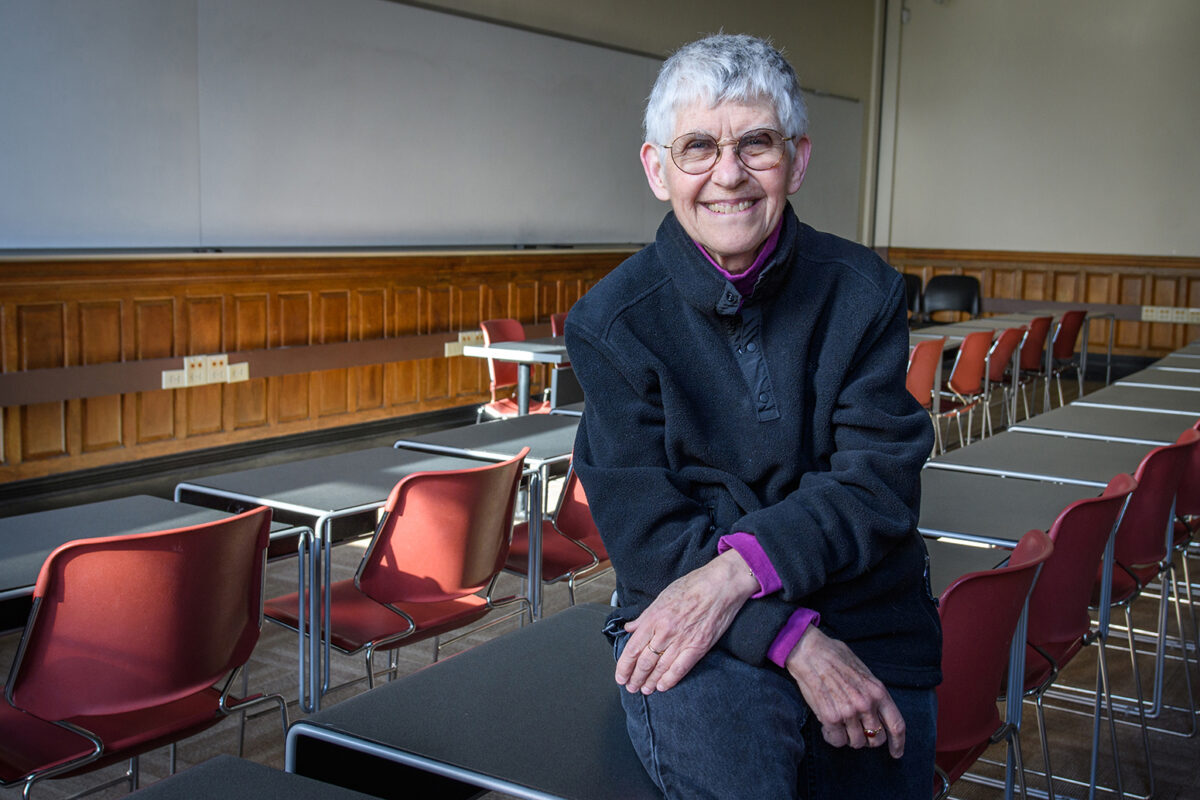
Cynthia Enloe to assume the Clark podium one last time
“Well, I’m not going into hibernation.”
With a chuckle, Cynthia Enloe has begun the Zoom call by immediately clearing up a misperception about the event billed as her “final Clark lecture,” a description that sounds so, well, final.
First, there is truth in advertising: The October 16 lecture in Tilton Hall will indeed be Enloe’s last regularly scheduled talk at Clark — the coda to her long-running series of fall lectures that she’s been delivering since about 2010. But in response to some ClarkNow reader queries expressing concern about her motivations for ending the talks, please know: 1. She is hale and healthy, and 2. The decision to bring this chapter in her legacy to a close was hers alone.
“It doesn’t mean I’ll never be back on campus again,” Enloe says during the call from her home in Cambridge, Massachusetts. “But when you’ve been doing something for so long, there does come a time when you need to wrap it up as neatly as possible before things get too awkward.”
And she’s determined to wrap it up in style.
Enloe’s lecture, “Feminist Curiosity is for These Dark Times,” will address, she says, “why, in 2025, we better have feminist-informed skills in gender analysis with everything: war and peace, climate and equality; governance. If we don’t avail ourselves of these analytical skills, we as a country are going to be in really bad shape.”
What the lecture will not be, Enloe insists, is “a walk down memory lane,” a revisiting of highlights from an internationally renowned career. “That is not my mode at all,” she insists.
That said, today, on this particular call and in anticipation of her last Clark lecture, Enloe graciously indulged an interviewer’s nudge down memory lane to answer questions about her long legacy of awakening and inspiring countless Clark students, many who have remained acolytes of her teachings well beyond their days in her classroom.
‘I’m a comparative politics person. I always try to be very conscious of where I am in the world.’
Enloe arrived at Clark in the fall of 1972 after teaching for five years at Miami University in Ohio as the first (and, at the time, the only) woman faculty member in the Government Department (now Political Science). She had earned her doctorate in comparative politics at the University of California, Berkeley, where she’d completed a Fulbright fellowship in Southeast Asia and experienced the tumult of the times, participating in protests opposing the war in Vietnam.
Before hiring her, the political science chair at Miami called Enloe’s supervisor at Berkeley and asked a pointed question: “Will she make trouble?”
“The bad part is, my supervisor said, ‘Oh no. Not at all.’ ” Enloe laughs. “That’s terrible! He could have at least said, ‘Well, maybe just a little.’ ”
Five years later, even after Enloe had secured tenure at Miami, the offer to join Clark proved irresistible. The University, she says, “wanted to be worldly, not in a superficial way, but just to be truly part of the world. And I loved that.” (The move to Massachusetts would also mean the passionate baseball fan, and Long Island native, would eventually switch her rooting allegiance from the Yankees to the Red Sox.)
At Clark, Enloe introduced fresh topics into the classroom and was part of a department that she describes as “rethinking” itself. She also was among a handful of faculty members who came together to launch a program in Women’s Studies after a group of undergraduate students in 1974 approached Dean of the College Marcia Savage to ask that faculty craft courses in this emerging field. The program evolved from a course of study overseen by a few hardy contributors to today’s Women’s and Gender Studies program, which draws from the research and scholarship of more than 50 faculty from various disciplines across the University.
The global aspect of her scholarship remained central to Enloe’s research and writings. Her career as both a full-time faculty member and, after retirement in 2003, as a research professor has included Fulbrights in Malaysia and Guyana and guest professorships in Japan, Canada, the United Kingdom, Australia, New Zealand, and Iceland. In 2022, Enloe served as the Middlebrook/Djerassi Visiting Professor of Gender Studies at the University of Cambridge, UK.

Enloe’s feminist teaching and research have explored gendered politics, with special attention to how women’s labor is made cheap in globalized factories and how women’s emotional and physical labor is used by governments to support their war-waging policies. Racial, class, sexual, ethnic, and national identity dynamics, as well as ideas about femininities and masculinities, are common threads throughout her studies and the 15 books she’s authored, including her most recent, “Twelve Feminist Lessons of War” (University of California Press).
Among her many honors and awards, Enloe in 2017 had her name added to the Gender Justice Legacy Wall, installed in The Hague at the International Criminal Court.
She has presented lectures in Sweden, Norway, Germany, Portugal, Spain, Chile, Vietnam, Korea, Cambodia, Colombia, Bosnia, Turkey, Brazil, the Czech Republic, Austria, Finland, Ukraine, and at universities around the U.S. Her writings have been translated into 15 languages.
“I’m a comparative politics person, which means you must be in other places,” she says. “You are not supposed to be sitting in the U.S. and trying to keep up with everything from here. You need to plunk yourself down in places you’re unfamiliar with and learn how things work.”
Enloe says that when she’s asked to speak, it’s typically “because people have a worry — something that’s going on in their country and how it intersects with the world. They want me to talk about this thing that worries them. I’m not doing it for money, or ego. I’m there because somebody thinks that whatever I do can be useful, and so I need to serve that purpose.”
Such specificity of concern also applies to Clark, notes Enloe. She compares the upcoming Clark presentation to one she recently made in Belfast, Northern Ireland.
“Look, Belfast is not just anywhere, and its people are not just anybody,” she says. “I always try to be very conscious of where I am in the world, and that’s true of Clark as well. Clark is not just anywhere, and Clarkies are not just anybody.”
When Enloe takes the Tilton podium on October 16, her final lecture promises to be as incisive and uncompromising as any she’s delivered. As is her ritual, she’s made notes in preparation, rethinking and refining her message — but she won’t read from those notes on stage. At the point of delivery, she will be perfectly comfortable with what she wants to say and eager to bring the audience along with her.
“I’ve always told my students, ‘Look, I’m not a specialist. You’re not a specialist.’ So come on, let’s just take this journey together.”