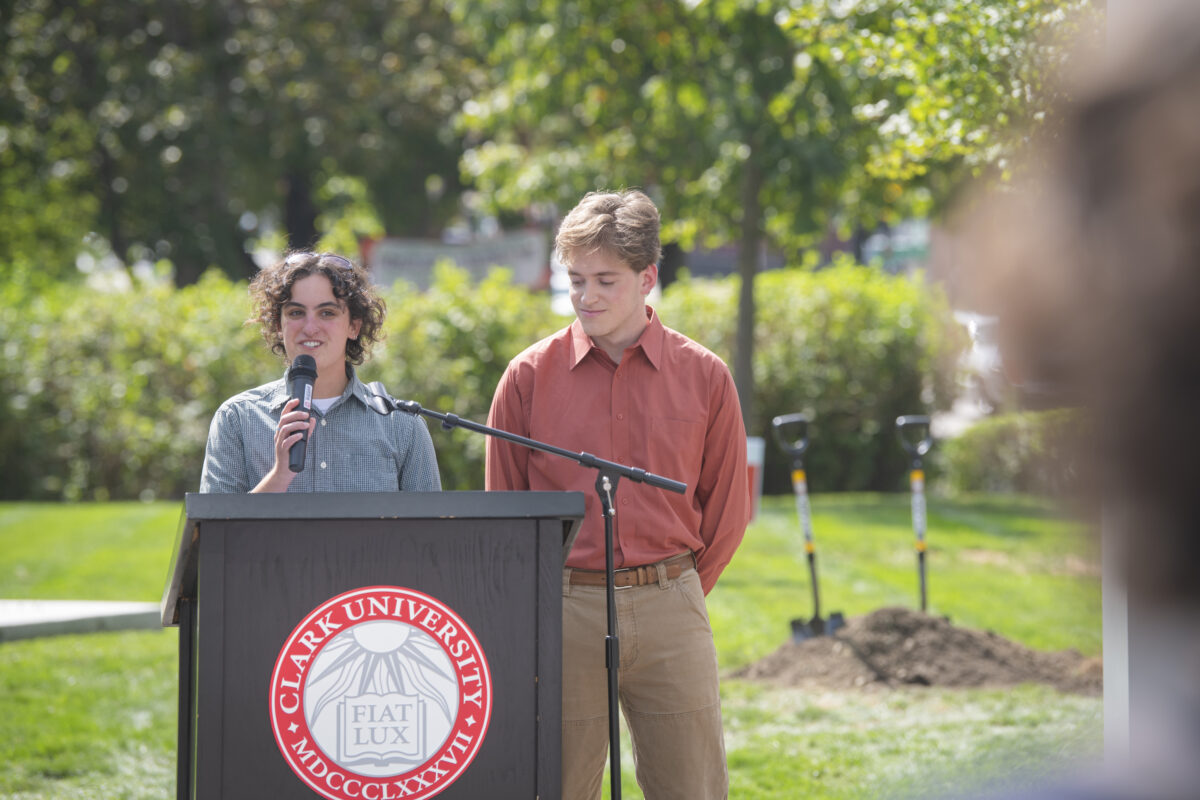
Ruby Lichtman ’27 and Zach Rutherford ’27, members of the Clark Environmental Action student group e-board.
Clark University has announced a major step toward ensuring the campus takes the necessary actions to assert its commitment to sustainability and stewardship of the environment.
On Monday, at a tree-planting ceremony held to celebrate the launch of the School of Climate, Environment, and Society, President David Fithian announced the reestablishment of the Sustainability and Climate Committee. The committee will be composed of faculty, students, and staff, who will help guide the University’s efforts to shape a strategic vision and action plan that will serve as a roadmap for achieving sustainability goals through its operations, academics, and community engagement.
“We talk about all politics being local. Well, all action is also local,” Fithian said. “We’ve got to take this first step.” He noted that many Clarkies are deeply invested in contributing to campus sustainability strategies, especially as a University-wide collaboration. “The opportunities for partnerships around this are very exciting.”
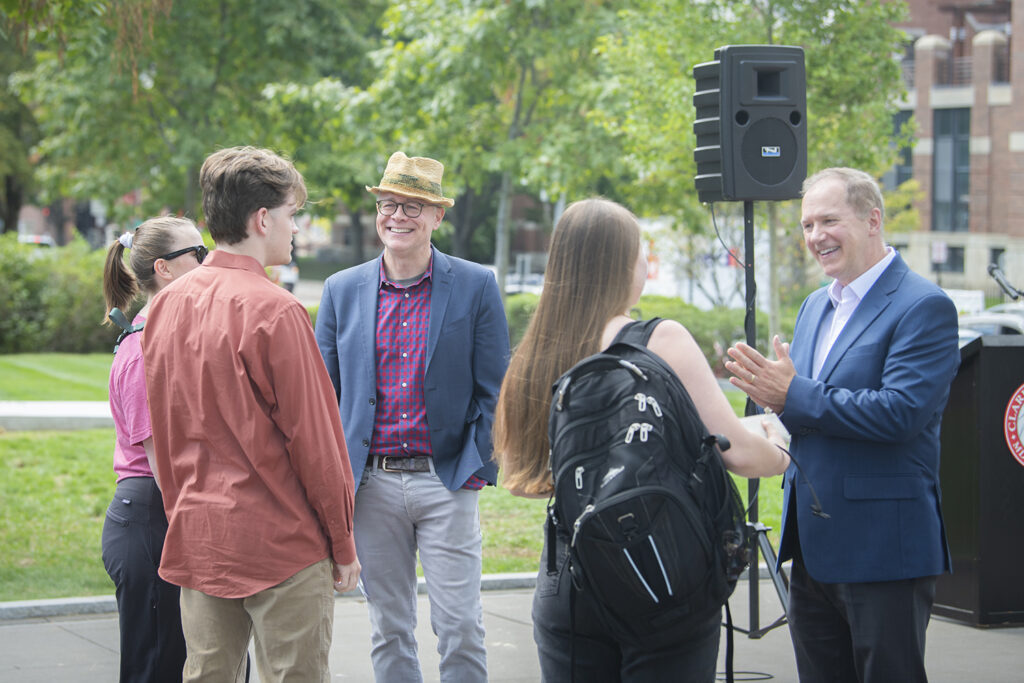
The student-run Clark Environmental Action (CEA) organization was instrumental in pressing Clark to rethink its approach to sustainability “right on this campus,” said Lou Leonard, the D.J.A. Spencer Dean for the School of Climate, Environment, and Society. He added that Clark is also reestablishing the full-time position of director of sustainability to oversee University initiatives toward a greener campus.
“We need to show the world that we care about these issues in a really intimate way,” Leonard said. “Bringing back the committee, staffed by a new director of sustainability, will deliver the impact that we need.”
Leonard then introduced Clark juniors Ruby Lichtman and Zach Rutherford, who serve on the CEA e-board, noting that “students demanded us to be here and take this step.”
Lichtman said she and fellow CEA members expressed concerns — through panel discussions, conversations with administration and faculty, and via petition — that Clark “ensure necessary actions are implemented effectively across the University,” which would include consistent and transparent reporting on carbon emissions.
Rutherford added that a number of colleges and universities have made commitments toward a decarbonized future but have taken little effective action toward achieving that goal. “We are convinced of Clark’s ability to buck that trend,” he insisted. “The momentum we’re seeing from Clark students, faculty, and administration is no passing phase; instead, it’s a turning point for environmental action.”