In new book, Clark-affiliated editors urge economic geographers to engage with ‘major global challenges and societal changes’
If ever there were a time for economic geographers to share their expertise with the world, that time might be now, according to the editors of a recently published book, A Research Agenda for Economic Geography: Reframing 21st Century Capitalism, who have ties to Clark University’s Graduate School of Geography.
Economic geographers study the people, places, networks, institutions, and resources affecting everything from global trade and urban planning to the production, transportation, and consumption of goods. As the world faces an ever-shifting trade war, unsettled markets, and realignment of economic and political alliances, the book’s editors are calling upon their field to respond to these global challenges.

“We believe our best work is defined by our engagement with major global challenges and societal changes,” they write in the book’s introduction. “This not only elevates the real-world relevance of economic geography, but is also the main (and arguably only) thing generating interest in our work beyond geography, both from interdisciplinary scholars, as well as policymakers.”
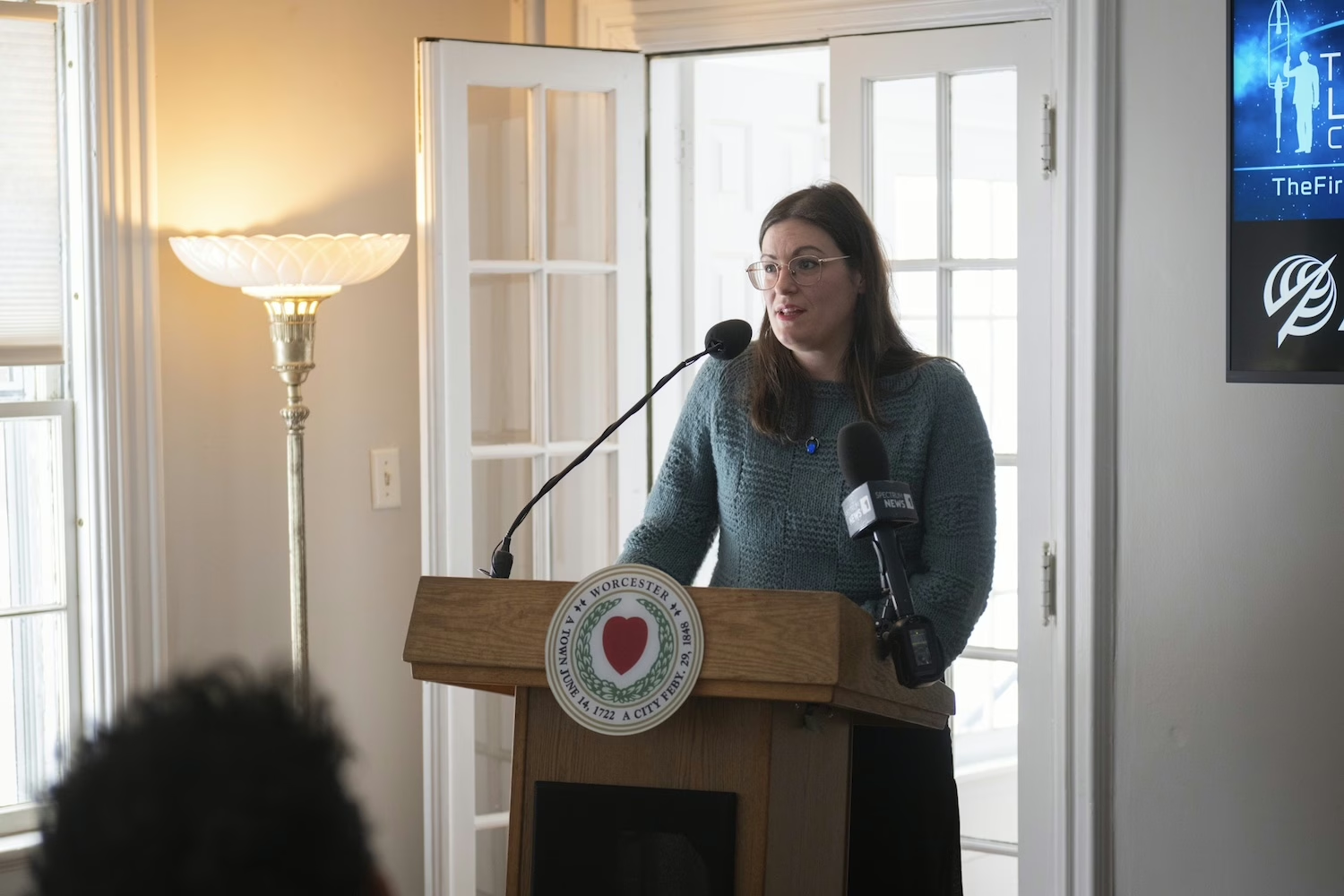
Clark has been aligned with the field since the renowned Economic Geography journal was founded a century ago. In June, Clark was the first university in the United States to host the 7th Global Conference on Economic Geography, which drew more than 400 experts eager to visit the campus and Worcester, a place historically significant to their field and inextricably tied to America’s Age of Industry. One of the book’s editors, Professor Yuko Aoyama of the Graduate School of Geography, organized the conference and is a former editor-in-chief of the journal.
Aoyama’s co-editors are three Clark alumni: Professor Dan Haberly, Ph.D. ’12, of the University of Sussex’s School of Global Studies; and professors Rory Horner, M.A. ’11, Ph.D. ’13, and Seth Schindler, Ph.D. ’13, of the University of Manchester’s Global Development Institute.
Their book includes perspectives from economic geographers across the world who examine the future of capitalism vis-à-vis the changes in globalization, the “green” transition, digitalization, and financialization.
In her chapter, “Reframing Globalization: The Rise of Supply Chain Diplomacy,” Aoyama describes how “recent series of events globally signal the effective end of the liberal international order that undergirded globalization as we know it,” she says. “Future research agenda for economic geographers include a great attention to be paid to the statecraft realignments and the geopolitics that induces economic restructuring in a multi-polar world.”
“We were excited about the agenda-shaping opportunity that this book series offer,” Aoyama adds. “Rather than looking back, we looked forward to theorize what is coming in the transformation of capitalism.”

The editors hope their book interests not only economic geographers, but also experts in business, development studies, economic sociology, heterodox economics, management and political economy. “Moreover, academics, policymakers and other practitioners with a more specialist focus should find the individual contributions of relevance,” they write in the University of Manchester’s Global Development Institute Blog
The three Clarkies were supervised by Aoyama, and have collaborated with her on a publication in the past. Their 2018 article, titled “Globalisation, Uneven Development and the North–South ‘Big Switch,’” in the Cambridge Journal of Regions, Economy and Society, analyzed the political shift of anti-globalization, from the 1990s activists’ focus on the impacts on the Global South to a 21st-century backlash concerned with the effects on the Global North. The article was also featured in The Conversation, “How Anti-Globalisation Switched from a Left to a Right-wing Issue — and Where it Will Go Next.”