

White Oak
Quercus alba
White oak is one of the most iconic forest trees of eastern and central North America. Long-lived and massive in size, white oaks are one of the most critical food sources and hosts for hundreds of species of wildlife.
History at Hadwen
White oaks were one of the species originally growing on Hadwen’s estate at least as early as 1882. During his lecture to the Massachusetts Horticultural Society in 1900, Hadwen stated, “Many species of the Oak are indigenous. I have some of nature’s planting four feet in diameter and sixty feet spread of limbs. They too rarely adorn private grounds, being difficult to transplant. When planted, they should be young and pruned to the pole. When the oak is given ample space to develop and time to mature, but few trees can be compared to it in its variety of beauty changing with the seasons from the delicate form and color of the opening leaf to the deep and glossy green of the summer and the gorgeous colored tints of the autumn.”
Detailed species information
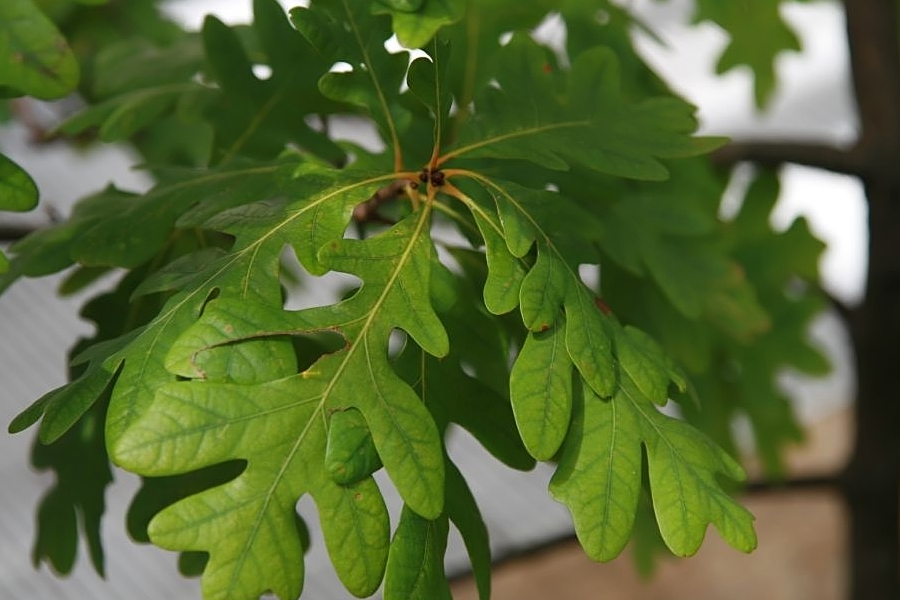
White oak is a deciduous tree in the family Fagaceae native to eastern and central North America. This species is long-lived, with some specimens reaching over 450 years in age. Typically, white oak trees reach 80–100 feet (24–30 meters) in height with far-extending branches that eventually form a massive canopy. The bark of the white oak is light gray and usually described as scaly or fissured. The green leaves are alternately arranged on the stem with seven to nine rounded lobes. Green catkins emerge in May, and flowers mature into light brown, shiny acorns with cup-shaped caps.
White oak is tolerant to a wide variety of habitats and environmental conditions but is mainly a lowland tree. It is one of the most recognizable species of the forests in the northeastern United States and is considered to be one of the most critical species for wildlife. The acorns, twigs, leaves, and shoots of the white oak are an irreplaceable food source for many types of mammals, birds, and insects.
The wood of the white oak is highly valuable due to its water and rot resistance. Its lumber is used for whisky and wine barrels, construction, paper, and shipbuilding. Because of its slow growth rate and massive mature size, white oak is not often used as an ornamental. Furthermore, white oaks’ intolerance to urban conditions and plantation makes them difficult, though not impossible, for street plantings. Despite this, when suitable sites are found, white oak is considered to be a majestic shade or specimen tree.