
White Ash
Fraxinus americana
White ash is a deciduous tree native to central and eastern North America. White ash populations have been impacted by the invasive insect, the emerald ash borer.
History at Hadwen
White ash has existed in the arboretum since some of the trees were first documented by Hadwen himself in a news clipping from October 1882. In the article, he writes that the arboretum “is not [his] in the legal sense of ownership in fee, merely a tenant at will.” He lists white ash amongst 70 other species he has growing on the property. Since then, it was documented in 1971 in a report on the status of the arboretum, and again in 2020.
Detailed species information
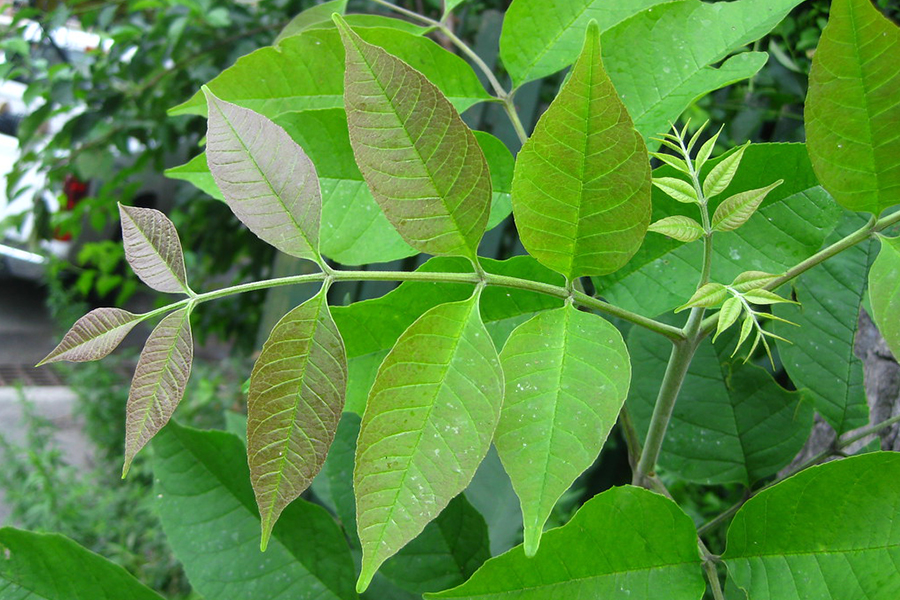
White ash, also known as American white ash, is a deciduous tree species in the family Oleaceae native to eastern and central North America. The white ash can grow up to 80 feet (24 meters) in height and up to 3 feet (1 meter) in trunk diameter. Its bark is dark gray or brown and fissured in uneven vertical lines. The leaves of the white ash are compound and oppositely arranged on the stem, with five to nine elliptical leaflets. The leaves are dark green in spring and summer and turn yellow or red in fall. The fruit of the white ash are winged samaras which ripen in fall but often cling to branches throughout the winter.
White ash is considered to be shade intolerant and prefers rich, loamy soils. The white ash has been severely impacted by the emerald ash borer (Agrilus planipennis), an invasive beetle species from Asia. The beetle larvae feed on the tree’s phloem and disrupt its ability to transport water and nutrients, ultimately killing the tree.
White Ash is highly valued for its wood, which is heavy, strong, elastic, and straight-grained. It is commonly used for furniture, flooring, tool handles, sports equipment, instruments, and other applications where strength and flexibility are important. The tree is also sometimes used in landscaping as its leaves provide striking fall coloration though not as widely used as green ash (Fraxinus pennsylvanica).