
Sassafras
Sassafras albidum
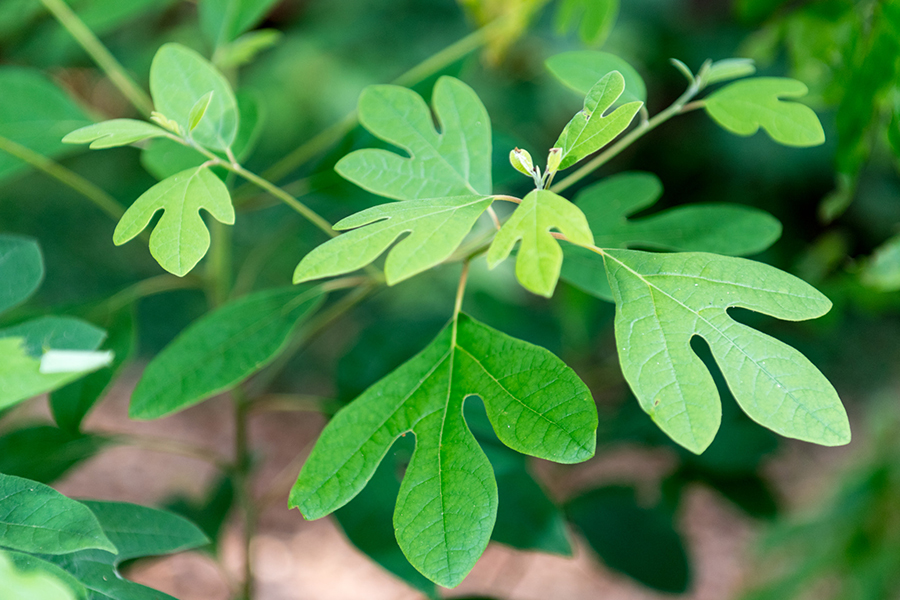
Sassafras is a deciduous tree native to eastern North America known for its distinctive leaf shape, reminiscent of a dinosaur’s foot. The tree is very aromatic and historically was used to flavor root beer!
History at Hadwen
In 1900, Hadwen notes the sassafrass as one of the many deciduous trees growing on his farm, “well worthy of planting.” The sassafrass is recorded again in documents from 1971, and 1978, before being recorded most recently in 2020.
Detailed species information
Sassafras is a deciduous tree in the family Lauraceae native to eastern North America. Typically, it grows 35 feet (11 meters) in height and 12 inches (30 centimeters) in trunk diameter. The smooth bark is orange-brown or red-brown and furrowed. The most distinct characteristic of the sassafras is the leaves which are alternately arranged on the stem and have three different shapes: entire, mitten-shaped, and three-lobed. The most common leaf shape for sassafras is the three-lobed shape which is said to resemble the footprint of a dinosaur. The small, six-petaled flowers are yellow in color and the fruit is a dark blue drupe.
Sassafras can be found in a variety of habitats, including forest edges and fields. Sassafras is considered shade intolerant and thrives in rich, well-drained soils. Many parts of the sassafras tree provide food for wildlife, especially the fruits which are an important food source for birds such as phoebes, woodpeckers, and thrushes.
Sassafras can be found in a variety of habitats, including forest edges and fields. Sassafras is considered shade intolerant and thrives in rich, well-drained soils. Many parts of the sassafras tree provide food for wildlife, especially the fruits which are an important food source for birds such as phoebes, woodpeckers, and thrushes.