

Northern Catalpa
Catalpa speciosa
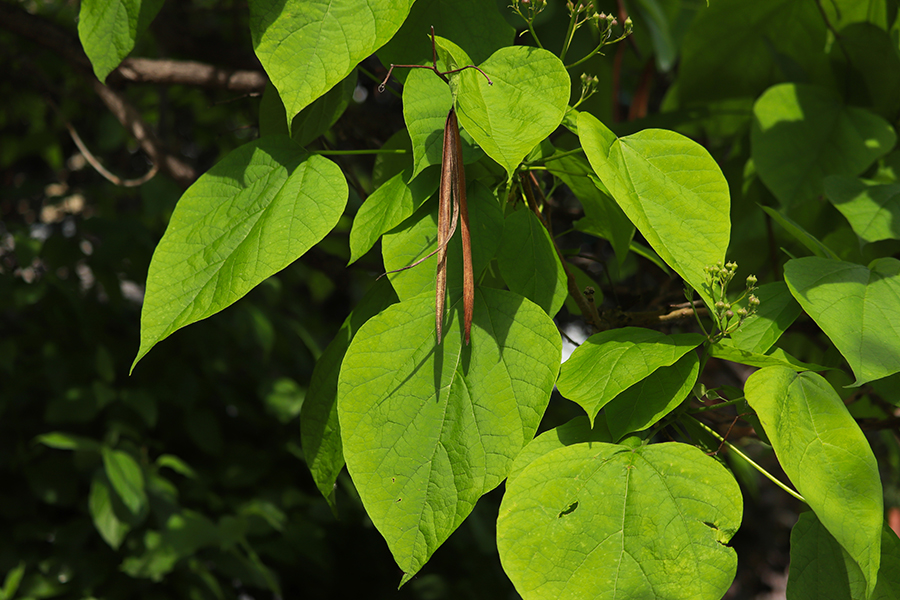
Northern catalpa is a deciduous tree known for its large, heart-shaped leaves, abundant iris-like flowers, and sizable bean-like fruits. The tree’s flowers are particularly favored by many pollinators, especially hummingbirds.
History at Hadwen
Northern catalpa was among the species originally planted by Hadwen. In 1900, Hadwen discussed the northern catalpas he had cultivated at the arboretum during a lecture delivered to the Massachusetts Horticultural Society.
Detailed species information
The Northern catalpa is a deciduous tree in the family Bignoniaceae, native to the midwestern United States. Typically a medium-sized tree, it reaches a height of 50–100 feet (15–30 meters). The catalpa’s large, heart-shaped leaves are oppositely arranged on the stem and measure 8–12 inches (20–30 centimeters) in length. Its showy flowers are trumpet-shaped, resembling those of irises, and are usually white with yellow and purple spots. Additionally, the tree produces large, bean-like fruits containing seeds with papery wings.
Initially native to a small part of the midwestern United States, the catalpa is now widespread east of the Rocky Mountains. Thriving in moist and alkaline soils with full sun, it exhibits toughness and adaptability to various conditions. The catalpa’s wood is soft and resistant to rot, rendering its lumber usable despite the tree often growing crooked. While catalpa lumber sees limited use, it is occasionally employed for fence posts, boat building, and carving. Although not commonly utilized in landscaping due to the large seed pods it produces, catalpa is sometimes planted for its showy flowers and distinctive leaves. More cultivars, including seedless varieties, are becoming available.