
Kentucky Coffeetree
Gymnocladus dioicus
The beans of the Kentucky coffeetree, a relatively rare tree in the legume family Fabaceae, can be roasted and made into a coffee substitute.
History at Hadwen
In 1900, Hadwen gave a lecture on his many years of growing trees on his property. During the lecture, he mentions his Kentucky coffeetree as one of the many deciduous trees he planted in the arboretum. The species is next recorded in 1971 in a preliminary report on trees in the arboretum.
Detailed species information
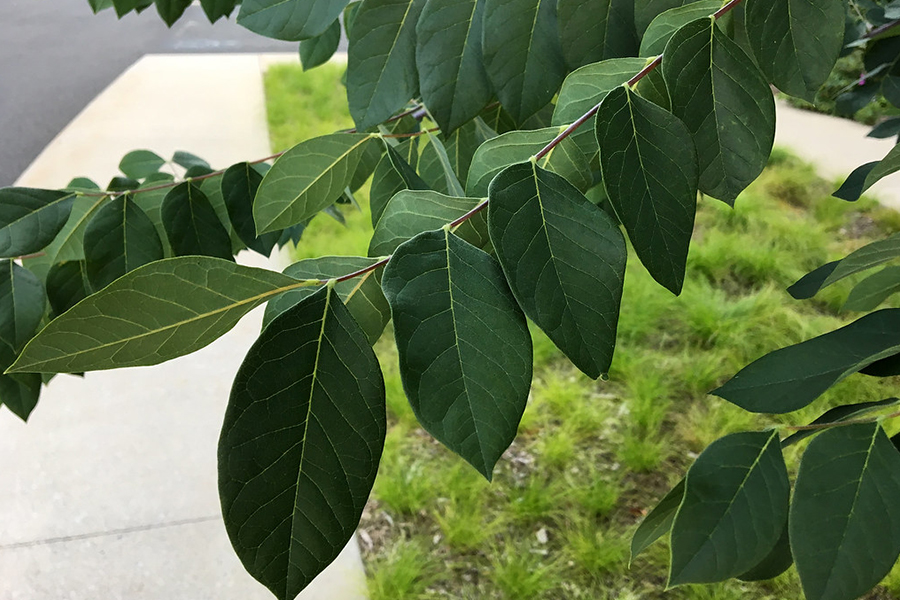
Kentucky coffeetree is a relatively rare deciduous tree in the subfamily Caesalpinioideae of the legume family Fabaceae. These trees are native to the midwest and parts of the southern United States. The tree reaches 60–70 feet (18–21 meters) in height and 3 feet (1 meter) in diameter. Relatively short-lived, the Kentucky coffeetree lives about 100 to 150 years and is characterized by gray, scaly bark with narrow ridges and alternate, bipinnately compound green leaflets. The flowers appear in June and are a greenish white. The Kentucky coffee tree is in the legume family and produces seeds contained in a six- to ten-inch pale green pod which contains a sweet and gooey pulp.
Typically, the Kentucky coffeetree prefers rich, moist soils in lowlands such as floodplains, river valleys, and ravines. The tree grows in small colonies with interconnected root systems and prefers limestone and calcium-rich soils. Because of how large and protected the seeds of the Kentucky coffeetree are, they cannot be dispersed by small animals or by wind. It is likely that historically the seeds were distributed by now-extinct megafauna, leading to the species only persisting in areas with very moist conditions to break down fallen pods.
Kentucky coffeetree is widely cultivated for landscaping and does exceedingly well in urban environments as it is resistant to many stressful conditions such as extreme temperature, road salt, drought, and insects. The beans of the tree can also be eaten if correctly prepared and are often roasted and used to make a hot beverage, which can serve as a coffee alternative.