
European Beech
Fagus sylvatica
European beech is a deciduous tree widespread throughout Europe and cultivated across the world.
History at Hadwen
Hadwen noted beech trees on the property as early as 1900, when he writes “the beech in its variety forms a class of ornamental trees worthy of more elaborate consideration than time will permit.” He found them to withstand the New England winters better than many other of his plantings, detailing there is “no other tree that withstands ice storms with less injury.” Beech trees continue to be documented on the property through until the most recent survey in 2020.
Detailed species information
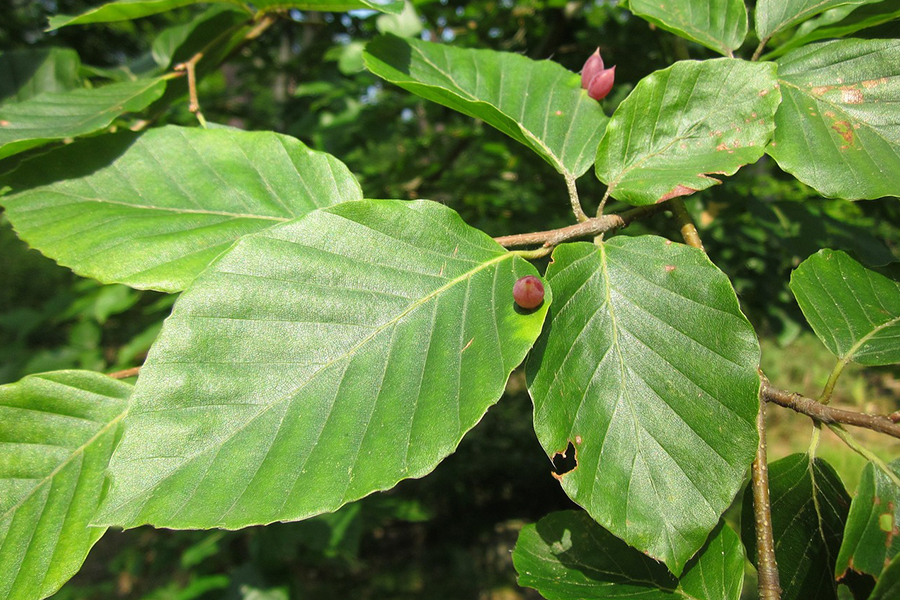
European beech, sometimes known as common beech, is a deciduous tree in the family Fagaceae and is widespread throughout Europe. This large tree typically grows from 50–60 feet (15–18 meters) in height and up to 5 feet (1.5 meters) in trunk diameter. In addition to its large size, the European beech is long-lived. Typically, the European beech lives from 150 to 200 years, but in ideal conditions, it can approach 300 years. The leaves of this species are alternately arranged on the stem, dark green in color with somewhat wavy edges. In the fall, leaves often cling to the trees until spring, a phenomenon called ‘marcescence’. The European beech produces flowers that are small catkins and nuts (beechnuts) which are small and triangular.
In their native range, European beech can be found in varied soil types but thrives best in well-drained soils and high humidity. European beeches are acclimated to very low light conditions as beech forests are typically dark. Young beeches can even be stunted by excessive sunlight. For this reason, European beech seedlings rarely survive in clearcut areas.
The lumber of the European beech is widely used for carpentry since its fine grain makes it ideal for applying varnishes and glue. This species is also a popular ornamental tree and is used for landscaping in Europe and North America. One of the largest European beeches is located in Brookline, Massachusetts, less than 50 miles east of the Hadwen Arboretum. Many cultivars of European beech have been made including copper beech (Fagus sylvatica purpurea) and fern-leaf beech (Fagus sylvatica ‘asplenifolia’) which can also be found at the Hadwen Arboretum.