

American Sweetgum
Liquidambar styraciflua
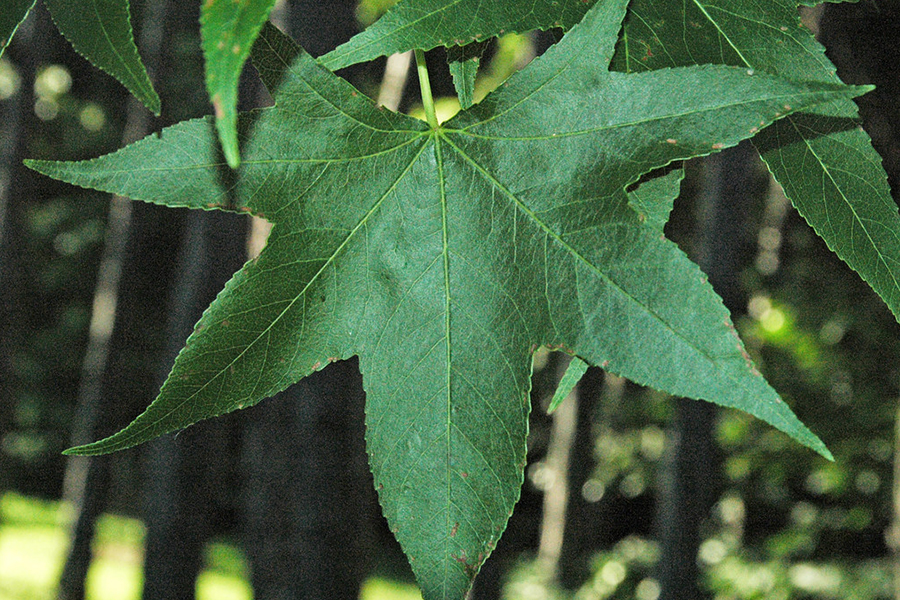
The American sweetgum is known for its distinctive five-pointed leaves which are said to smell like mango when pulled off the branch.
History at Hadwen
The American sweetgum had been recorded on the grounds of the Hadwen Arboretum since at least 1900, when Obadiah Hadwen noted that his trees of this variety were twenty feet in height, finely formed, and of shapely growth. Hadwen was fond of the American sweetgum and wrote that as an ornamental tree, it has few equals. “The exquisite gloss of the foliage in the summer, changing with varying autumn tints to a beautiful bronze, and the exquisite fonn of the leaves, combine to give it a distinctive character and to render it an ornamental tree of the first class.”
Detailed species information
American sweetgum is a temperate deciduous tree in the family Altingiaceae. American sweetgum is one of the most common hardwoods in the southeastern United States and can also be found in Mexico and Central America. In Nahuatl, a Uto-Aztecan language, the sweetgum is known as Ocotzocuahuitl which translates roughly to “tree with pine resin.” This tree species ranges in size from medium to large, depending on the conditions. Typically, sweetgum can reach 150 feet (45 meters) in height and 2–3 feet (0.6–0.9 meters) in diameter although cultivated specimens like the ones in the arboretum are usually smaller.
These trees can live up to 400 years and are characterized by distinct five-pointed leaves which can sometimes be three or seven-pointed. In summer, the leaves are dark green and in fall the leaves turn bright yellow, red, orange, or purple. Unfortunately, in the most northern parts of its range, the American sweetgum leaves are killed by the cold and have minimal fall colors. American sweetgum has light brown bark with dark streaks and hard, spherical fruits covered with spiky capsules containing seeds. These seeds are a favorite snack for chipmunks, squirrels, and finches.
The American sweetgum is able to tolerate poor drainage and moderate salinity in soils but needs lots of light. Because of its relative hardiness in temperate zones and its distinctive appearance, the American sweetgum is popular for ornamental planting. Additionally, the wood of the sweetgum is an important commercial product in the southeastern United States sometimes referred to as satin walnut in the carpentry industry.