
American Planetree
Platanus occidentalis
Because the wood of the American planetree rots quickly, its hollow trunks serve as critical habitats for cavity-nesting birds such as screech owls, chimney swifts, and wood ducks.
History at Hadwen
The American planetree was one of the species originally planted by Hadwen on his estate. In later studies conducted in the 1970s, American planetree is absent. This could be due to its vulnerabilities to disease making it an unusual choice in landscaping. One American planetree exists in the Arboretum today, planted by Clark University volunteers in 2021.
Detailed species information
American planetree, also known as American sycamore or just sycamore, is a deciduous tree in the family Platanaceae. It can be found throughout the eastern and central United States and often reaches 600 years in age. It can be distinguished easily from other trees by the irregular mottled pattern of its bark, which typically flakes off in large swaths. This is due to the rigid nature of the American planetree’s bark, which does not naturally stretch as the tree grows, but instead falls off in brittle pieces.
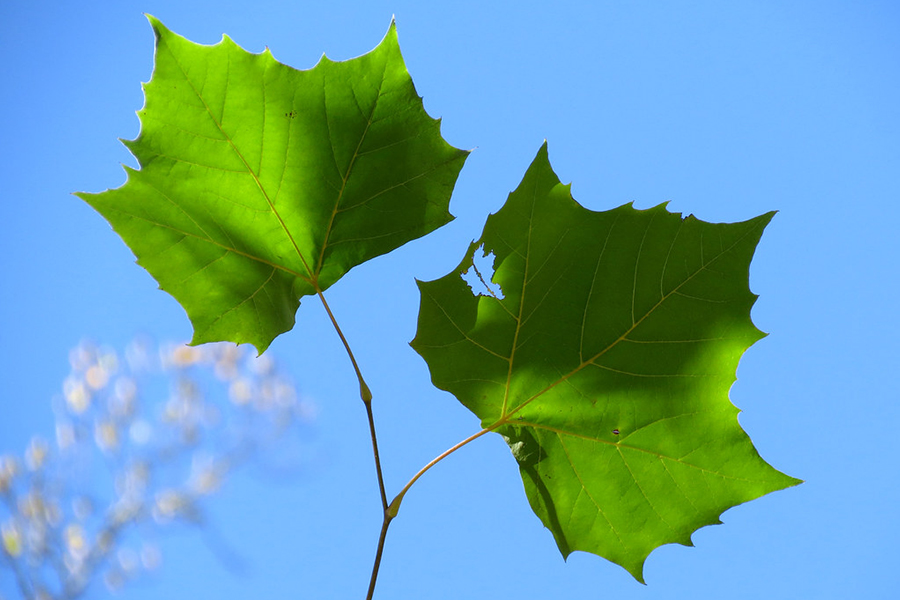
Because this species is long-lived, it can reach 131 feet (40 meters) tall and well over 6 feet (2 meters) in diameter. The largest recorded American planetree is 174 feet (53 meters) tall and is known as the Buttonball Tree. It’s located in Sunderland, MA, about 60 miles west of the Hadwen Arboretum. These trees are often divided into several secondary trunks. The leaves are alternate and three to five-lobed. Flowers emerge in May with dense, spherical heads covered in dark red staminate.
This tree is often found in moist environments such as wetlands and floodplains and is typically the largest of the plant species in these environments. It reproduces in a “weedy” pattern with large quantities of seeds dispersed as soon as the tree reaches maturity. The wood of the American planetree rots quickly, often leaving hollow trunks which serve as habitat for many cavity-nesting birds such as screech owls, chimney swifts, and wood ducks. American planetree is also a specialized host for the sycamore tussock moth and an important host of other insects such as the drab prominent moth. In addition to this, the American planetree is a host to various pests and diseases such as sycamore leaf beetle and a fungus causing plane anthracnose disease.