

American Beech
Fagus grandifolia
American beech is a deciduous tree found throughout the eastern United States. The only beech native to North America, American beech populations are currently under threat from multiple pests and pathogens.
History at Hadwen
Beech trees are documented in 1882 as one of Hadwen’s original tree plantings, although it is not noted whether these were American or European beeches. In a 1900 lecture, he says, “The American Beech, found growing over our northern regions, is much esteemed for its neat and airy foliage which remains on the branches during the winter.” According to later surveys in the 1970s and 2020s, American beeches have stayed a consistent part of the Hadwen Arboretum landscape.
Detailed species information
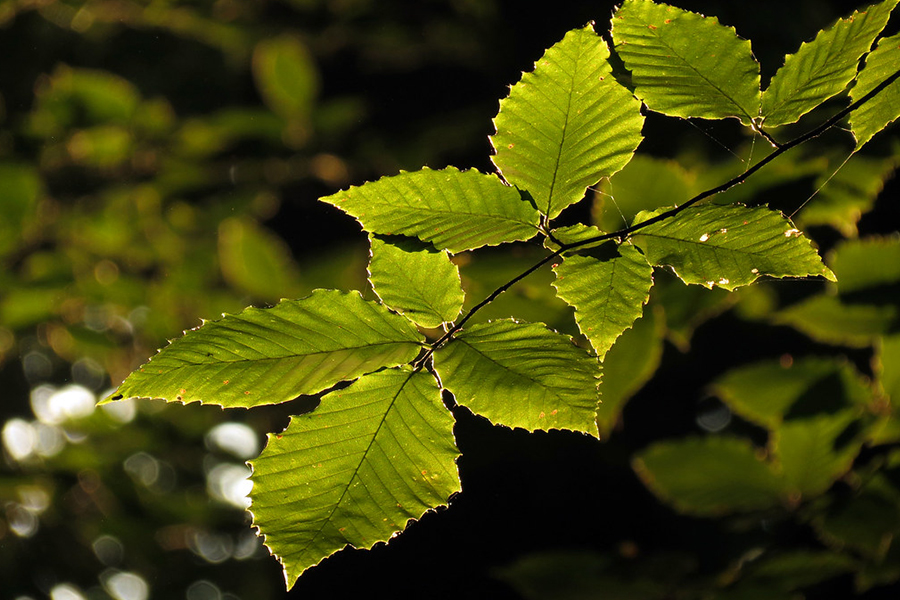
American beech is a deciduous tree in the family Fagaceae found widely throughout eastern North America. The American beech is a large tree, reaching 50–115 feet (16–35 meters) in height. Typically, these beeches have wide-spreading branches and open canopies with smooth, gray bark. The simple green leaves are alternately arranged on the stem and have strong venation and toothed edges. The fruits of American beeches are small nuts contained in four-lobed soft husks referred to as beechnuts.
Commonly found in the understories of North American forests due to their shade tolerance, American beeches are present in many stages of forest succession. These trees prefer rich, moist but well-drained soils and are intolerant to compaction, salt, and pollution, making them unsuited for urban conditions. The nuts are a critical food source for wildlife, including birds, rodents, deer, black bears, raccoons, and many others. Currently, beech tree populations are highly threatened by several diseases and pests, including beech bark disease, beech leaf disease, and beech leaf-miner weevils. Beech bark disease is caused by the European beech scale insect (Cryptococcus fagisuga), which infects beeches with one of two fungus species, Neonectria ditissima or Neonectria faginata, ultimately leading to the death of the tree. Beech leaf disease is caused by a nematode called Litylenchus crenatae mccannii, which damages the leaves and is also eventually fatal.
Beech wood is not commercially valuable due to its difficult-to-work nature and tendency to rot; however, it is considered high-quality firewood. The edible nuts have a pleasant taste and are often harvested for culinary uses, though they are not commercially grown or disturbed. The American beech makes an elegant shade tree in landscaping but is less often planted than its relative, the European beech (F. sylvatica), which is faster-growing and more suited to urban environments and transplantation.