

Red Spruce
Picea rubens
Red spruce is an evergreen tree native to the northeastern United States and southeastern Canada. One of the most commercially important trees in the northeast, red spruce is used for construction, carpentry, and Christmas trees.
History at Hadwen
The first planting of the white pine in the Hadwen Arboretum was in 1846. Hadwen admits that they were originally planted more with the purpose of shelter than for ornamental effect, and jokes that by 1900 they had been broken by storms and ice and would “make good saw logs.” Hadwen seemed to be aware of their increasing popularity, and attributed this to “their symmetry of form and varying shades of everlasting green, and the beauty and grandeur of individual trees.”
Detailed species information
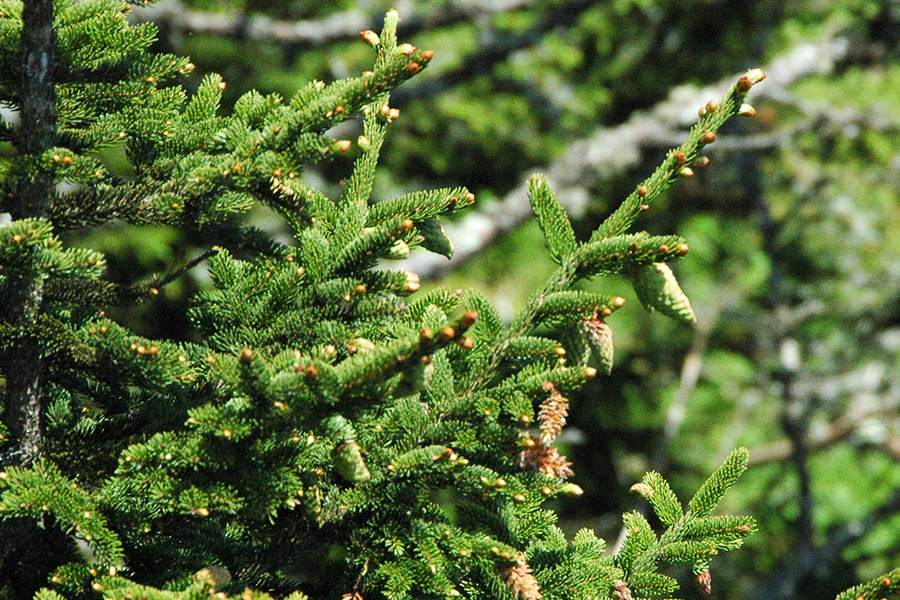
Red spruce, also known as Eastern spruce or yellow spruce, is an evergreen coniferous tree native to the eastern United States, southeastern Canada, and high elevations of the Appalachian Mountains south of New York state. This large and long-lived tree often reaches 60–80 feet (18–24 meters) in height. The tree has a narrow, conical form and roughly plated gray bark with a reddish-brown color revealed beneath the plates. The leaves of the red spruce are yellowish-green needles about half an inch (13 millimeters) in length. The cones hang down from branches and mature in early fall with hard, rounded scales.
Red spruce is a shade-tolerant and slow-growing species often found in late-succession forests. Establishing in the shady understories of forests, the red spruce can live for hundreds of years until it becomes part of the overstory. It prefers well-drained but moist soils and is often found at high elevations. It provides food and shelter for many species of birds and mammals. Red spruce is a commercially important tree in the northeastern United States. Its wood is light, soft, and commonly used for construction, carpentry, paper pulp, and musical instruments. The red spruce is also commonly used for Christmas trees. In landscaping, red spruce is rarely planted, although in the right climate, it could make a fine specimen planting in a park or garden.