

Sociology, B.A.
Curriculum
At Clark, our approach to studying sociology is grounded in empirical social science and classical theoretical traditions.
You’ll put theory into action through a range of hands-on experiences, from internships and research projects to volunteer and study abroad opportunities. Because our students and faculty are deeply concerned about everything from criminal justice reform to social policies affecting immigrants, families, children, and the elderly, you’ll be part of a compelling learning community where you can both satisfy your intellectual curiosity and make a commitment to change our world for the better.
Courses in the sociology major examine a wide array of social processes, such as social stratification, social movements, and social change. Through the investigation of social institutions, you will acquire the conceptual and analytical tools to enhance your understanding of not only your own life, but also the world.
Capstone requirement
Sociology majors must take a capstone seminar. To enroll in a capstone seminar, students must have completed Introduction to Sociology (SOC 10), Classical Sociological Theory (SOC 201), and The Social Research Process (SOC 202). Each capstone seminar also lists an additional prerequisite.
The capstone seminar builds on knowledge gained in previous courses and includes a significant research component. All courses numbered between 270 and 296 are capstone seminars. A senior honors thesis (Honors, SOC 297) also fulfills the capstone requirement.
Learning outcomes
The sociology major develops a number of related skills. Students are able to:
- Develop the ability to make connections between individual lives and broader social forces.
- Identify, compare, contrast, and synthesize basic theoretical orientations in the discipline.
- Apply theory to data to build sociological knowledge.
- Identify, compare, and contrast basic methodological approaches.
- Identify appropriate methods for empirical research.
- Conceptualize and interrogate patterns of inequality in local and global contexts.
- Understand diversity and its structural and cultural implications.
Featured Courses

Activism, Protest, and Social Movements
This course examines the dynamics of activist and protest movements, including the conditions that give rise to them, factors that shape their development, and the ways they affect culture, society, and politics.
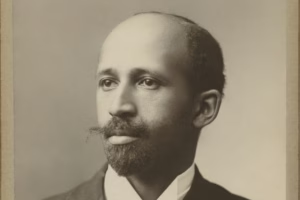
Class and Status in Black American Life
Centered on the works of W.E.B. Du Bois and E. Franklin Frazier, and contemporary research by Karyn Lacy and Mary Pattillo, this course examines the evolution of class and status hierarchies within Black America.
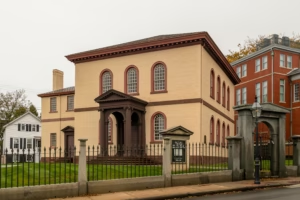
American Jewish Life
What is Jewish and what is American about American Jews? How do they compare with other ethnic groups? Explore these questions along with related topics like immigration, economic mobility, gender and intermarriage.