

President David Fithian has announced that Clark University’s 2026 Commencement will take place on Monday, May 18, at the DCU Center in Downtown Worcester. Two distinct ceremonies will be held: Bachelor’s degrees will be awarded at 10 a.m., and master’s and doctoral degrees will be presented at 2:30 p.m.
“Commencement is a joyous milestone for our students, and I look forward to celebrating this special day with all our Clark graduates, families, and friends,” Fithian said.
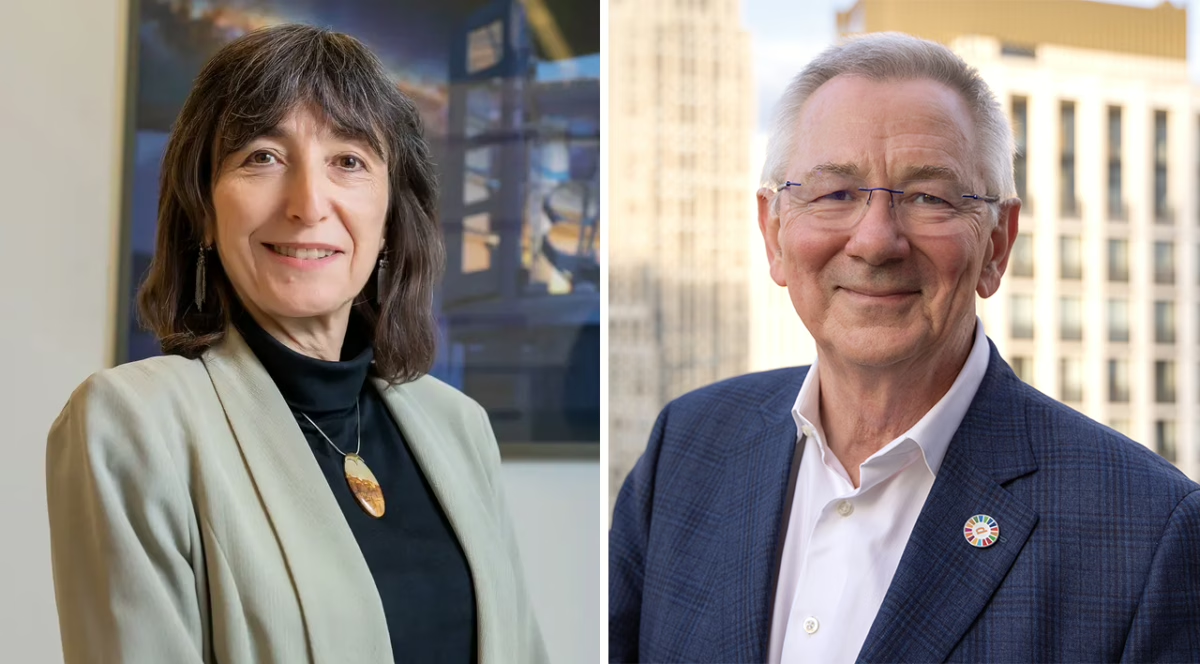
In addition to recognizing the impressive achievements of our graduates, Clark will award honorary degrees to two highly accomplished individuals: an internationally recognized leader in the fields of climate change, sustainable development, and environmental economics, and one of the world’s most accomplished astrophysicists, renowned for her foundational contributions to modern cosmology and for her leadership in some of the most important astronomical projects of the past half-century.
Sir Andrew Steer is one of the world’s foremost climate experts. His career spans academia, international development, and global policy leadership, and his work has helped shape how governments, institutions, and markets respond to the climate crisis.
He currently serves as Professor of Practice in Environmental Economics at the London School of Economics and Political Science, where he is also Chair of the Grantham Research Institute on Climate Change and the Environment. Simultaneously, he holds an appointment as Distinguished Research Professor of the Practice in Environment and Economics at Georgetown University’s Institute for Environment and Sustainability. He has been instrumental in advancing interdisciplinary research that connects climate science, economics, public policy, and social justice—an approach that closely mirrors the intellectual ambitions of Clark’s new School of Climate, Environment, and Society.
Prior to joining LSE, Steer served as president and chief executive Officer of the World Resources Institute (WRI), one of the world’s leading environmental research and policy organizations, and as the inaugural President and CEO of the $10 billion Bezos Earth Fund, established by Jeff Bezos, where he led strategic investments in sustainability, biodiversity, and decarbonization. Earlier in his career, Steer held senior leadership positions at the World Bank, including Special Envoy for Climate Change, where he worked closely with governments and multilateral institutions to integrate climate considerations into economic development strategies.
Steer has advised heads of state, international organizations, and philanthropic foundations, and has been a powerful advocate for translating academic research into practical solutions at scale. In 2024, Forbes named him one of the world’s 50 most impactful climate leaders, and he was knighted in the United Kingdom for his contributions to international development, sustainability, and climate action.
Lou Leonard, the D.J.A. Spencer Dean of the School of Climate, Environment, and Society, will present Sir Andrew Steer for the degree of Doctor of Humane Letters, honoris causa.
Dr. Wendy L. Freedman is one of the world’s most accomplished astrophysicists, renowned for her foundational contributions to modern cosmology and leadership on some of the most important astronomical projects of the past half-century. Her career resonates deeply with Clark University’s historic legacy in the physical sciences, particularly in light of the centennial of Robert H. Goddard’s breakthroughs in liquid-fuel rocketry.
Freedman, currently the John and Marion Sullivan University Professor of Astronomy and Astrophysics at the University of Chicago, is widely recognized for her leadership of the Hubble Space Telescope Key Project, which produced the first precise measurements of the Hubble constant (the rate at which the universe is expanding) and dramatically refined scientific understanding of the scale, age, and expansion of the universe.
Her work laid the empirical foundation for what is now known as precision cosmology, helping to establish the modern framework through which scientists study dark energy, dark matter, and the evolution of the cosmos. Few scientists have had as great an impact on humanity’s understanding of its place in the universe. Freedman was named to TIME Magazine’s 100 Most Influential People in 2025, and in 2024 was named to Nature’s 10, a list that recognizes key scientific developments of the year.
Freedman has also played a central leadership role in major research institutions, including the Observatories of the Carnegie Institution for Science, where she oversaw the development of next-generation telescopes and expanding access to cutting-edge astronomical research. She also was the inaugural chair of the board for the Giant Magellan Telescope Project at Las Campanas Observatory in Chile. For her achievements, she has been recognized with many of the highest honors in science, including election to the National Academy of Sciences, the National Medal of Science, and other prestigious awards.
Professor Michael Boyer will present Dr. Wendy Freedman for the degree of Doctor of Science, honoris causa.