


When Theatre Arts Professor Gino DiIorio first encountered Coleman Hughes, it wasn’t at an academic symposium or even a performance. It was a televised congressional hearing.
In June of 2019, Hughes — then just 23 years old — appeared before Congress to testify in a high-profile hearing on reparations. DiIorio, a Clark alumnus and playwright who wrote “Reparation” in 2010, watched the testimony and was impressed.
“Who is this kid?” DiIorio remembers thinking. “He’s incredibly well-spoken, an independent thinker.”
That curiosity eventually led to an invitation. On Wednesday, March 11, Clark will host Hughes for an on-campus conversation on his 2024 book, The End of Race Politics: Arguments for a Colorblind America. The event, organized by DiIorio, is free and open to the Clark community.
Hughes, now 30, is a writer and podcaster whose “Conversations with Coleman” has built a following for its quiet, intellectually rigorous exchanges on race, philosophy, and public policy — a deliberate contrast to the combative format that dominates much of contemporary media.
While acknowledging the reality of racism, his book argues that group identity should not be the primary lens through which individuals are evaluated, hired, or served by institutions.
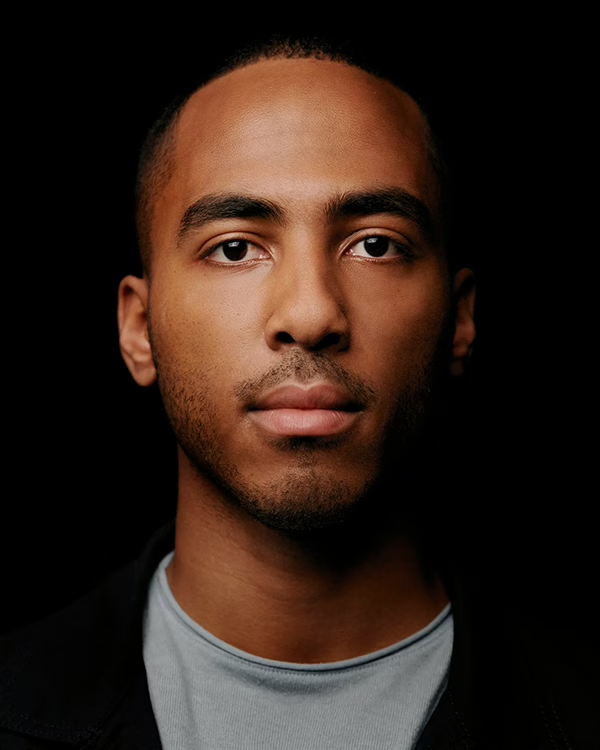
Hughes’ stance drew enough controversy that his 2023 TED Talk was initially suppressed after TED employees complained that his views on colorblindness made them feel unsafe. The episode became a flashpoint in ongoing debates about free speech and institutional self-censorship.
For DiIorio, who has been a vocal advocate for having diverse viewpoints on campus, the Hughes invitation is personal as much as it is intellectual.
“Challenging convention would be bringing in a speaker that we disagree with,” DiIorio says. “That was the Clark that I went to.” He graduated in 1983 and recalls a campus culture where opposing views were welcomed, heard, and rigorously debated.
He worries that culture has eroded. “I think we spend way too much time pushing our kids toward a particular political point of view instead of teaching them how to disagree with each other and have civil discourse,” he said.
The event is designed as a conversation, not a lecture — in keeping with Hughes’ own approach. DiIorio describes Hughes’ podcast style as “calm,” marked by genuine listening and probing follow-up questions rather than performance or point-scoring.
DiIorio hopes attendees leave not necessarily converted, but genuinely challenged. “I’m not hook, line, and sinker on everything he says,” he notes, “But I hope people listen with an open mind.”