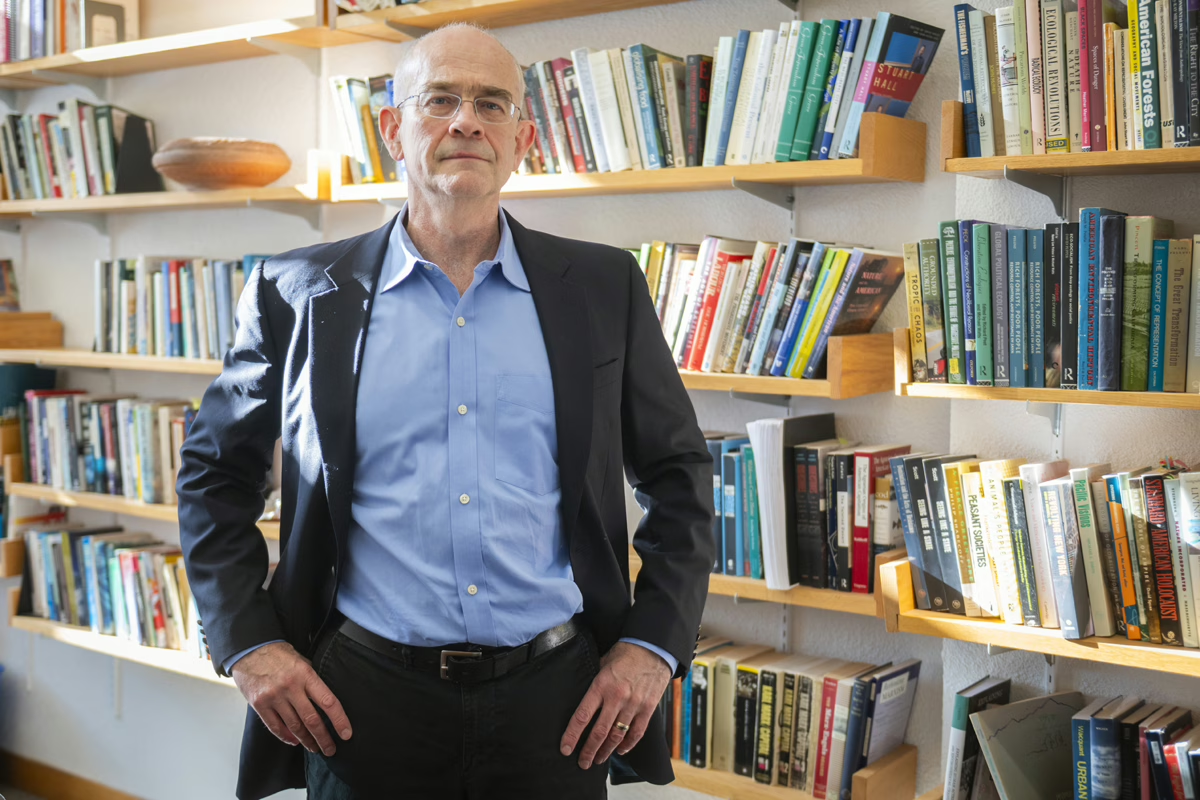
James McCarthy, professor of geography, will be honored with the Distinguished Career Award by the Cultural and Political Ecology (CAPE), a specialty group within the American Association of Geographers, during the AAG’s conference next month in San Francisco. McCarthy will be recognized at a March 19 ceremony.
“We are truly impressed by all of the service and contributions you have made to the field of political ecology, as well as the breadth of your contributions to political ecology and geography,” Josh Cousins, chair of CAPE, told McCarthy in announcing the award. “We are excited to recognize you and your scholarship, and place you in a long line of inspiring political ecologists and nature-society scholars to have received this award.”
McCarthy has been invited to deliver the CAPE keynote at the 2027 AAG conference.
Regarding receipt of the award, McCarthy noted that his work in cultural and political ecology has been significantly shaped by the opportunity to work with many of the best Ph.D. candidates in the world in that field, who choose the Graduate School of Geography because of its long-standing strength in that domain. McCarthy noted that the chance to work with the Ph.D. students Clark attracts in political ecology was one of the major factors that drew him to the institution.
The Graduate School of Geography is part of the School of Climate, Environment, and Society.
Professor McCarthy’s areas of interest include: political ecology; political economy; environmental politics, policy, and governance; property; rural areas and extractive industries; social movements; and social theory.
His research and teaching center on questions of environmental governance: how people lay claim to and struggle over their environments; how human societies regulate their relationships with their environments and with what consequences; and, especially, how the political-economic structures and dynamics of capitalist societies produce particular sorts of environmental transformations, dynamics, and outcomes. In each case, he is interested in whether the relationships in question are just and sustainable, and in how they transform individuals, societies, and environments over time.
Professor McCarthy has investigated these questions with respect to a variety of environments and dynamics in the United States and Canada, and globally. He also has done work for the Ford Foundation, Oxfam, and other organizations involved in shaping policy and programs.
He has been a frequent contributor to refereed journals. Two of his most recent pieces included “To Own the Land is to Own the Sunlight: The Significance of Land Tenure for Solar Power” and (co-authored) “The Dawn of Solar Photovoltaics: Emergent Political Economies at the Solar-Agri-Land Nexus,” both appearing in the Spring 2025 issue of Sustainability Science. His articles have also appeared in Geo: Geography and Environment, Progress in Human Geography, Dialogues in Human Geography, and Energy, Research and Social Science, among others.
In 2020, he edited the book Environmental Governance in a Populist/Authoritarian Era, which, according to its publisher, Routledge, “explores the many and deep connections between the widespread rise of authoritarian leaders and populist politics in recent years, and the domain of environmental politics and governance – how environments are known, valued, and managed; for whose benefit; and with what outcomes.”
Stories in ClarkU News have chronicled the research into global energy transition undertaken by McCarthy and his Ph.D. students, from New Hampshire to Senegal to Germany. McCarthy has done intensive research into the impact of major renewable-energy projects sited in areas that are home to Indigenous populations, including recent work in the rural communities in Rajasthan, India.
McCarthy earned a B.A. in English and environmental studies from Dartmouth College and an M.A. and Ph.D. in geography from the University of California, Berkeley. Prior to joining the Graduate School of Geography in 2011, he was an assistant and associate professor of geography at Penn State University. He is the Leo L. and Joan Kraft Laskoff Professor of Economics, Technology and Environment at Clark.