

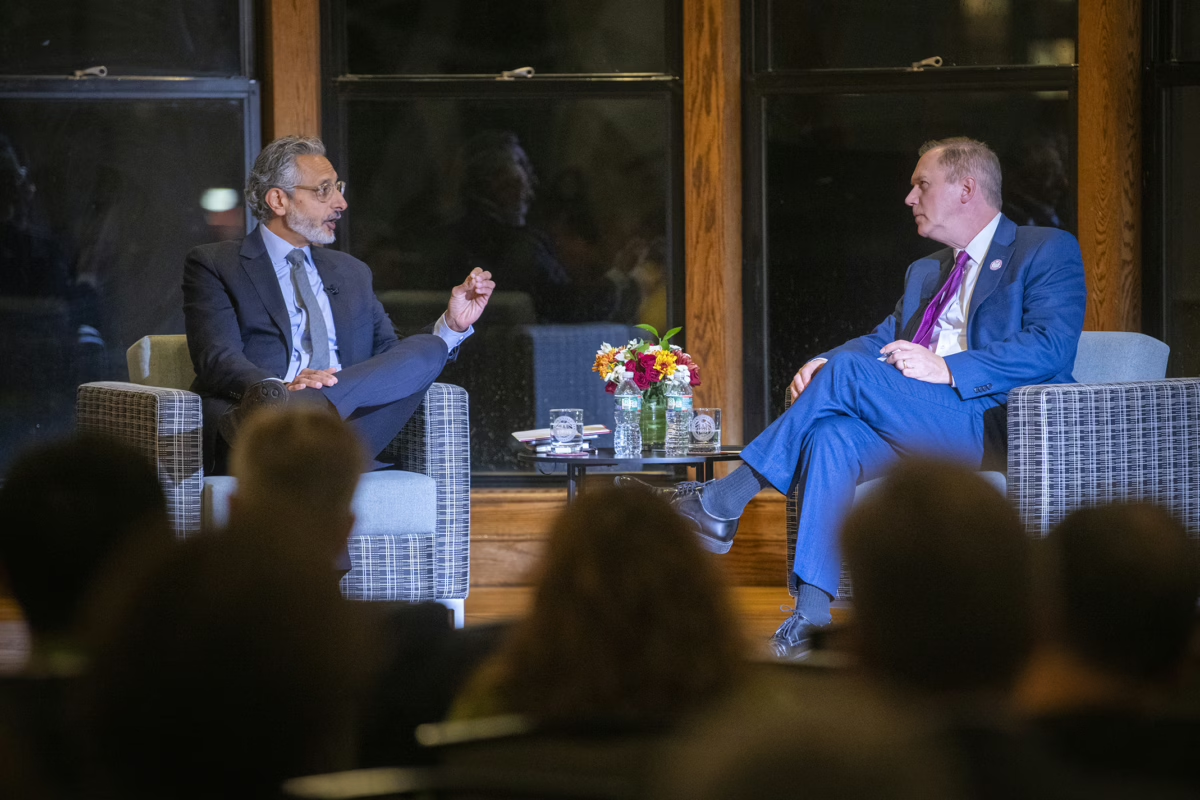
“Free speech is not just about what you say, but it’s how you say it.”
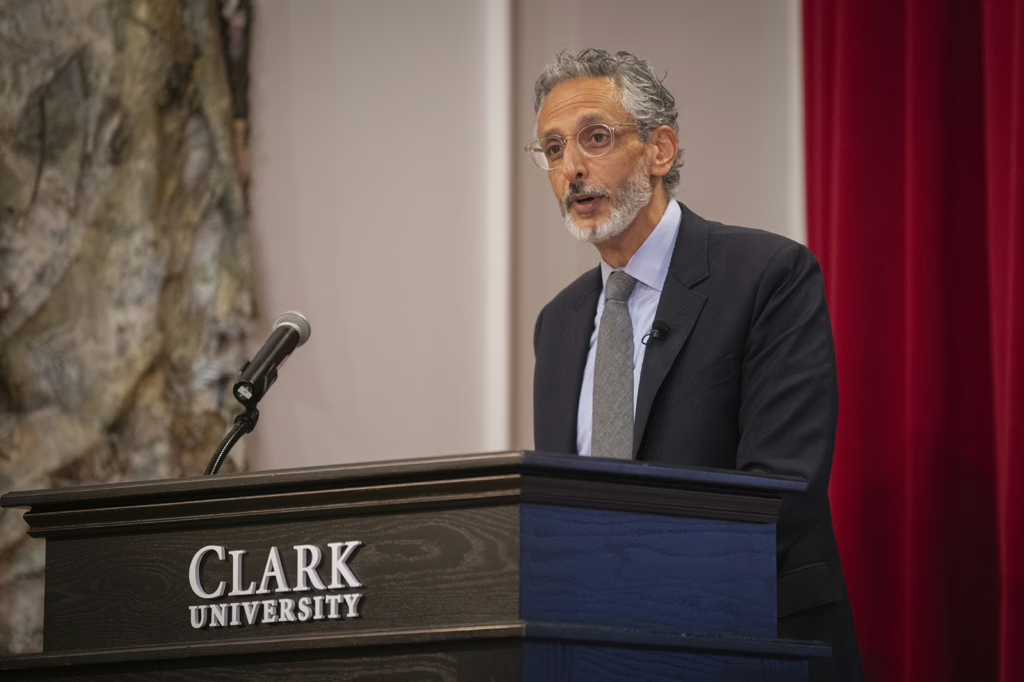
With that statement from the podium in Tilton Hall, Tony Banout introduced this semester’s Presidential Lecture, a probing discussion about the benefits and challenges of free expression in the public discourse.
In his Nov. 10 presentation, “What Are We Talking About When We Talk About Free Speech?” Banout, the inaugural executive director for the University of Chicago Forum for Free Inquiry and Expression, noted that the notion of free speech can be fraught with nuance and contradiction. He cited the recent mixed message sent by the federal government, which issued an executive order enshrining the right to free expression without government interference, yet which also has insisted that universities sign a compact holding out the promise of federal funding in exchange for concessions curbing expression of ideas critical of conservative positions.
Freedom of inquiry and expression is essential to higher education, Banout said, and free speech is a bedrock of a functioning democracy, including when the discourse generates distress. Banout recounted several examples of conservative speakers either being disinvited or shouted down on college campuses. He quoted the noted intellectual Noam Chomsky, who said, “If you don’t believe in free speech for those you despise, you don’t believe in free speech.”
Both the left and the right have had historical moments in which free speech rights were protected. Banout recalled a 1966 march led by Martin Luther King Jr. through Cicero, Illinois, a town that was famously hostile to his civil rights efforts. Just over a decade later, a group of neo-Nazis marched through Skokie, Illinois, a town with a high concentration of Jewish residents, many of them Holocausts survivors.
Banout described the reasoning behind the ACLU’s support of the controversial Skokie march on freedom-of-speech principles. ACLU executive director Aryeh Neier, himself a Holocaust survivor, argued that while he personally detested the Nazis’ rhetoric, preventing the march would have curtailed their freedom of expression in a way he believed would ultimately be damaging for a democratic society. “Freedom has its risks,” he wrote, “and suppression of freedom, I believe, is a sure prescription for disaster.”
Banout moved through other examples in U.S. history. Supreme Court Justice Thurgood Marshall crystallized the First Amendment position in a 1972 ruling when he stated that the government has “no power to restrict expression because of its message, its ideas, its subject matter.”
It was a stance that Frederick Douglass had posited decades earlier when he described free speech as “the dread of tyrants.” Curbing it not only does an injustice to the speaker, but also to those who are deprived from hearing the “dangerous speech,” Douglass argued.
Banout noted that free expression is fundamental to liberal education, adding that humans are “likely to gravitate and seek the company of those who tend to agree with us.” But aligning ourselves only with those whose views we find acceptable “runs counter to liberal education,” which requires us to assess our own assumptions and perspectives. Confirmation bias, he said, is a form of “self-deceit.”
“We seek evidence that proves our own positions. We interpret ambiguous evidence in a way that favors our own views, and we often simply disregard that which would challenge or disprove our views. This is the antithesis of education. This is not why you came to Clark. Self-deceit is easy. Education is hard. Self-deceit is natural. Education takes work.
“Liberal education should liberate us from our tendency toward self-deceit,” Banout insisted.
Following his lecture, Banout sat for a conversation with Clark President David Fithian, who began by posing a question about whether free speech is an “absolute” principle or must be tempered so as not to cause harm.
Banout acknowledged that speech can create harm — for instance, when safety is compromised. But the 1972 Supreme Court decision stipulated that speech restrictions cannot be put into place to regulate content.
“I think the question is how you set up policy on a campus, or law in society, that is most helpful in setting out the farthest limit of what’s permissible while also cultivating a culture in which people are fully included, which means able to speak their minds freely,” Banout said.
“I don’t think you’re going to evade the reality that people will still be offended at times or people will share ideas that others find immoral or wrongheaded.”
The conversation ranged across a number of relevant topics, including students who admit to self-censoring their views to avoid conflict, Clark’s guardrails against speech is deemed to be threatening, and the polarizing effect of social media.
Banout said social media has siloed the public and perpetuated an “outrage culture” that is “beyond any one institution’s ability to control.”
“There will always be contemporary challenges that outpace our regulatory ability,” he said.
Banout and Fithian also addressed the notion that a liberal education at some level is meant to generate some measure of “discomfort” when it challenges one’s views and exposes potential blind spots.
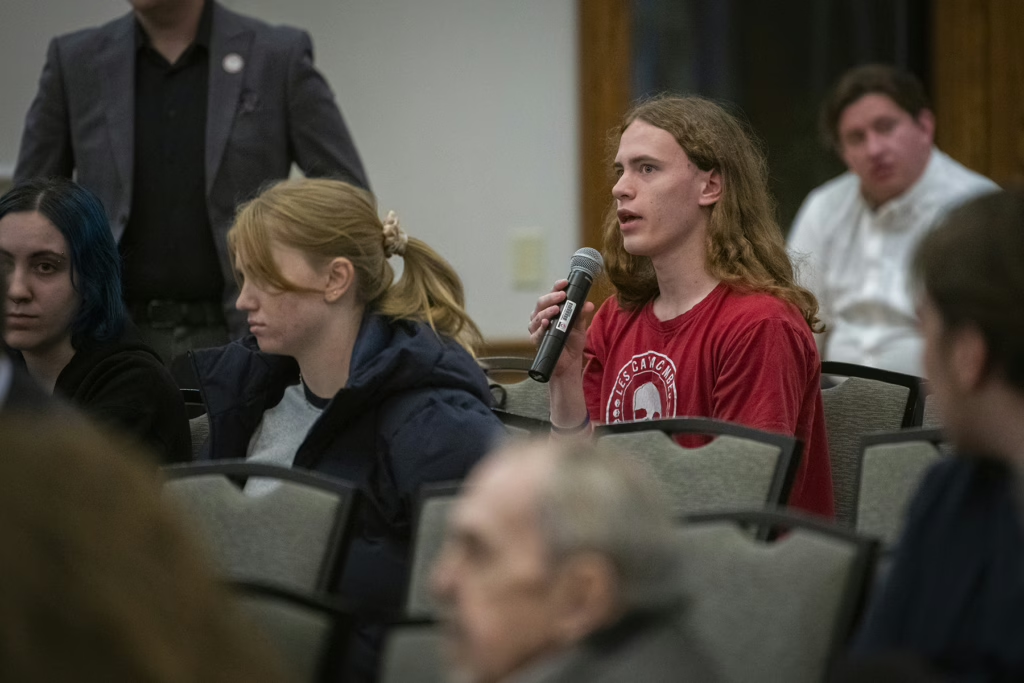
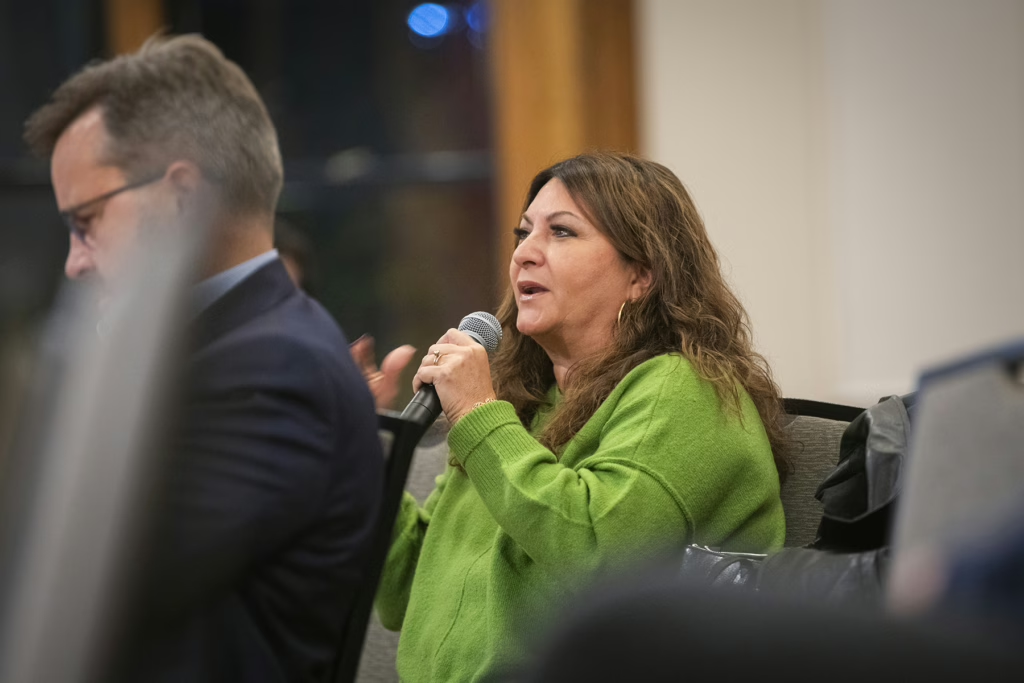
During a question-and-answer session with the audience, Sociology Professor Rosalie Torres Stone cautioned that some students have known great discomfort in their personal lives — whether through discrimination or low socioeconomic status — and they struggle to provide an alternative voice to the dominant ideas in the classroom. “Not all students are equipped to feel that they can argue back,” she said. “I feel very protective of students who have always felt that discomfort.”
The night concluded with President Fithian asking what is the most essential question involving free speech in America right now.
Banout stressed that we need to examine free speech as fundamental to the structure of our constitutional democratic order, and to be wary of the fallout when that principle is corrupted.
“When speech is highly used by any side to drive a political agenda, we are in troubled times,” he said.