Oral history project celebrates women’s contributions to Clark
When Clark renamed its Higgins School for Humanities to the Alice Coonley Higgins Institute for Arts and Humanities in 2024, History Professor Melinda Marchand, Ph.D. ’20, noticed that many current Clarkies were not familiar with the institute’s namesake and her legacy.
Marchand, a historian of women in America who is passionate about public history, had been spending a lot of time in Clark’s library and archives, poring through a wealth of campus history, and began imagining a project.
“I had been realizing throughout my time at the archives that there are a lot of cool women who have contributed to Clark in some form, and I thought it would be great to celebrate them by bringing them out of the archives,” she says.

Marchand is creating a digital exhibit and oral history project that will catalog women’s impact on the University. Amelia Clark ’26, a history and studio art major, is serving as research assistant for the project, aptly titled “Women of Clark.” The effort is supported by a seed grant from the Alice Coonley Higgins Institute for Arts and Humanities.
When Melinda Marchand told Amelia the project would be an oral history, the rising senior was thrilled. “That’s a facet of public history that I think is so important because you’re talking to the people who have lived these experiences and have perspectives on events you may have studied, but don’t really know for yourself,” she says. “Working on an oral history project specifically related to Clark University is so exciting.”
Melinda and Amelia are in the beginning phase of the project and have been spending time in the University archives to gather knowledge about women who played vital roles in the college community — even before women were accepted into undergraduate programs. For example, there’s the Hall Club, which started more than 100 years ago as a group of women who helped then-Clark President G. Stanley Hall on issues related to parenting and community. The club remains active today with an interest in discussing women’s history.
“Like other women’s clubs started in the late 1800s or early 1900s, it was a space for women to talk about things there might not otherwise be spaces for — at that point in time, there wasn’t really a space for women in academia,” Amelia says. “G. Stanley Hall took a special interest in what they were doing.”
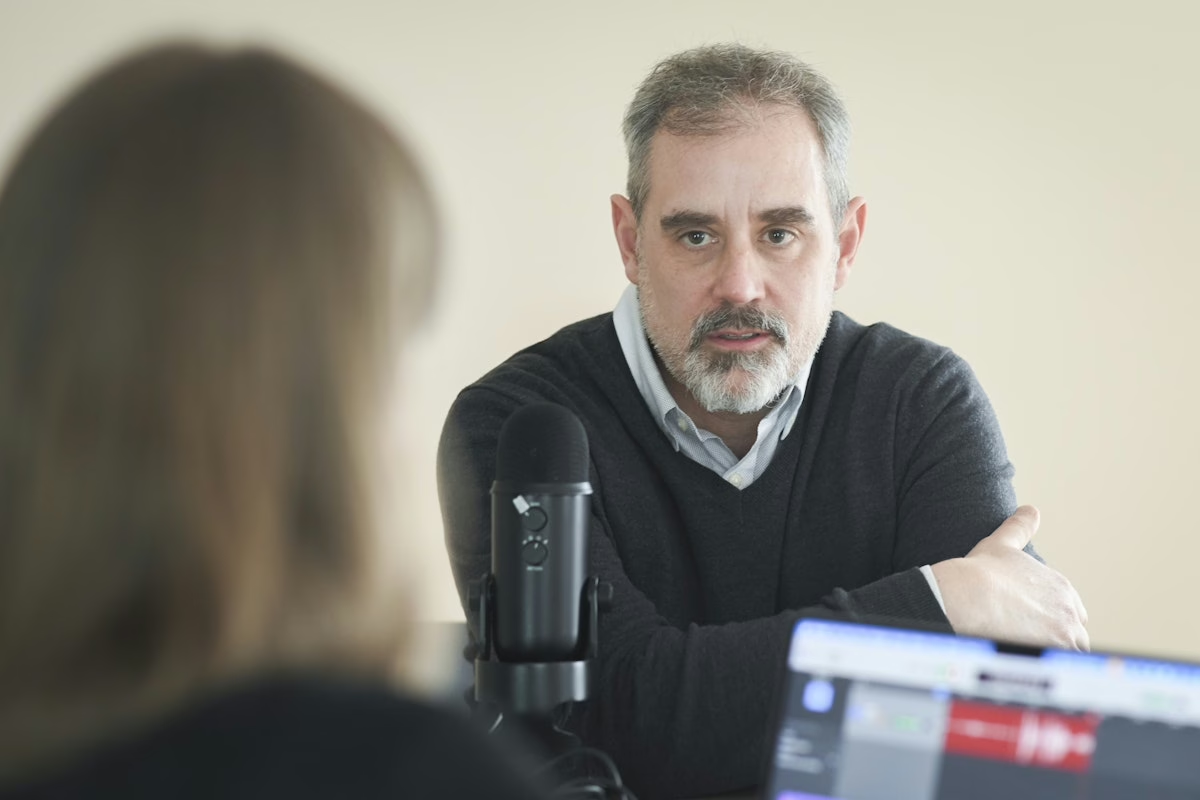
The researchers this summer are interviewing women who have been associated with Clark — alumni, former staff and administration, professors, athletes, and community members — to collect stories about how they contributed to the institution and how it has, in turn, shaped them. They’ll collaborate with the Goddard Library, especially Cynthia Shenette, head of archives and special collections, and Catherine Stebbins, digital projects librarian, throughout the project.

The oral histories will be searchable and indexable, Melinda says, and the digital exhibit will be made with the software tool Omeka, standard for public history museums and archive collections. The digital exhibit will have an introductory page explaining high-level themes of the project, allowing viewers to navigate to pages that showcase detailed information within those themes and timelines of women’s involvement at Clark.
“For example, in the ’60s and ’70s, a lot of women were involved in civil rights protests and anti-Vietnam protests, so we’ll probably have a page devoted to this era of activists,” Melinda says.
While some oral history projects focus on a single topic, Melinda and Amelia plan to collect full histories. “We want to build up to their arrival at Clark,” Melinda says, “and then ask them questions about their experiences here, building community with other women and/or with men, and how much time they spent on campus versus getting out into the community. To what degree have people over the years taken advantage of Main South businesses? To what degree have people gotten out into the broader community?”
Collecting these robust histories, Amelia says, is “exciting to me because we don’t know exactly what we might find that we’ll be able to showcase in the exhibit.”
Both professor and student feel motivated to work on this project because of the support of fellow Clarkies.
“I’ve been at Clark since 2013, and I’ve always been surrounded by really brilliant, friendly, outgoing women,” says Melinda, naming the late History Professor Amy Richter, who was Melinda’s dissertation advisor, as an inspirational mentor and friend. “I feel like we don’t have enough time to celebrate the contributions of women to the livelihoods of our students, staff, and faculty. There are so many stories of women that are not told at Clark and elsewhere, and as a proponent for women’s history, it feels important to me to bring them to the surface.”
Amelia likewise has been inspired by her mentors and peers, particularly as a member of the women’s rowing team.
“All the women I row with are just so amazing,” she says. “My experience as a student has been transformational, and there are so many other people in the Clark community, so I would love to bring those voices to the surface.”
The pair envision Women of Clark as a living project that can be updated. They hope to complete their first set of oral history interviews by the end of summer, and information could be online to peruse during the fall semester.