


Seasons of change
Decarbonizing the country one municipality at a time
By Melissa Hanson
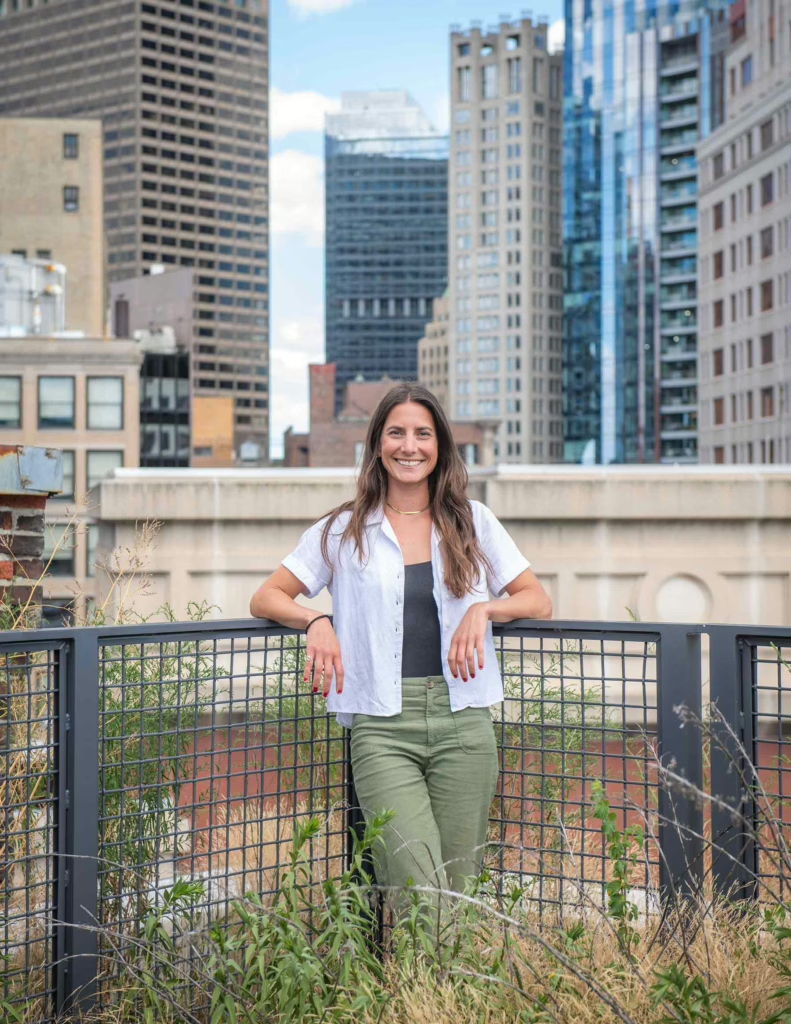
Serena Galleshaw ’12 loves to get outside. During the winter months, she hits the slopes for skiing and snowboarding, and she surfs in every season. But Galleshaw, who grew up in New England and works in Boston, is troubled by how much the climate here has changed during her lifetime.
“Watching our winters become different is definitely a driving source of motivation,” says Galleshaw, an urban planner and sustainability coordinator for Sasaki, an interdisciplinary planning firm. “I’m a year-round surfer, so coastal adaptation work is really important to me.”
Galleshaw has worked on projects in the Northeast and beyond for Sasaki, primarily focusing on decarbonization, resilience, and adaptation. She helps municipalities and schools develop climate action plans and get off fossil fuels.
“I got into planning because I kept asking myself, ‘How can I make it easier for more people to live sustainably?’ One of the ways to do that is land-use policy, because if you can’t walk to your grocery store, that’s a policy failure,” she says.
Galleshaw contributed to a decarbonization plan for Middlesex Community College, which has campuses in Lowell and Bedford, Massachusetts, that called for buildings to transition to electric heating and cooling. She also built a digital resilience and recovery guidebook and toolkit for a regional planning commission in Southwest Ohio. After a series of tornadoes in 2019, the commission wanted a go-to resource for natural disaster recovery for the region.
Galleshaw majored in global environmental studies at Clark. Her self-designed capstone on experiential education and ecological literacy as a solution to the climate crisis involved working with the Audubon Society in Worcester to investigate the river otter population. “The Audubon Society wasn’t sure river otters existed in the region but had heard rumors,” Galleshaw says. “I tracked the otter and confirmed that it was actually there. Worcester is a dense urban city, and to know that there were still river otters was cool.”
“Watching our winters become different is definitely a driving source of motivation.”
She has seen conversations about climate change evolve since she earned her degree and started working in the field. In the early 2000s, she recalls, many people were still questioning the existence of climate change. Today, plans and policies to address it are in motion.
“Massachusetts is a leader when it comes to climate policy and climate action, so there are many opportunities to get involved,” she says. “A lot of the climate action planning I’m doing for schools, for example, started because there’s an executive order requiring the state to decarbonize all assets by 2050.”
As technology and climate action evolve, so do planning, zoning, and modeling tools. Says Galleshaw, “We have an amazing opportunity to use our science to make better policy decisions that can save costs on buildings, do some amazing retrofits on our communities to better support the world that we live in, and ultimately help save lives.”
Steven King photo
Editor’s Note: As of September 2025, Serena Galleshaw is a program manager in Disaster Resilience Innovation at Verizon.