
Our
planet.
Our
Clark.
The newly launched School of Climate, Environment, and Society is Clark’s response to a planet in crisis
‘We’re playing the long game on this.’
by Jim Keogh
A moment is upon us. Perhaps the moment.
The Earth continues to spin, as always, but it’s shuddering. We have entered an epoch of profound global change stressing the world’s natural and human systems in ways that, left unchallenged, are not sustainable.
With the consumption of resources threatening to exceed our ability to produce them, the exploitation of land and water is reaching the point where the suggestion of one day migrating humanity to distant planets—the stuff of science fiction—isn’t dismissed as readily as it once had been.
This all can feel so beyond our capacity to hold. Paralysis can creep in—surrendering to despair seemingly far easier than fighting for hard solutions. Here is where an urgent and bold response is needed.
And Clark has responded.
This fall, the University launched the School of Climate, Environment, and Society, which builds on Clark’s legacy of probing for solutions to the most pernicious threats to our shared environment. The school advances integrative research, education, and engagement to understand and sustain the Earth’s systems, and seeks equitable and just solutions to those threats through intensive academics and deep collaborations with communities and organizations on the frontlines of change.
“We are in the age of climate crisis. This isn’t a future problem—this is a today problem,” says Lou Leonard, the D.J.A. Spencer Dean of the School of Climate, Environment, and Society. “And we need to have the heart and the grit to realize that we’re playing the long game on this. It’s not going to feel like we’re winning every day. But all of it matters.”
Voices of the Future
The current generation of students has come of age knowing two things: The world is precious, and the forces that would do it harm must not be abided. Our students share their thoughts about the climate, the environment, and the kind of future that they want to embrace.
“I can remember being in middle school and hearing scientists sounding the alarm about the extreme effects of climate change and thinking, ‘I hope this won’t happen in my generation.’ Well, it’s here, and it’s my generation.”
“I worked with kids at a lake this summer, and I loved to see their energy and joy and the way they cared for the environment. And watching the loons on the lake, doing their thing, always gives me hope. The world is so remarkable.”
“It’s really important tostepout of the classroom and put what you learn into action.”
“My generation is turning the climate conversation on its head a little bit by recognizing that some people, like those in small developing island states, need priority treatment because they’re being disproportionately impacted.”
The School of Climate, Environment, and Society emerged as a signature recommendation from the planning and development of Clark’s strategic framework, Clark Inspired. The proposal for the school was shaped over two years by working groups, subcommittees, and an implementation team, all composed of faculty across various disciplines as well as several staff members. The implementation team presented its formal proposal on July 3, 2023.
Crucial to its elevation from concept to reality was a $10 million gift in 2024 made by philanthropist and former trustee Vickie Riccardo and her daughters, Alyssa ’17 and Jocelyn Spencer. The cornerstone gift established the D.J.A. Spencer Dean position and facilitated the creation of the Vickie Riccardo Climate Catalyst Fund to help support the school’s development and growth.
“This isn’t a future problem. This is a today problem.”
Housed within the School are the departments of Geography, Sustainability and Social Justice (formerly International Development, Community, and Environment), and Economics, as well as the George Perkins Marsh Institute, and the Clark Center for Geospatial Analytics. The Biology Department and the Environmental Humanities Research Collaborative are founding partners in the school. Within this structure, scholars and practitioners from these departments and centers, and from disciplines across the University, strategically and deliberately come together to advance research and applied community projects.
Students now have an opportunity to enroll in a new undergraduate major in climate, environment, and society, or pursue a master’s degree in climate and society, while Clark also is expanding and amplifying course offerings related to climate science, environmental studies and policy, biodiversity, and sustainability, among other critically important areas. All students, regardless of their major, can register for courses within the school.
Leonard noted that the School of Climate, Environment, and Society will provide a forum for the deep exploration of issues and the accommodation of multiple perspectives in the search for solutions.
“The world can feel like it’s chaotic and unfixable, but that’s only because we’ve been looking at it in a traditional way,” Leonard says. “In the School of Climate, Environment, and Society, we’re seeking to understand the world from a physical science perspective, from an economic perspective, from a policy perspective, and from a culture and justice perspective.
“This kind of transdisciplinary education is vital to actually making sense of the world in these times and being prepared to effectively deliver change.”
“I’m approaching climate change with revolutionary optimism.”
“Even though I’m skeptical about how much we can combat climate change as a global force, I do think we can make positive improvements in the local community. It’s much more manageable to get something done in your hometown.”
“Good efforts exist, but they’re not meeting the damage that’s been done. We’re just putting a bandage on a wound that needs cleaning and stitching.”
“My junior year I did a study abroad in Ecuador with an organization that works with Indigenous communities who were doing really cool work on reforesting the Amazon. Just seeing the breadth of what can be done on a local scale is very empowering.”
Voices of the Future
Leonard, an environmental lawyer, came to Clark after serving as dean of the Falk School of Sustainability and Environment at Chatham University in Pittsburgh, where he also led operations of the Eden Hall Campus, a sustainability-focused living-learning laboratory. Before that, he was a visiting scholar at the Environmental Law Institute in Washington, D.C., and, for over a decade, senior vice president for climate and energy at the World Wildlife Fund for over a decade, where he participated in negotiations leading to the Paris Climate Change Agreement and helped launch initiatives such as the We Are Still In coalition and the Clean Energy Buyers Alliance.
Leonard has practiced and taught international and domestic energy and conservation law in both the government and private sectors for over 25 years. He served as special counsel to the secretary of the interior, where he specialized in water law and Native American rights and was chief U.S. negotiator for agreements bringing new water supplies and funding for tribal reservations.
With the School of Climate, Environment, and Society, Leonard envisions new possibilities for leveraging Clark University expertise to prepare next-generation leaders to address complex 21st-century problems and secure jobs in an evolving economy.
“We are in the midst of the largest transformation of global and local economies, perhaps in human history,” Leonard says. “There are over a million climate-related jobs in the United States right now, with a hundred thousand new jobs a year being added in fields related to climate, environment, and society. But because this is all so dynamic, we need to not only prepare students for the jobs of today, but also develop the kinds of skills and critical thinking that will position them for the jobs of the future.”
Voices of the Future
“I’m from Egypt, where you can see the impact of climate change. Here, people don’t see it; they don’t care if it’s three or four degrees warmer.”
“Because of our rate of consumption, many scientists have concluded that death is the most environmentally friendly thing we can do. By the end of my undergraduate years, I decided that dying will not be the most environmentally friendly thing I will do in my life.”
“I’ve heard older people
say, ‘Well, I’ll be gone,
so you’ll have to fix this.’That’s pressure.”
“There’s so much bad news about climate that you really have to search for any good news. But I believe good things are coming.”
“Yes, there is anger with how the world is operating, but you have to use that anger to unite people in the most productive way. If I’m angry, I need to do something with that anger.”
The school’s human-centered approach asserts that the best technical solutions in the world can’t alone address the problem of climate change. Ultimately, human use, adoption, and adaptation are essential, especially given how vulnerable technology is to changing political and economic headwinds.
“We’re in the midst of times where so much seems at risk, under attack, and lost. But when I step back, I see many trend lines pointed in the right direction, in terms of renewable energy deployment and the reduction in use of the dirtiest fuels, but as importantly in terms of how much people care about these issues, particularly Gen Z. If you had told me 10 or 15 years ago how much we’d accomplished by 2025, I wouldn’t have believed you,” Leonard says.
“But that doesn’t mean we are on the right track—absolutely not. Many of the severe impacts of climate change that we anticipated for 2050 or beyond are here today. It’s way past time to assume everything is going to be okay.
“We have work to do.” ●
With thanks to Nourhan Beshir Amin Attia, M.S.-ES&P ’26, Zach Baranowski ’25, M.S.-ES&P ’26, Ella Christie ’27, Ali Civilikas ’26, Julia Head ’26, Aidan Humphreys ’26, Jack Keane ’25, M.S.-GIS ’26, Nate Kidd ’26, Juliana Reynolds ’26, Ana Sanchez ’27, Ava Soch ’28, Chip Tobin, M.S.-ES&P ’25, Jenna Ward ’25, M.S.-ES&P ’26.
Planet, People, Policy, Economy
Positive impact in the world is our guiding mission. The School of Climate, Environment, and Society prioritizes adaptable, problem-centered outward engagement, challenging business-as-usual and preparing next-generation leaders to address complex 21st-century problems.
At the core of the school’s identity are five interconnected imperatives that reflect a problem-focused integration of diverse perspectives to better serve our planet and its people through sensible policy and a just economy.
Realizing Sustainable Development
How can we improve the quality of life of people around the world in ways that protect our planet’s future, recognizing the ways that people make decisions in their daily lives?
Advancing Environmental Justice
How can global, national, and local policies and institutions ensure that the most vulnerable communities will not bear the greatest cost of our changing Earth system?
Fostering Community Resilience
How can we plan and build green, resilient, and livable cities to ensure the flourishing of humans and nature in urban spaces?
Transitioning Toward Sustainability
What are the social and economic transformations necessary to slow climate change and adapt to a changing earth system, and what is necessary to promote widespread adoption of new perspectives and behaviors?
Conserving and Valuing Nature
How are human actions endangering planetary systems including climate? How is human welfare connected to ecosystem health and conservation, and what alternative pathways conserve natural systems and sustain valued ecosystem services?
Learn more about the School of Climate, Environment, and Society
School of Climate, Environment and Society kickoff
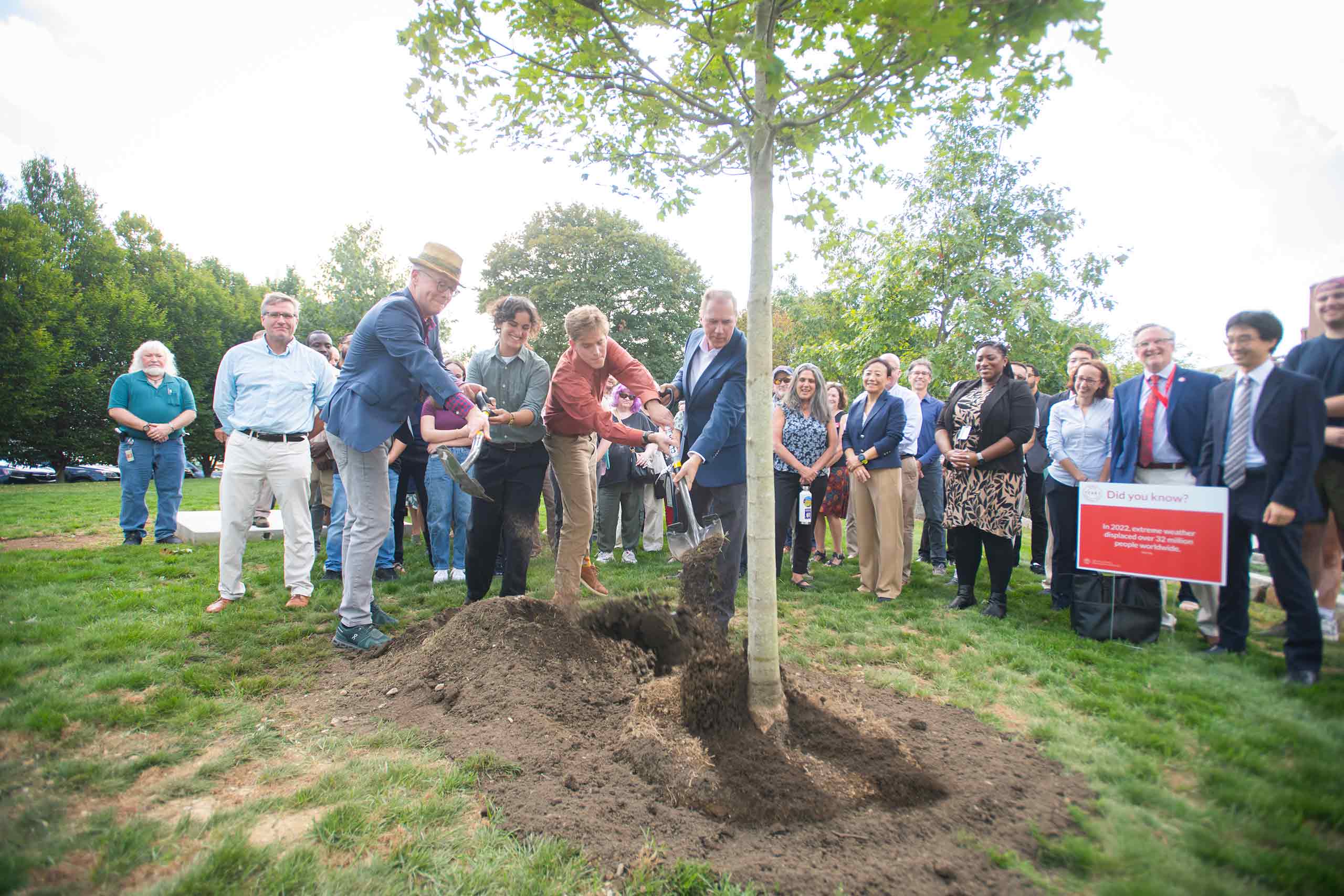
Clark held a full day of events on Sept. 15 to celebrate the launch of the School of Climate, Environment, and Society and announce plans to enhance campus sustainability and stewardship efforts. The day began with a guided tour of Clark’s 26-acre Hadwen Arboretum, moved onto campus with student-oriented activities and information sessions, and concluded with a bat observation and walk at nearby Coes Pond.
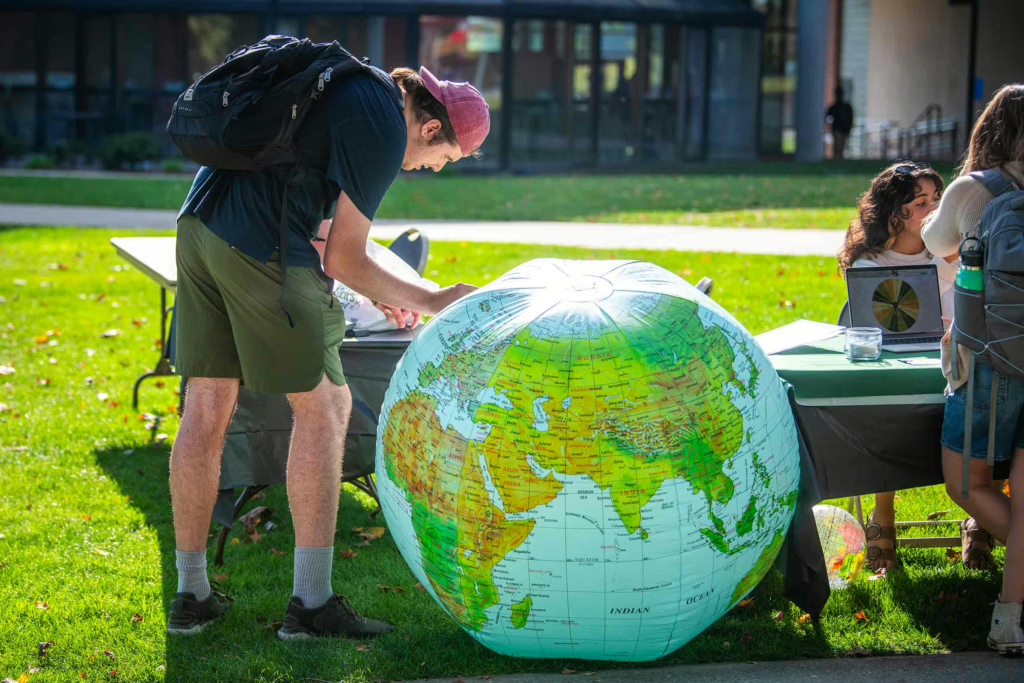
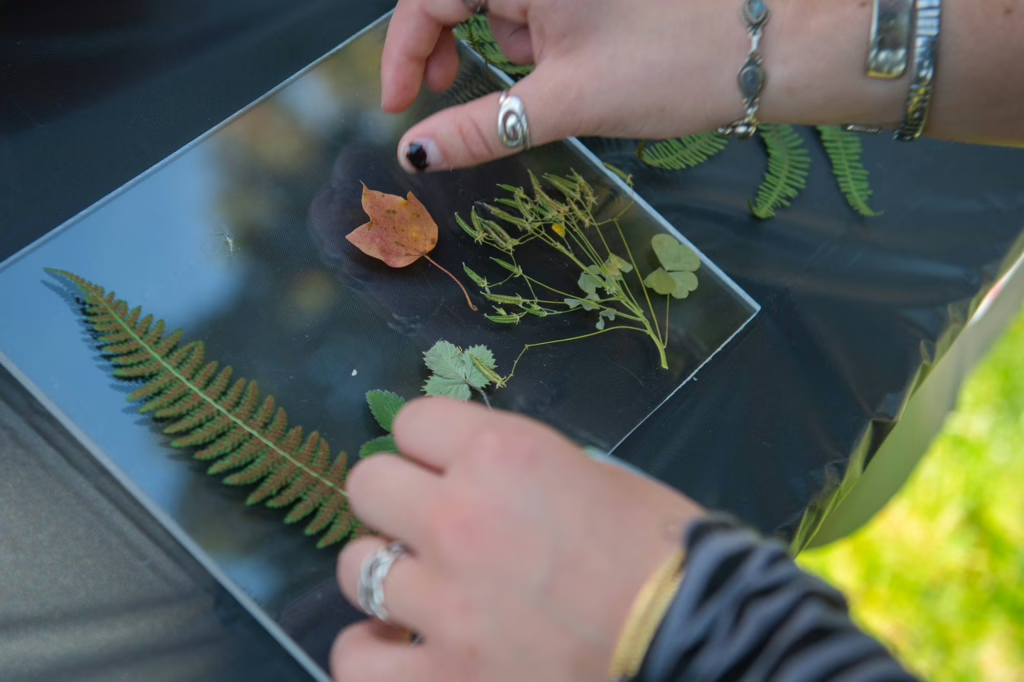
Students made nature art.
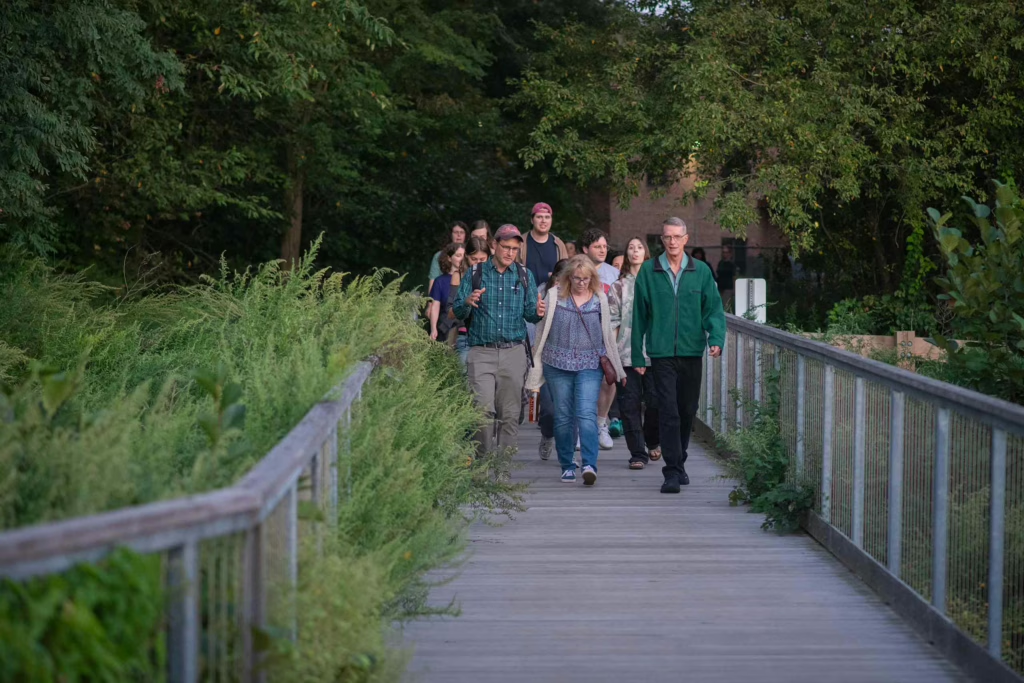
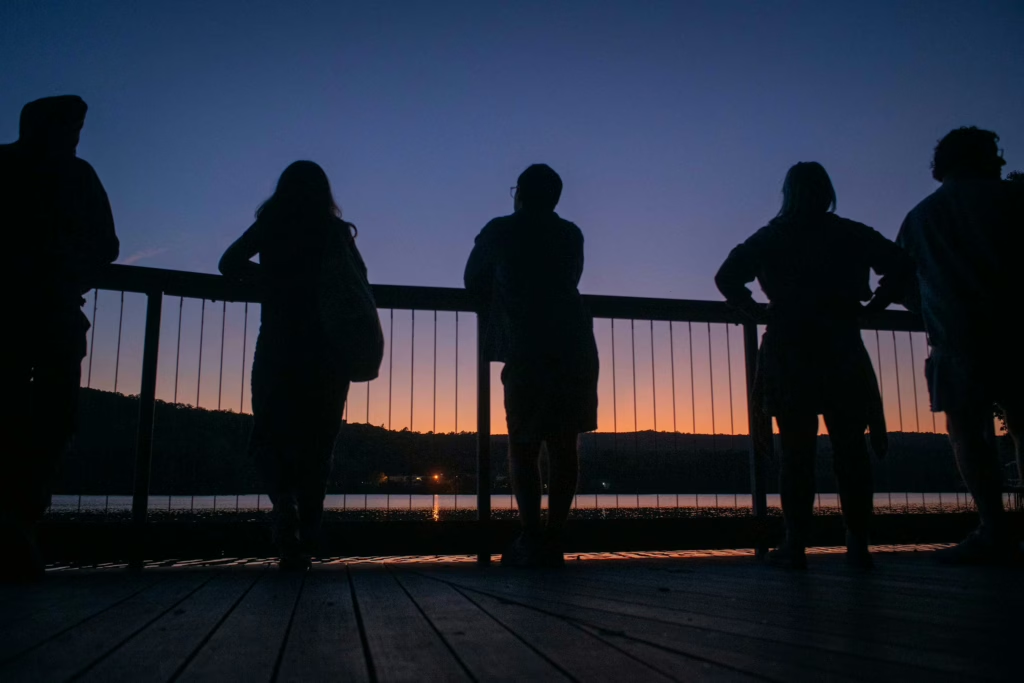
Professor Morgan Ruelle (above left) led the bat observation walk.