

Clark as transformer
In 1864, George Perkins Marsh — widely considered America’s first environmentalist — published Man and Nature: Or, Physical Geography as Modified by Human Action, recognizing the irreversible impact of humankind’s actions on the Earth.
Just over a century later, Clark took Marsh’s hypothesis a step further when it hosted the ground-breaking conference, “The Earth as Transformed by Human Action.” Organized by Clark geographers Robert Kates and Billie Lee Turner with Harvard’s William C. Clark, the international symposium drew widespread attention from the scientific community, encouraged Clark’s research in earth system science and sustainability science, and helped lay the foundation for the creation of the University’s George Perkins Marsh Institute.
Writing about the conference in the August 1988 issue of The Professional Geographer, Turner noted, “Three years of planning and preparation for the conference centered around outlining and commissioning some 40 papers from leading experts or teams of experts around the world” documenting global environmental changes and their impact on human society. As attendees Ian Douglas and Michael Chisholm wrote in Area, the journal of the Royal Geographical Society, the goal was to “tease out the links between processes affecting the land, sea, and atmosphere” and, ultimately, people.
“The book was deemed a landmark study and a wake-up call to the world.”
“This challenge is being taken up, inter alia, by the Graduate School of Geography at Clark University.”
Three years later, Cambridge University Press published the conference’s papers in The Earth as Transformed by Human Action, co-edited by Turner with contributions from a number of Clark researchers and faculty, including Roger Kasperson, one of the first geographers to be elected a member of the National Academy of Sciences, and Robert Kates, who served as a member of the Intergovernmental Panel on Climate Change that received the Nobel Peace Prize in 2007. The book, a major stocktaking of the anthropogenic impacts on the planet and its ecosystems over 300 years, was deemed a landmark study and a wake-up call to the world.
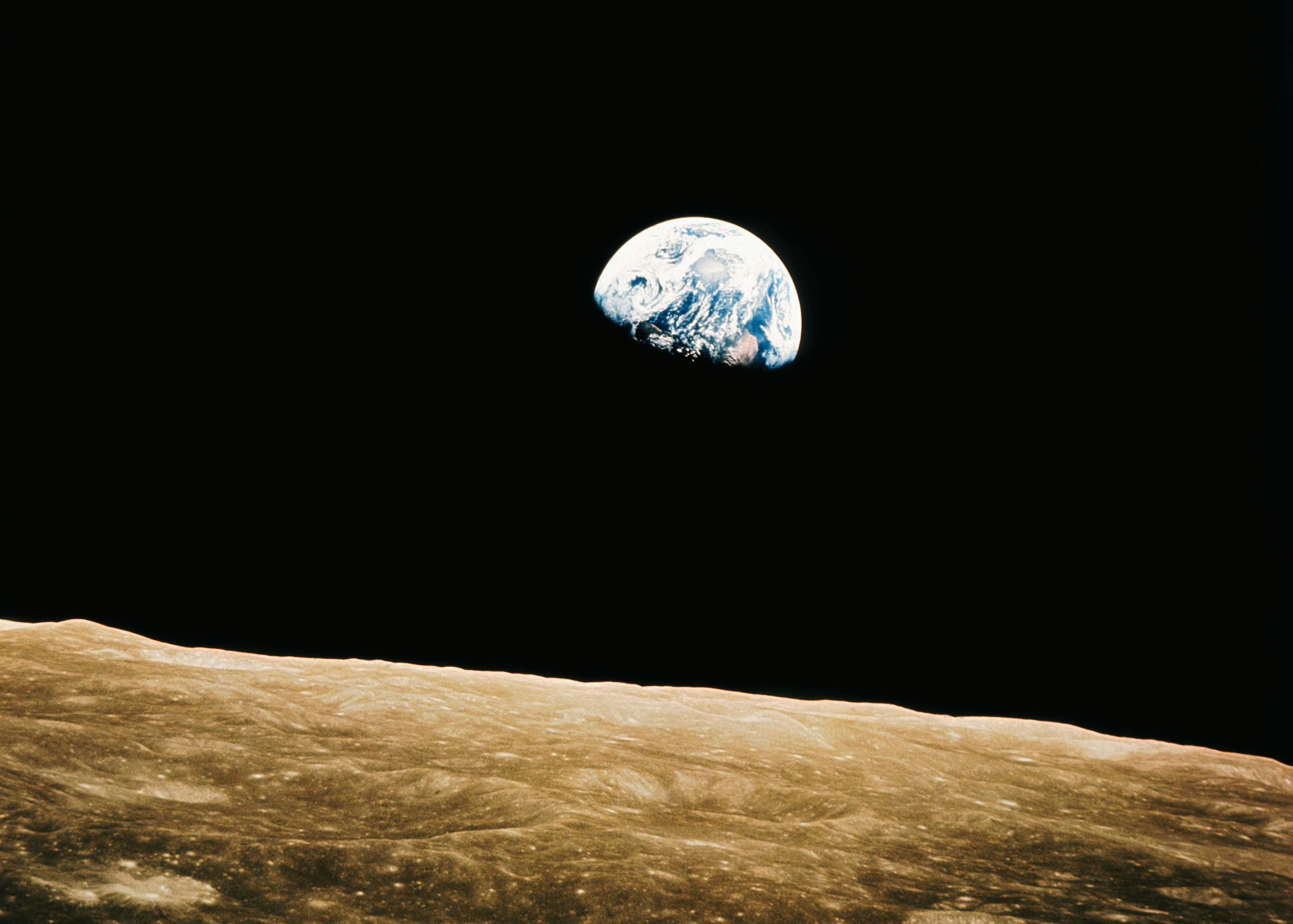
Above: “Earthrise,” photographed on Dec. 24, 1968, by astronaut William Anders aboard Apollo 8.