
A Greener Worcester?
Imagine That.
The Miyawaki Forest near the Worcester Public Library.
The city is an inspiration, and partner, in Clark’s efforts to empower a sustainable community
By Jim Keogh
On a steamy night in August, fireworks exploded over Polar Park. The Worcester Red Sox had just won their game, and the club was continuing its Friday tradition of celebrating with lights in the sky.
A mother and father, along with their two young boys, were heading to their car in the parking lot of the Worcester Public Library when they stopped to watch the display, peering between the extended branches of young willows and oaks. They hadn’t anticipated the fireworks, or they likely would have stayed in the ballpark. Nor, almost surely, did they understand why they were observing the show through a grove of trees growing within the confines of a city parking lot.
This urban microforest—known as a Miyawaki forest, after the Japanese botanist who developed the concept—was planted on 6,500 square feet as one in an arsenal of tools to cool the city, particularly in neighborhoods where the prevalence of brick and asphalt, combined with a lack of vegetation, has resulted in the phenomenon known as the urban heat island effect.
Sixty canopy trees, 700 shrubs and flowering trees, and 2,500 understory plants were transplanted from Clark’s Hadwen Arboretum by an army of volunteers and planted in nutrient-rich soil that also was dug and transported from the Arboretum, resulting in a strip of land that is more than 10 degrees cooler than the surrounding asphalt.
The library-lot forest and a second Miyawaki forest, planted at the Plumley Village apartment complex, are rooted in collaborations among the city, state, and Clark and were generated through a proposal developed by Worcester environmentalist (and former Clark professor) Evelyn Herwitz. Students in the HERO (Human-Environment Regional Observatory) program, run by geography professors Deborah Martin and John Rogan, have been key not only in establishing the forest but also in locating and monitoring Worcester’s heat islands as part of a citywide strategy to counteract the most serious impacts of temperature rise.
The family in the parking lot—indeed, most Worcester residents and visitors to the city—may be unaware of the steps being undertaken to cool their world at the hyper-local level, but those efforts are very much woven into the fabric of Clark. The launch of the School of Climate, Environment, and Society is emblematic of the opportunities that abound for Clark students to study, intern, advise, and help the city catch its breath.
* * *
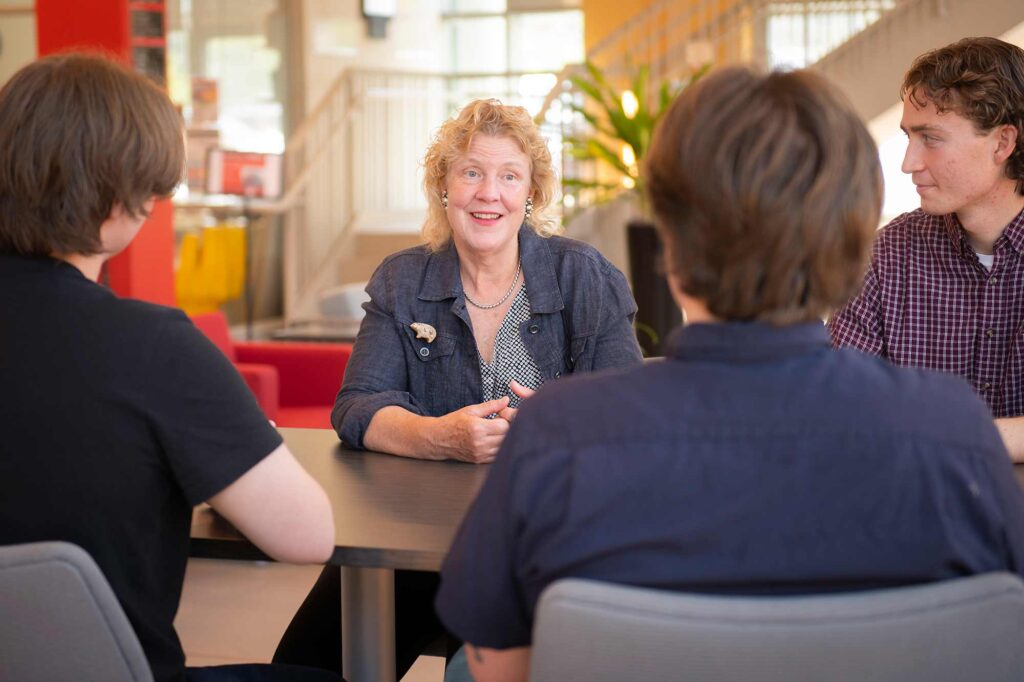
Melissa Hoffer is well acquainted with Clark University.
She’s collaborated with the Council on the Uncertain Human Future, whose origins are at Clark, and this past spring she participated in a kickoff conference for the School of Climate, Environment, and Society. Recently, she chatted with HERO students on campus about the work they do to help green “gateway” cities like Worcester, Leominster, and Lowell.
And as the chief climate officer for Massachusetts, she appreciates how Clark’s efforts to promote and practice sustainability synergize with state-run climate initiatives in Worcester and beyond. Hoffer notes that Clark’s interdisciplinary approach to these important issues is analogous to Gov. Maura Healey’s insistence that climate action be a driver for all the agencies under her purview, what’s called a whole-of-government approach. That means climate-sensitive strategizing rests not only within the jurisdiction of the energy and environment departments, but also with agencies overseeing economic development, public safety, transportation, and health and human services, among others.
“I love that you’re integrating climate in this very interdisciplinary way with the new school,” Hoffer says of Clark. “You are the academic analog of what Governor Healey is trying to do.”
“If I were a young person looking at schools to apply to in this particular moment, I would find what Clark is offering extremely attractive.”
Melissa Hoffer, Chief Climate Officer for Massachusetts
Students attending college in Massachusetts are part of a thriving climate-response ecosystem that is unique, says Hoffer, who is the only cabinet-level state climate officer in the country. She notes Massachusetts’ legacy of leadership in areas such as cap-and-trade and the regulation of greenhouse gas emissions, which has established a roadmap for federal policy.
Hoffer points to the intellectual capital within the state’s strong academic institutions, which, in concert with the research-and-development profile of private industry and support and investment from the state, have created burgeoning opportunities in areas like climate technology, where the start-up culture is particularly robust.
She sees intensive and deliberative action as an antidote to “climate anxiety,” the feeling of being helpless and ineffectual in the face of climate and environmental transformation.
“It’s a very hopeful space to be in, because we’re actually working to deal with the problems that are so terrifying to many of us,” Hoffer says. “Believe me, I feel angry, too, sometimes. But if you can take that raw emotion and translate it into constructive action, that can be a powerful thing.
“People feel better when they’re working toward a solution, and it’s exciting to think about students at Clark who are taking a constructive approach to help solve this problem.”

Caleigh MClaren ’22, M.S. ’23, assisted with the Miyawaki Forest plantings.
During the recent meeting with three HERO students—Nate Kidd ’26, Aidan Humphreys ’26, and Jamie Young ’27, Hoffer was so impressed with the Clark group’s work that she extended them an invitation to speak to the Youth Climate Council, a statewide coalition of high school students who advise the governor and the Office of Climate Innovation and Resilience on climate policy and actions.
With the School of Climate, Environment, and Society, Clark is a fit “for students who are looking for some concrete, pragmatic orientation on how to deal with this problem in the world,” Hoffer says. “They’re going to want to come where there’s a faculty that’s sophisticated about it, where they see that the institution is making a real commitment to it and lifting it up as a priority. When I was at Clark for the conference and had a chance to talk with some professors, I just thought, ‘Yeah, this is it.’
“There are going to be all kinds of ways that people can take this knowledge and experience out into the real world. If I were a young person looking at schools to apply to in this particular moment, I would find what Clark is offering extremely attractive.”
* * *
“Imagine” is a powerful word. Dreamy and boundless; the essence of possibility.
Imagine 2050, an initiative of the Central Massachusetts Regional Planning Commission, transforms the possibilities into a policy roadmap to promote a sustainable and equitable future for Worcester and 39 surrounding communities. “It’s a sweeping vision that spans from the urban core of Main South to post-industrial mill towns in the Blackstone Valley to farmers in the region’s rural hills,” says Dominique DuTremble ’13, M.A. ’15, director of regional planning and special projects at the commission.
“This work matters deeply,” DuTremble explains. “We’re planning in the face of climate disruption, accelerating technology, and economic uncertainty. It’s inspiring, but it’s also a responsibility. These changes are real, and they’re happening now.”
Through Imagine 2050 visioning sessions, table events, surveys, and stakeholder interviews, the planning commission arrived at a series of core principles around themes that include mobility and connectivity, responsive governance, equitable economic growth, strengthened climate resilience, and improved quality of life. Scenario planning based on these principles, in combination with collected data, helped CMRPC formulate potential recommendations.
The organization is also working on a comprehensive climate action plan and collaborating with communities to reduce municipal energy use.
“Our job is to meet communities where they are and help them move toward the future they want,” DuTremble says. “That means balancing long-term ecological goals with day-to-day realities like affordable housing, transportation access, and livable wages. It’s not theoretical—these are people’s lives.”
DuTremble, who earned her undergraduate degree in political science and her master’s in community development and planning, is proud of the pipeline between her alma mater and the agency.
“Clark has been a perpetual source of talent for CMRPC,” she says. Student interns regularly support planning work in food systems, transportation, housing, and more. It’s no surprise, then, that the organization has attracted many Clarkies to its ranks. Currently, the organization boasts 14 Clark alums, according to Anthony Senesi, communications and civic engagement coordinator, and himself a Clarkie (Class of 2017).
“Our job is to meet communities where they are and help them move forward. It’s not theoretical. These are people’s lives.”
Dominique DuTremble ’13, M.A. ’15
director of regional planning and special projects
Central Massachusetts Regional Planning Commission
“Regional planning is a holistic discipline—it’s systems-level thinking with real-world impact,” DuTremble says. “It’s not paperwork. It’s creative, collaborative, and community-rooted. There’s tremendous opportunity in Central Massachusetts for the next generation of planners.”
She adds that Clark interns have played a vital role in Imagine 2050, especially in data collection and community engagement—whether through stakeholder interviews, workshop facilitation, or listening sessions.
“Being at CMRPC feels a lot like being at Clark,” DuTremble reflects. “Both places draw people who are smart, values-driven, and deeply committed to making the world better. That’s the energy we need more of in regional planning.”
* * *
“Clark is not a stranger to us, and we are not a stranger to Clark.”
With this simple declaration, Kaska Yawo, executive director of the African Community Center in Worcester, announced a formal partnership with Clark that would amplify the University’s efforts to help African and Haitian immigrants navigate economic and cultural challenges while preserving their most precious traditions. The effort further strengthened the bond between ACE and Clark: The University’s faculty and students frequently collaborate on research and wellness efforts, and Clark alumni have been a consistent presence as employees and leaders at the organization over the years.

Students in Sustainability and Social Justice Professor Anita Fábos’ Cultures of Exile course collaborated with members of the Haitian and African communities, some of whom had been forcibly displaced from their home countries, on projects surrounding themes of food traditions and identity. Using ArcGIS software, one group of student researchers built upon a previous project by Lia Tang ’23, M.A. ’24, to create an online map that provides a list of essential resources, foodways, and informational hubs for Worcester’s immigrant communities.
Fábos notes that the paradigm is shifting away from commonly held categories like “migrant” and toward the concept of “mobility” to describe how people are “being in the world.”
“It’s more expansive and includes many more of us,” Fábos says. “In the context of climate and the transformations that urban and non-urban spaces are experiencing, I think that’s something that will affect us all. So the idea of mobility rather than migration helps us consider how we’re going to transform together.”
In her classes, Fábos takes what she describes as a “person-centered approach” to refugee studies, which joins the many threads of an individual’s experience. She explains that the refugee system is divided into discrete compartments (emergency, humanitarian, relief, resettlement, and integration), each with distinct personnel and policies. Clark’s approach “focuses on the person who has interacted with most or all of these compartments—as a whole person and not as ‘a fleeing person’ or ‘a person needing aid.’
“We have found that belonging manifests in all kinds of new and different ways when you are forcibly displaced,” she continues. “ ‘Place’ is always important, and our ties and connections to our heritage are essential. Forced migrants weave their heritage identities into their ongoing efforts to ‘belong’ in new places. They are often expected to drop their heritage and assimilate, but strong communities are built on transforming together.” ●