
Urban greening is often promoted as a strategy for creating healthier, more climate-resilient cities, yet green investments and their benefits remain unevenly distributed. In this installment of the Graduate School of Geography Colloquium Series, Michelle Stuhlmacher (DePaul University, Chicago) will examine how housing dynamics and neighborhood change influence urban greening through two complementary studies.
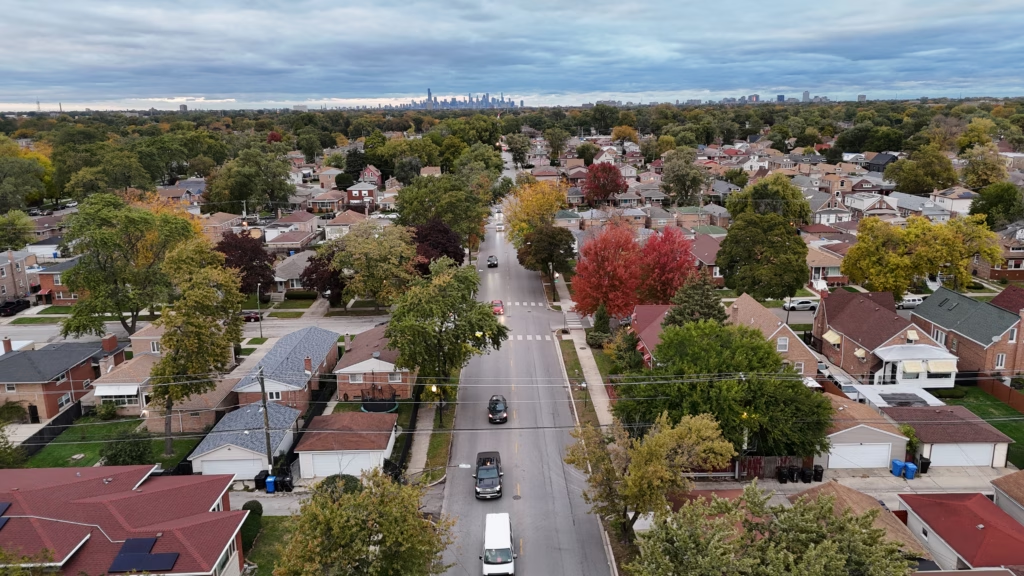
The first investigates formerly redlined neighborhoods in Chicago, tracking changes in vegetation, canopy, and park investment from 2010 to 2020. Stuhlmacher has found that while historically redlined areas experienced greater net greening than higher-graded neighborhoods, trajectories varied significantly: formerly redlined areas with rising homeownership attracted more green investment than those where homeownership declined, suggesting that the spatial legacies of housing discrimination are neither uniform nor static. The second study is an ongoing national analysis (n = 37 U.S. cities, 1990–2020) that asks whether renters have systematically lower access to tree canopy cover, whether that relationship persists across different types of cities, and over time. Together, this research highlights urban greening as an ongoing political-economic process influenced by housing tenure, property markets, and local governance.
Michelle Stuhlmacher is an Associate Professor in the Department of Geography and GIS at DePaul University in Chicago. Her research employs satellite imagery to study urban green space and its socio-environmental impacts on urban systems.