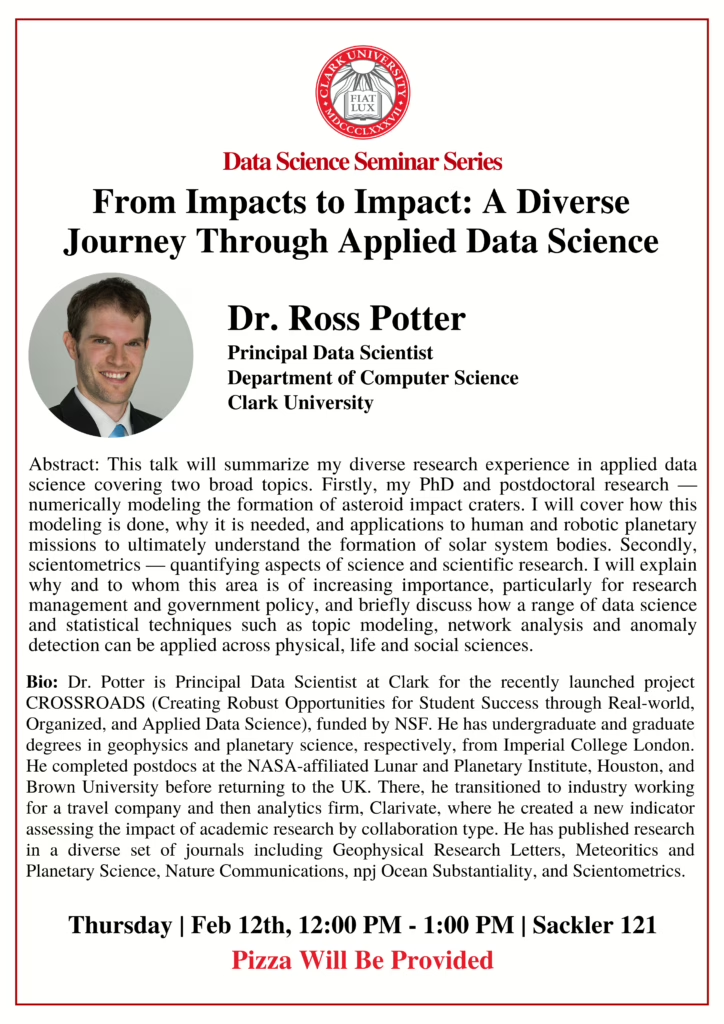


This talk will summarize Principal Data Scientist Ross Potter’s diverse research experience in applied data science covering two broad topics. Firstly, his Ph.D. and postdoctoral research — numerically modeling the formation of asteroid impact craters. He will cover how this modeling is done, why it is needed, and applications to human and robotic planetary missions to ultimately understand the formation of solar system bodies. Secondly, scientometrics — quantifying aspects of science and scientific research. He will explain why and to whom this area is of increasing importance, particularly for research management and government policy, and briefly discuss how a range of data science and statistical techniques such as topic modeling, network analysis and anomaly detection can be applied across physical, life and social sciences.
Potter is Principal Data Scientist at Clark for the recently launched project CROSSROADS (Creating Robust Opportunities for Student Success through Real-world, Organized, and Applied Data Science), funded by NSF. He has undergraduate and graduate degrees in geophysics and planetary science, respectively, from Imperial College London.
He completed postdocs at the NASA-affiliated Lunar and Planetary Institute, Houston, and Brown University before returning to the UK. There, he transitioned to industry working for a travel company and then analytics firm, Clarivate, where he created a new indicator assessing the impact of academic research by collaboration type. He has published research in a diverse set of journals including Geophysical Research Letters, Meteoritics and Planetary Science, Nature Communications, npj Ocean Substantiality, and Scientometrics.