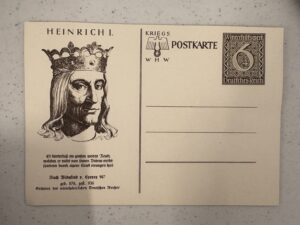
Accension Number: 2022.02.8.43
Stamp: 6 Winterhilfswerk Deutches Reich
No postmark
This postcard displays an illustration of Henrich I, also known as Henry the Fowler, who was a significant figure in German History. He was born in 876 and died July 2, 936. Henrich was a German king and the founder of the Saxon dynasty (918-1024), he strengthened the East Frankish (German) army, encouraged the growth of towns, secured German borders against Pagen incursions, and brought the region of Lotharingia (Lorraine) back under German control in 925. Underneath the illustration a brief synopsis of Heinrich I is written:
- “Er hinterließ ein großes, weitreichendes Reich, das er nicht von seinen Vätern geerbt, sondern durch seine eigene Kraft gewonnen hatte.“ Which translates to: „He left behind a large, far-reaching empire, which he did not inherit from his fathers, but won through his own strength.”
In 1936, Hitler’s Schutzstaffel—the SS—began transforming a medieval castle abbey associated with King Henry into a Nazi worship center. This was largely headed by Heinrich Himmler, one of the most powerful members of the Nazi elite. Himmler oversaw the regime’s mass atrocities, was a racist extremist that fantasized about conquests against foreigners and was a former Catholic that had become obsessed with mysticism and created his own neo-pagan religion. The legend of Heinrich I, Himmler believed, could be adapted to Nazi narratives. He referred to Heinrich as the founder of Germany’s first “Reich” and is quoted with saying: “He had the knowledge that the German people. . . must look beyond their own clan and their own space so as to align themselves with greater things.” “His ‘Slav wars’ found the first step beyond the Elbe for German colonization. . . We present-day Germans perceive his meaning with complete clarity.” Moreover, Himmler used the king’s myth to validate genocidal SS policies; “He had the courage to create unpopular politics and had the wherewithal and the power to see them through.”