Accession Number: 2022.02.9.11
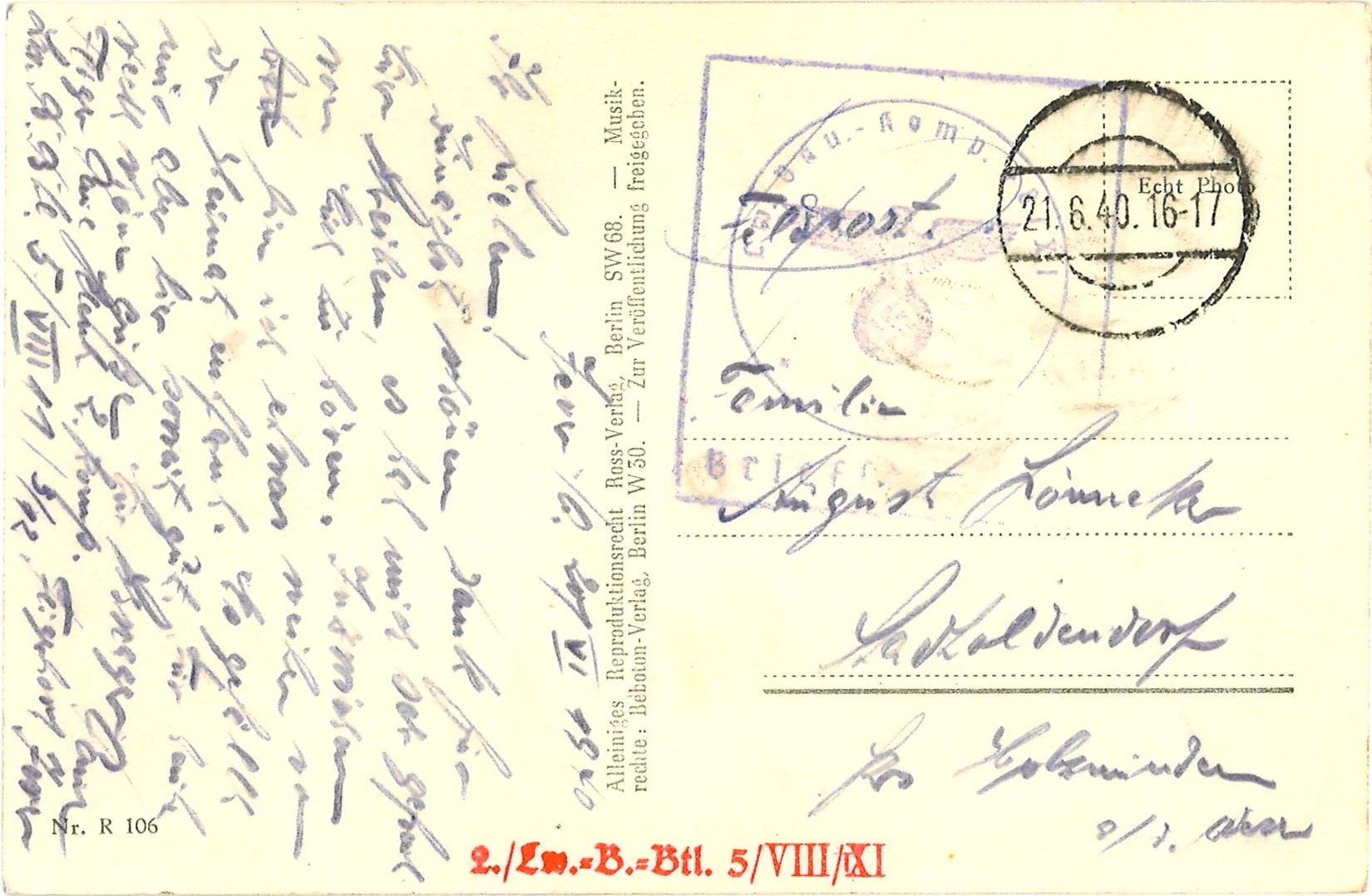
Stamp: The hand-stamp usage in 1940 over an adhesive postmark indicates that this postcard was mailed by the feldpost.
Postmark: 21-6-40 16-17
Historical Context:
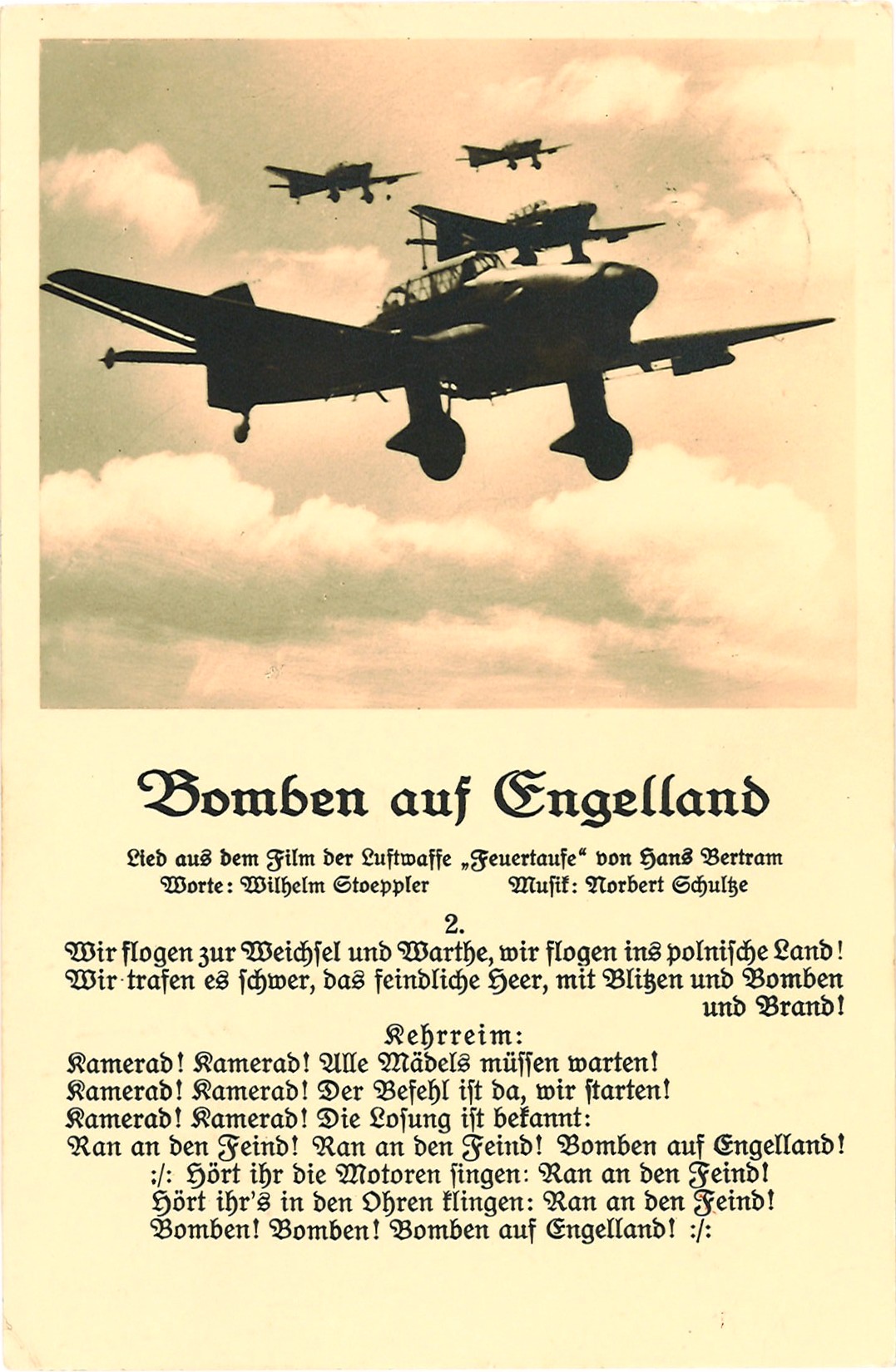
Feuertaufe (Baptism of Fire) is a German-produced propaganda film made with aerial footage of airstrikes taken by combat cameramen during Hitler’s invasion of Poland. The song depicted on the front of this postcard was used in the film.
Description of the film’s contents by the National Archives:
Reel 1 shows airplanes in flight; a Polish newspaper; a parade of Polish cavalry units; and Polish planes, armored units, and tanks. Maps illustrate Poland’s presumed expansionist tendencies which include the conquest of Germany. Crowds in Danzig listen to a Nazi orator. German-Danzig troops patrol and construct wire obstacles. Shows German flags and symbols on Danzig buildings, German troops, German warships, and German planes on the ground. Includes a montage of maps and scenes of Zurich, Budapest, London, Warsaw, and Paris.
Reel 2, Polish officers salute troops and enter a railway car where they surrender to German officer. Shows devastated Polish cities, refugees, and a destroyed railway yard.
Reel 3, German planes land, the pilots deplane, bombs are loaded into airplanes, aerial cameras are taken from an observation plane and the film is developed, pilots study aerial photos, Stukas bomb Danzig and one crash lands, pilots study maps, men attach bombs to Stukas, and Stukas bomb railway yards and strafe Polish columns.
Reel 4 maps German aerial attacks of Polish cities and shows German planes in flight. German soldiers examine bomb craters and ruins. Shows destroyed Polish railway yards, planes, vehicles, and hangars. German airmen rest, clean guns, shave, cook, dig ditches, and drill. Shows undamaged railway yards and destroyed bridges. Polish refugees plod along a road and throw flowers at German troops. German cavalry, trucks, and heavy artillery units advance. Maps the German advance into Poland. German troops guard Polish prisoners of war along a road.
Reel 5 shows burning ruins in a Polish city and dead civilians. German horse drawn units move through a city, soldiers string telephone wires, a hospital truck passes, and soldiers ride in wagons. Shows German cavalry, a wrecked car in a bomb crater, destroyed Polish horse drawn vehicles, dead horses, antiquated Polish artillery, and dead Polish troops.Polish civilians dig pits for the burial of soldiers and horses, and return to their ruined homes. A wounded man on a stretcher is removed from a truck.
Reel 6, German airplanes drop leaflets over Warsaw and non-combatants drive through German lines. Maps the German attack on Warsaw, German officers, along with Goring and Hitler, confer in a railway car. German airmen ready their planes, fly over the countryside, bomb Warsaw, and land. Shows Warsaw in flames. German airmen warm themselves around a fire and eat.
Reel 7, German motorcyclists, trucks, cavalry, and infantry advance as Polish refugees move to the rear. Shows destroyed bldgs. and bridges. Maps the German conquest of Poland and capture of Warsaw. German planes take off, fly over the countryside, and bomb Warsaw. Men attach bombs to Stukas.
Reel 8, Polish officers and men move out of Warsaw after its surrender. German soldiers celebrate their victory, and examine Polish prisoners. Shows Polish prisoners on fire trucks and other vehicles, refugees, bomb craters, and ruins. German troops advance through Warsaw. Warsaw citizens receive food from German troops. Polish officers leave and Germans enter the Polish military headquarters. German cavalry units ride into the city and camp. Hitler reviews a parade of German troops, armored vehicles, and tanks in Warsaw as planes fly overhead. Goring discusses the part played by the air force in German conquests. German soldiers man artillery batteries and patrol a French beach. German airplanes fly over open water on the way to England. Shows airmen in the planes.”
Front:
A photo of several German bomber planes flying.
Bomben auf Engelland
Lied aus dem Film Der Luftwaffe “Feuertaufe” von Hans Bertram
Worte: Wilhelm Stoeppler; Musik: Norbert Schulze
2.
Wir flogen zur Weichsel und Warthe, wir flogen ins polnische Land!
Wir trafen es schwer, das feindliche Heer, mit Blitzen und Bomben und Brand!
Rehrreim:
Kamerad! Kamerad! Alle Mädels müssen warten!
Kamerad! Kamerad! Der Befehl ist da, wir starten!
Kamerad! Kamerad! Die Losung ist bekannt:
Ran an den Feind! Ran an den Feind! Bomben auf Engelland!
Hört ihr die Motoren singen: Ran an den Feind!
Hört ihr’s in den Ohren klingen: Ran an den Feind!
Bomben! Bomben! Bomben auf Engelland!
[Translation]
Bombs on England
Song from the movie The Luftwaffe Baptism of Fire from Hans Bertram
Words: Wilhelm Stoeppler; Music: Norbert Schultze
2.
We flew to Weichsel and Warthe, we flew into the Polish land!
We hit it hard, that enemy army, with lightning and bombs and fire!
Chorus:
Comrade! Comrade! All the girls must wait!
Comrade! Comrade! The command is here; ain’t starting late!
Comrade! Comrade! The solution planned:
Toward the enemy! Toward the enemy! Bombs on England!
Listen to the motors sing: toward the enemy!
Hear it ring in your ears: toward the enemy!
Bombs! Bombs! Bombs on England!
Back:
This postcard has a written message in unintelligible script. It was sent on June 21st, 1940.