Robert Hutchings Goddard Biographical Note
| 1882, October 5 | Born at Maple Hill, Worcester, MA |
| 1883 | Moved with family to Roxbury, MA |
| 1888-1898 | Attended Mount Pleasant, Hugh O'Brien, and English High Schools in Boston |
| 1889 | Began thinking about flight into outer space |
| 1898 | Moved with family to Maple Hill, Worcester |
| 1899, October 19 | "Anniversary Day" of dedication to the development of a method of attaining great heights |
| 1899-1901 | Kept from school by illness |
| 1901-1904 | Student, South High School, Worcester |
| 1904-1908 | Student, Worcester Polytechnic Institute (B.S. 1908) |
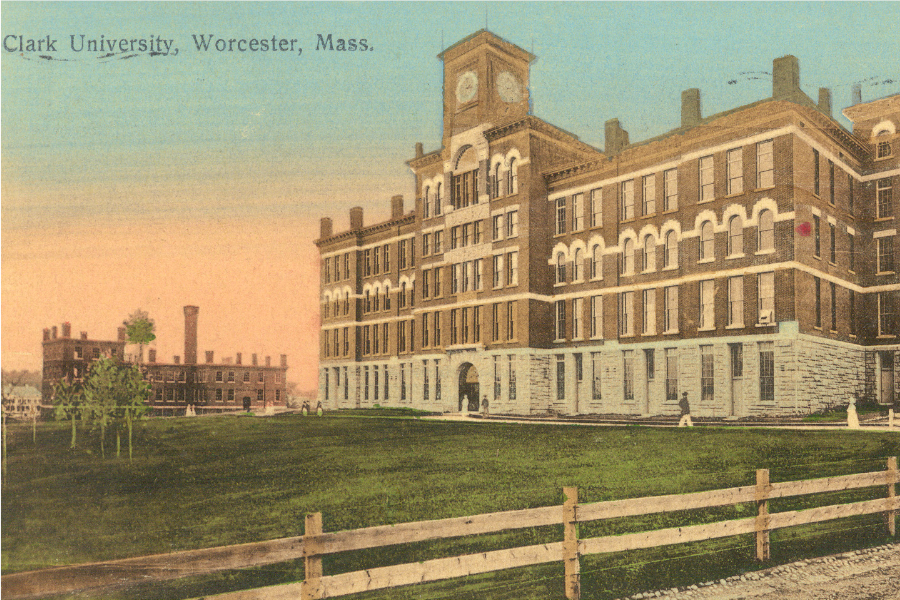
| 1908-1909 | Instructor of Physics, W.P.I., and special student in Physics, Clark University |
| 1909-1911 | Fellow in Physics, Clark University (A.M. 1910, Ph.D. 1911) |
| 1911-1912, 1914-1915, 1918-1920 |
Honorary Fellow in Physics, Clark University |
| 1912 | First explored mathematically the practicality of using rocket power to reach high altitudes and escape velocity |
| 1912-1913 | Research Instructor in Physics, Princeton University |
| 1913-1914 | Contracts and partly recovers from tuberculosis |
| 1914, July | Awarded first two patents for rocket apparatus: U.S. Letters Patent #1,102,653 liquid-fuel gun rocket; U.S. Letters Patent #1, 103,503 a multistage step rocket (eventually awarded 214 patents, 1914-1956) |
| 1914-1915 | Instructor in Physics, Clark College; Assistant Professor 1915-1919; Associate Professor, 1919-1920 |
| 1915 | Proves experimentally that a rocket will provide thrust in a vacuum |
| 1916-1918 | Instructor, Clark University |
| 1917, January 5 | Received first financial assistance from the Smithsonian Institution ($5,000 from Hodgkins Fund); Further grants made through 1929 and in 1932 |
| 1917-1918 | Developed the basis for the rocket weapon, later known as the bazooka, done for U.S. Army Signal Corps & Ordnance Department, in the shops at the Worcester Polytechnic Institute, at Clark University, and later at the Mount Wilson Observatory in California. This was demonstrated successfully at the Aberdeen Proving Grounds on November 10, 1918, before representatives of the armed services. |
| 1919 | First to publish in the U.S. a basic mathematical theory underlying rocket propulsion and rocket flight, together with results of experiments with solid-propellant rockets, "A Method of Reaching Extreme Altitudes", Smithsonian Miscellaneous Collections, Vol. 71, No. 2 |
| 1920-1923 | Part-time consultant on solid-propellant rocket weapons for U.S. Government at Indian Head, Maryland |
| 1920-1925 | First to develop a rocket motor using liquid propellants (liquid oxygen and gasoline) |
| 1920-1943, August 5 | Professor, Clark University |
| 1923-1943 | Director of the Physical Laboratories, Clark University; chairman of the physics and mathematics departments |
| 1924, June 21 | Married Esther Christine Kisk |
| 1925 | Static test at Clark University: liquid-propellant rocket lifted its own weight for first time |
| 1926, March 16 | First to launch a liquid-propellant rocket, at Auburn, MA |
| 1929, July 17 | Tested first rocket containing instruments at Auburn, MA, which attracted wide public attention |
| 1929, November 23 | First meeting with Charles A. Lindbergh |
| 1930, July 10-1932 | First two-year grant from Daniel Guggenheim. Began conducting full time rocket research at Roswell, NM (on leave of absence from Clark University) |
| 1932 | First developed gyro stabilization apparatus for rockets |
| 1932 | First used deflector vanes in the blast of the rocket motor as a method of stabilizing and guiding rockets |
| 1932-1934 | Teaching at Clark University. Continued research financed by the Smithsonian Institution and The Daniel & Florence Guggenheim Foundation |
| 1935 | "A" series rocket tests (14-test series; rockets at this stage were about 15 feet long) |
| 1935, March 8 | First to launch a liquid-propellant rocket which attained a speed greater than that of sound (700 mph) |
| 1935 | Rocket reached altitude of 7500 feet |
| 1936, March 16 | Publication of "Liquid Propellant Rocket Development", Smithsonian Miscellaneous Collections, Vol. 95, No. 3 |
| 1936-1938 | "L" series rocket tests (30-test series; rockets were about 18 feet long) |
| 1937 | Rocket reached height of 9000 feet |
| 1938-1941 | "P" series rocket tests (this 36-test series represents his last flight rockets; they averaged about 22 feet in length) |
| 1942-1945 | Director of Research, Navy Dept., Bureau of Aeronautics developing jet-assisted takeoff and variable-thrust liquid- propellant rockets, at Roswell, NM & Annapolis, MD |
| 1943-1945 | Consulting Engineer, Curtiss-Wright Corporation, Caldwell, NJ |
| 1944-1945 | Director, American Rocket Society |
| 1945, June 2 | Received an honorary Doctor of Science degree, Clark University |
| 1945, August 10 | Died at Baltimore, MD. Buried in Hope Cemetery, Worcester, MA |
ORGANIZATION MEMBERSHIPS: Fellow of the American Association for the Advancement of Science and of the Institute of Aeronautical Sciences; Member of the American Physical Society; American Meteorological Society; American Rocket Society; National Aeronautics Association; Geophysical Union; American Institute of Social Sciences; Sigma Xi; Sigma Alpha Epsilon
Esther Christine (Kisk) Goddard Biographical Note
| 1901, March 31 | Born at Worcester, MA |
| 1917 | Student, South High School, Worcester, MA |
| 1918-1920 | Secretary to President Edmund C. Sanford, Clark College |
| 1920-1922 | Student, Bates College |
| 1922-1924 | Secretary to President Wallace W. Atwood, Clark University |
| 1924, June 21 | Married Robert Hutchings Goddard |
| 1945 | Johns Hopkins University (B.S.) |
| 1947 | Member, Worcester Branch, National League of American Pen Women |
| 1948 | Editor, with G. Edward Pendray, of Rocket Development, condensation of Dr. Goddard's notes on his experiments, Prentice-Hall Co., reissued 1961 |
| 1951 | Clark University (A.M.) |
| 1958 | Citation by the Trustees of Worcester Polytechnic Institute |
| 1958 | "Woman of the Year" of the Worcester Business and Professional Women's Club |
| 1961 | Goddard Educational Award, given annually at Women's Space Symposium, Los Angeles, CA |
| 1963-1970 | Member, Board of Directors, Age Center of Worcester Area, Inc. |
| 1964-1970 | Trustee, Clark University |
| 1962- | Honorary Member, Chamber of Commerce of Auburn, MA |
| 1964- | Member, Executive Board of Mass. Chapter, Arthritis Foundation |
| 1965-1970 | Member, Board of Trustees, Medical Research Institute of Worcester |
| 1965 | Honorary Alumna, Worcester Polytechnic Institute |
| 1965-1973 | Director, Worcester Federal Savings and Loan Association |
| 1966-1972 | Member, Advisory Board, Anna Maria College, Paxton, MA |
| 1966-1970 | Member, Advisory Historic Landmark Committee for the City of Worcester, MA |
| 1966, March | Named "First Missile-Tracking Photographer" by Point Mugu, California Chapter of the Photo-optical Instrumentation Engineers) |
| 1967 | Fellow, American Astronautical Society |
| 1967, May | Citation for meritorious public service from the Massachusetts Federation of Business and Professional Women's Clubs |
| 1967 | Honorary Member, Soroptimist Club of Worcester, MA |
| 1969 | Worcester Polytechnic Institute (Honorary Sc.D.) |
| 1970 | Honorary Member, Directors Council, Worcester Science Center |
| 1970 | Editor with G. Edward Pendray, The Papers of Robert H. Goddard, 3 volumes, McGraw-Hill Book Co. |
| 1970 | Honorary Member, American Institute of Aeronautics and Astronautics, New York City |
| 1970 | Member, Board of Governors, National Space Club, Washington, D.C. |
| 1970 | Honorary Member, Air Force Association, Vandenberg Air Force Base, CA |
| 1970 | Honorary Citizen, Roswell, NM |
| 1970 | Trustee, Cathedral of the Pines, Rindge, NH |
| 1970 | Outstanding Member, American Association of University Women |
| 1972 | Named "Pen Woman of the Year", National League of American Pen Women |
| 1972 | Clark University (Honorary Degree, L.H.D.) |
| 1982, June 4 | Died at Worcester, Massachusetts |