
Educating about genocide and mass atrocities
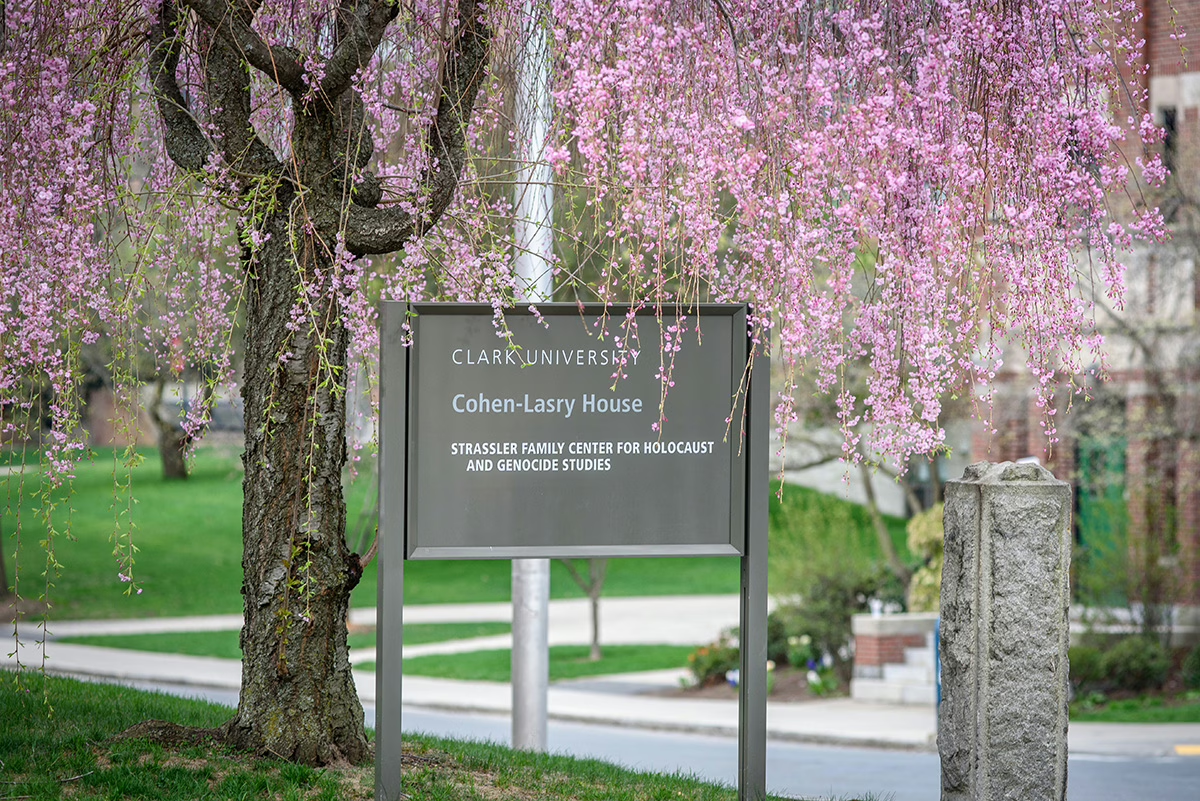
The history of genocide, mass atrocities, crimes against humanity and their continuing consequences stand at the core of the Strassler Center at Clark University. Home to a uniquely rich undergraduate program and a landmark doctoral program, the Strassler Center is the first and only institute of its kind.
Since 1998, it has gained international standing as the foremost PhD program training students in Holocaust History, the Armenian Genocide, and other genocides perpetrated around the globe.
Center faculty and students foster important scholarship and germinate significant ideas as conveners of a robust series of international symposia, workshops, and conferences that broaden the boundaries of genocide studies by introducing less known cases and novel approaches. The causes, conduct, and consequences of genocide are complex and require multifaceted approaches. The Strassler Center is committed to pushing boundaries in order to foster greater knowledge as well as to train professionals who hope to find solutions, offer healing and aid, education, and opportunities for memorialization.
Our faculty and expertise
“When you start to focus on their lives, then you can start to understand the way that these cycles of violence impact their possibilities for the future, their children’s possibilities and their sense of their own experiences .”
—Frances Tanzer, Ph.D.
Land acknowledgement
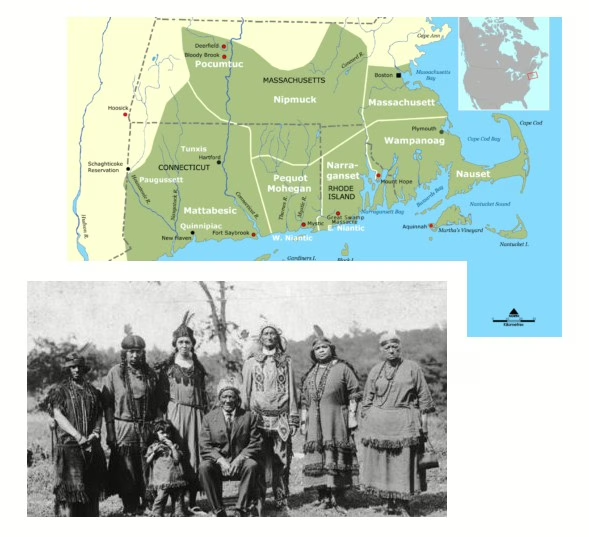
We acknowledge the long history of Nipmuc peoples and their bonds of kinship on the land where the Strassler Center community teaches, learns, and researches about genocide and mass violence.
Strassler Center in focus
News
Featured event
The David Atamian Journals: An Unparalleled Record of the Armenian Genocide
24 April 2026 |5:30pm |Higgins Lounge
Dana Commons
Speaker: Dr. Khachador Mouradian (Lecturer in Middle Eastern, South Asian, and African Studies (MESAAS) at Columbia University, and the Armenian and Georgian Area Specialist in the African and Middle Eastern Division at the Library of Congress).
About the speaker
David Atamian (1892, Behesni–1978, Arlington, Virginia) survived the Armenian Genocide and produced an unparalleled multi-volume journal of the early twentieth century. The manuscript spans more than 10,000 pages in thirteen volumes, covering his youth, the genocide, and the postwar period. Donated to the Library of Congress in 1946, the manuscript was described as “perhaps the most significant, certainly the most unusual” acquisition of the year. In this illustrated talk, Dr. Mouradian offers the first scholarly reading of the manuscript, showing how the journals deepen our understanding of the late Ottoman era and shed light on the daily emotional world of deportees.