
 |
 |
|
 |
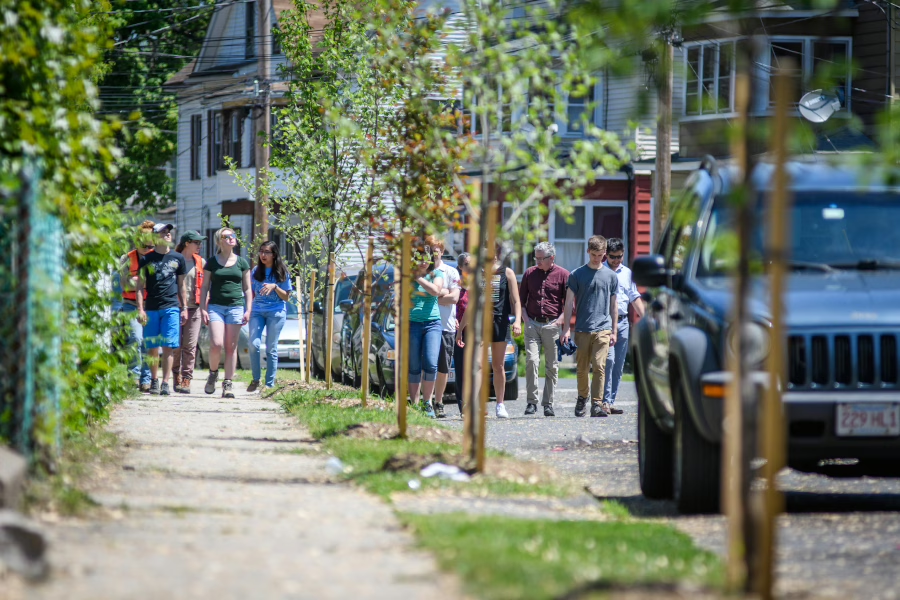
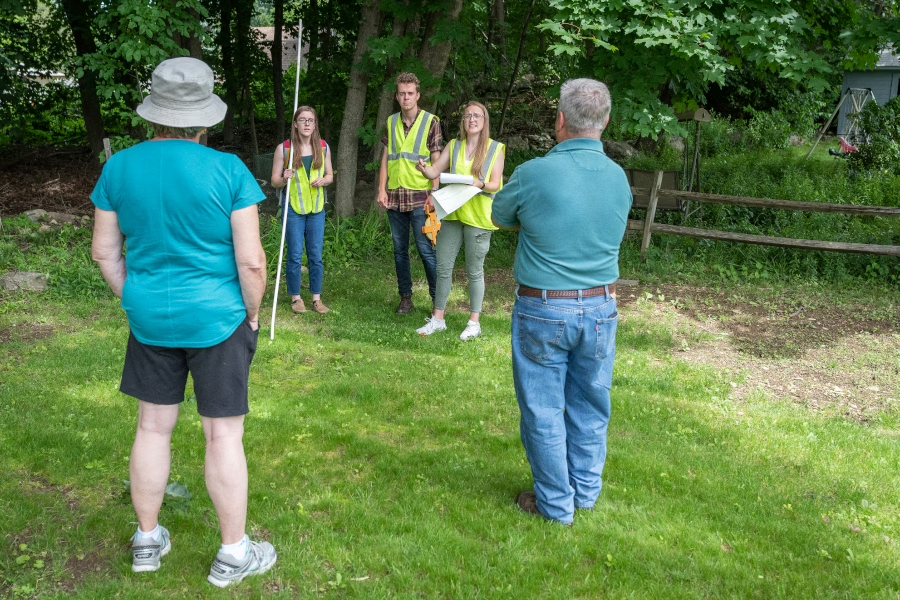
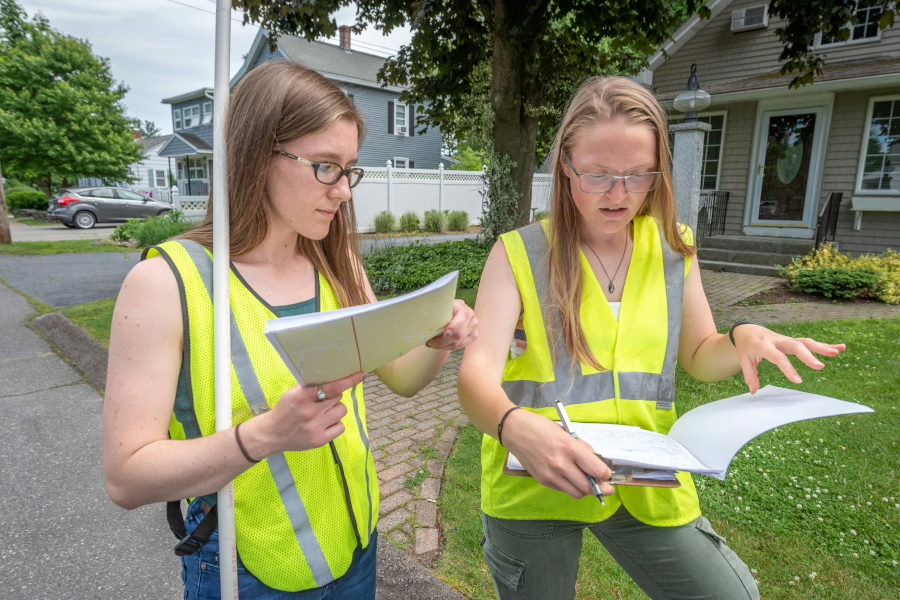
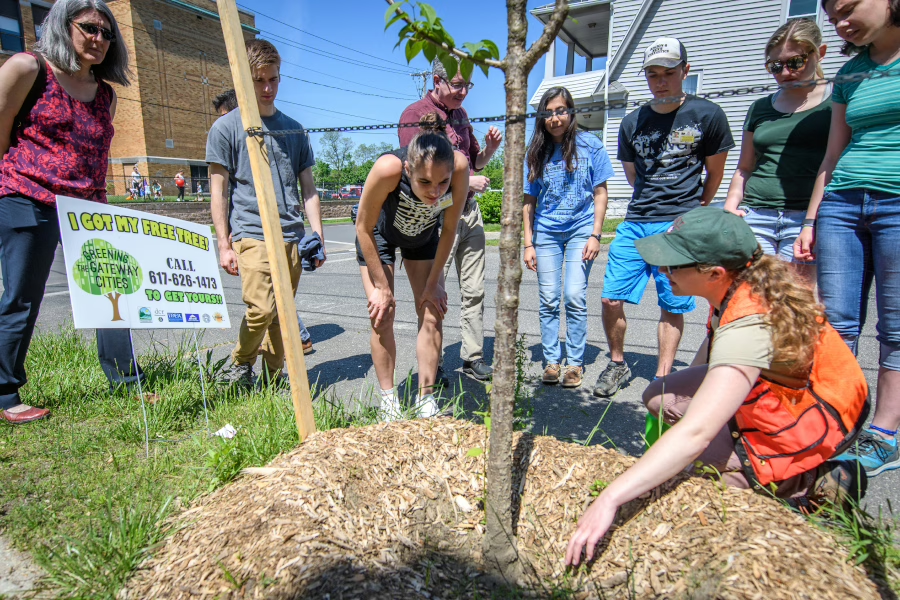
The Human-Environment Regional Observatory-Central Massachusetts (HERO-CM) research program provides opportunities for undergraduate and graduate students to analyze the causes and consequences of global environmental changes at local scales in faculty-led research projects. This program permits students to conduct research in interdisciplinary and inter-institutional projects. Current HERO research is funded by the National Science Foundation, the National Marine Fisheries Service, the Thoreau Foundation, and the O’Connor ‘78 Fund.
|
 |
 |
 Program History
Over
the last 300 years, the environment of Central Massachusetts (CM) has
experienced dynamic transition through five politico-economic states: Neolithic
gathering, colonial extraction, American agrarian, industrial, and
post-industrial/service. In the mid 19th century, CM was the early focus of the
North American industrial revolution. For now, it is witnessing a transition
into a service and high-tech economy, focused on computing and software (New
England’s Silicon Valley), medical, and research-oriented industries. Such
changes have been accompanied by significant population growth, giving rise to
dichotomous classes of occupants: a large and well-to-do professional class that
is juxtaposed to an aging working class and large influx of immigrant
populations. The region is clustered with small- to medium sized cities and
densely settled peri-urban communities interspersed with large patches of
woodlands and remnants of the former expansive farms. The southern and eastern
portions of CM capture parts of the eastern seaboard "megalopolis", complete
with their dense occupation of commuters. The northern and western portions, in
contrast, contain farmlands, private and public forests, Boston’s massive
Quabbin Reservoir, and many recreational land uses, including the ski industry.
The history of CM
lends itself to a study of changing human-environment relationships: human
causes, environmental consequences, and human responses.
The current relationships are
affected by the older ones, such as woodlands adapted to human interference and
numerous "brownfields" affecting land use and groundwater, promoting an
understanding of long-term environmental feedbacks on current processes, in
which accumulative environmental changes themselves become drivers of land use
and greenhouse gas emissions. These changing conditions, added to those of
crowding, watershed protection, and local environmental concerns, often lead to
strict land zoning policies.
This rationale for
a Human-Environment Regional Observatory (HERO) is matched by the special data
sources accumulated in Central Massachusetts over time. A number of well-known
research institutions in CM gather historical and environmental data and
information on the human-environment relationships of the region. American Antiquarian
Society houses the most extensive early American archival records in the
country. This long-term political and social documentation is matched by that of
terrestrial ecology and land-cover data accumulated at the Harvard Forest, a Long-Term Ecological
Research site (LTER) devoted to human-disturbed landscapes. Additionally,
researchers at the George
Perkins Marsh Institute of Clark University include experts in economic and
urban geography, risk-hazard, industrial ecology and land-use research. With
funding from
the
Culpeper and Keck Foundations, a new Clark’s CoFERT laboratory for high end
computing, data management, and GIS analyses, with its own research vehicle, has
been established to push forward a small-scale, Worcester County "HERO."
The Project actively uses the CoFERT lab's
resources.
Given this
historical context of the region and its current economical trends, as well as
the region’s rich research infrastructure, CM offers potential insights into
long-term, dynamic human-environment relationships and their change over time.
To benefit from these unique opportunities, the Human-Environment Regional
Observatory for Central Massachusetts (now known as the HERO-CM Project) was
initiated in the summer of 1999 by Clark University’s George Perkins Marsh
Institute with funds provided by the Culpepper Foundation.
The HERO-CM Project
initially set out to pursue the following objectives:
-
To establish an
undergraduate-directed, digital data archive (focused on spatially explicit
data) on the human-environment conditions in Central Massachusetts;
-
To use this data
archive for faculty-undergraduate linked researches on various themes related
to human-environment relationships;
-
To enhance the
undergraduate experience as well as create a valued asset to the larger
research community;
-
To make the
archive a public source of information.
In
2000 the Clark initiative was folded into a larger, multi-site research effort
funded by the US National Science Foundation (NSF), housed at
Penn State
University. This research project has ended, but Clark's HERO activities
are continuing, under new funding from the US National Oceanic and Atmospheric
Administration and the Henry David Thoreau Foundation. This article
provides more detail on the scholarly and pedagogic achievements of the Clark
HERO program.
effort in which it
currently resides.
Click here for a graphic
presentation of the history of HERO-CM project.
|
 |
Additional Resources
|
|
|
You may also be interested in:
|
|
|


HERO scholars study global environmental change through forest cover monitoring, land change prediction and vulnerability analyses.
|
|