Clark University Academics & Faculty
950 Main Street • Worcester, MA 01610
Tel: 508-793-7711 • academicaffairs@clarku.edu

Center for Excellence in Teaching & Learning
Faculty
These pages contain general resources for faculty and instructors, as well as information specifically for new faculty, and faculty teaching first-year seminars (FYS). Faculty may log into the FYS pages by using the format "clarku\username" and Clark password.

Faculty Opportunities and Resources

  • Currents In Teaching and Learning is now accepting submissions for its Spring 2009 issue.  For more information about this publication and how to submit, please click here.
     
  • Educational and Professional Development workshops are frequently held for faculty, graduate students, and undergraduates.  Visit our events page to learn about upcoming workshops.
     
  • Peer Learning Assistants are undergraduate students selected by the faculty member to facilitate teaching and learning activities that might otherwise be difficult for the faculty member to carry out by him/herself.  Experience at other institutions and in several FYSs and other introductory level courses at Clark has shown that PLAs are most useful in facilitative roles, e.g. giving students feedback on early drafts of writing, leading small group discussions, working with individual students who are having difficulty, facilitating group project work (in or out of class), and/or facilitating online discussions on Blackboard. Because they are undergraduates, as is the practice at Clark, PLAs do not grade student work, and they generally do not have the content expertise to serve as substitutes for graduate teaching assistants. PLAs are paid $8.50 per hour (AY06-07) from federal work-study funds or from other institutional funds, or some choose to take academic credit (e.g. independent study or directed reading) for their work. PLAs generally work about 10-15 hr/wk. CETL offers:

    1. Assistance in redesigning your course to incorporate the inquiry based learning that PLAs can help to facilitate.
    2. Logistical assistance for hiring and managing PLAs.
    3. Training for PLAs and the faculty who employ them.

    To discuss how PLAs might help improve your students’ learning while reducing your workload, please contact Judy Miller at judmiller@clarku.edu.
     
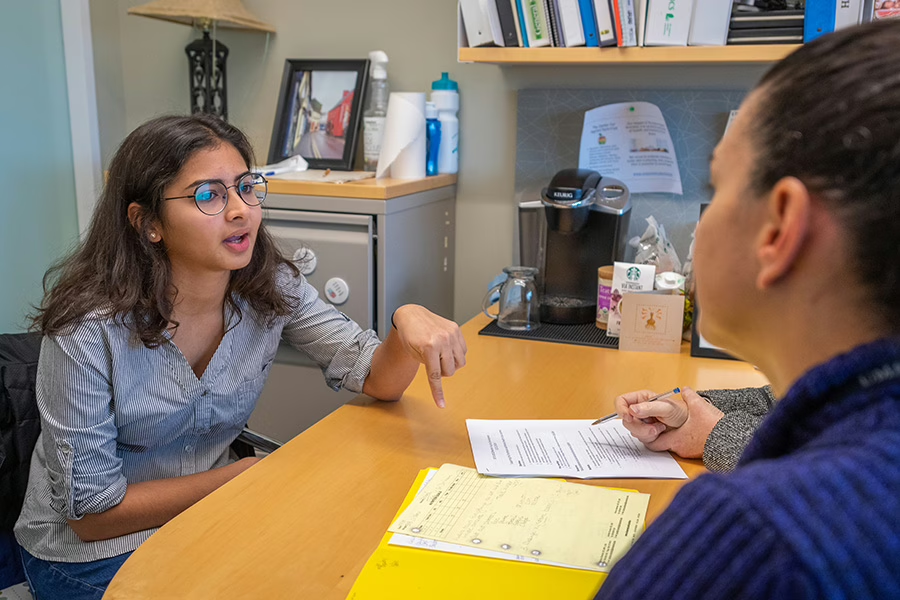
  • We offer confidential individual teaching consultations to anyone who teaches at Clark, including full time and part time faculty and graduate teaching assistants. Consultations are typically requested when an instructor has a specific teaching area in which s/he has questions or wishes to improve, but can also be requested for more general teaching feedback. A consultation typically begins with a meeting to determine your interests and needs and to review your course. If you wish, we may proceed to one or more classroom observations, with written feedback provided, and/or continue with additional meetings. Other possibilities include, but are not limited to, videotaping your class and reviewing your student ratings. You make the decisions, and we tailor the consultation to your needs and available time. Most importantly, the consultation is completely confidential. Unless you choose to share information or reports with other people, no one else will ever know that the consultation took place, let alone its content or results. Consultations are done by Judy Miller.
     
  • The Colleges of Worcester Consortium Certificate in College Teaching Program. The certificate program is designed for graduate students, adjunct faculty, and full-time faculty who are either pursuing or engaging in a career in academia. This program offers graduate students and faculty the opportunity to learn best practices in college teaching with the theoretical background that supports it. Courses may be taken “a la carte” or in pursuit of the 1.5-unit Certificate in College Teaching. Clark faculty and graduate students may qualify for tuition reimbursement for Certificate courses.  The Certificate in College Teaching Program was recently featured in an article in the Teaching Professor Newsletter.

Faculty Resource Documents

TA Feedback and Evaluation Process

First Year Seminar Opportunities for Faculty

What are First-Year Seminars?

First Year seminars (FYS) offer a marvelous opportunity for faculty to showcase their “learning through inquiry” approach to the liberal arts. In these courses, faculty support students in the development of academic and professional skills while working closely with students in an intimate classroom setting. In a FYS, faculty engage in active and collaborative dialogue with a group of no more than 16 students who share intellectual interests. By enabling faculty to convey their passion for research to first year students, these courses have proved to be an excellent way for departments to recruit new majors.

In first year seminars faculty explore an academic area in depth and work closely with students at the start of their college career. The small size of each seminar creates an environment conducive to lively discussions and active learning. First year seminars focus on helping students develop core academic skills, including reading, writing, speaking, thinking, arguing, and creative expression, all at a college level of intellectual sophistication.

Research shows that good teaching and good advising go hand in hand, thus FYS faculty act as academic adviser to the students in their FYS until their major is declared in the sophomore year. All faculty advisers are provided with training and support to assist them in the advising of first-year students during their crucial transition to life at Clark.

Above all, first year seminars provide an ideal setting for creating a community of learners who go on to do remarkable work. Not surprisingly, data on student performance and retention confirms that on average, Clarkies who enroll in first year seminars have stronger academic records as sophomores, juniors, and seniors and are also more likely to graduate on schedule than those who don’t take a FYS. Every first year seminar fulfills one of the Program in Liberal Studies (PLS) requirements, and several are writing intensive courses that carry a Verbal Expression (VE) designation.

In the 2006-2007 academic calendar year, Clark offered 25 first year seminars (up from 16 as recently as Fall 2002), which meant that we had enough seats to accommodate 70 percent of our incoming students. Next year, Clark aims to offer 30 first year seminars, which would raise our capacity to 80 percent. Faculty in those departments where the curriculum is less well suited to the first year seminar format are strongly encouraged to continue thinking about innovative ways to engage new students in a “learning through inquiry” mode.

Our ultimate goal is to build a rich and broad curriculum in which we offer every student the opportunity to take a special FY course (a seminar, a research group, or similar undertaking) designed to introduce them to Clark’s distinctive learning environment. Two currently active projects that support this long-term goal are:

Difficult Dialogues: The Ford Foundation has funded a two-year Difficult Dialogues project at Clark directed by Sarah Buie and Bill Fisher. Faculty interested in building a “difficult dialogue” component into their first year seminars for Fall 2007 can apply for summer stipend money available to facilitate this work. Please contact Sarah ( sbuie@clarku.edu ) if you are interested in learning more about the possibilities.

Learn through Inquiry: With funding from the Davis Educational Foundation, we plan to develop six new learn-through-inquiry based FY seminars in each of the next two academic years. Faculty who participate will receive a $2000 stipend in return for participating in an ongoing program of faculty development, evaluation of student learning across courses, and mentoring of the next year’s faculty. Participation in this program is by application. Contact Judy Miller ( judmiller@clarku.edu ) for more information.

The Academic Advising Center, CETL, and the Difficult Dialogues project work closely together to provide encouragement and support for faculty who have been or who are willing to become involved in the FY seminar program.

First year seminars change from year to year. The following list offers some examples of seminars that were offered in the past. For additional information about a particular seminar, we encourage faculty to exchange e-mail with the faculty member teaching the specific course. This is a great way to gain from the experience of faculty while developing your own focus for a FYS. For details about a specific course being offered for the upcoming year and the faculty member teaching the course, go to: http://www.clarku.edu/offices/aac/fys.cfm

First Year Seminars in Fall 2006

BINF 100 - DECODING MYSTERY OF LIFE
BIOL 040 - BRAIN AND ENVIRONMENT
CHEM 103 - ACCELERATED INTRO TO CHEM
CHEM 103 - LAB FOR FY SEM IN CHEM
CMLT 117 - NARRATIVES: HEBREW BIBLE
CMLT 129 - REVLTN IN HISPANIC CULTURE
COMM 050 - COMM & CULTURE: MAIN SOUTH
COMM 050 - DISC FOR COMM 050
CSCI 100 - ART AND COMPUTING
CSCI 110 - INVESTIGATING SOUND
ECON 100 - INTL ENVIRO POLICY
EN 124 - GLBL WARMING
ENG 103 - POETICS: SEX, DRUGS & ROCK
ENG 104 - WALDEN TODAY
ENG 131 - LATINO/A BORDERLANDS
ENG 132 - CONTEMPRY WOMEN ESSAYISTS
ENG 147 - SHAPING FANTASIES
GEOG 090 - NATIVE AMER/NATRL RESRCES
GEOG 152 - GEOGRAPHY OF GLOBALIZATION
GES 090 - NATIVE AMER/NATRL RESRCES
GOVT 101 - GENDER GAP IN AMER POLITICS
GOVT 102 - POLITICAL SCIENCE FICTION
HGS 090 - NATIVE AMER/NATRL RESRCES
HIST 037 - 19TH C AMER: WOMEN'S EYES
HIST 117 - NARRATIVES: HEBREW BIBLE
JS 117 - NARRATIVES: HEBREW BIBLE
MATH 110 - EXPLORING EMOTION SPACE
PHIL 104 - AIDS PANDEMIC
PHIL 109 - LIFE&TIMES OF DAVID HUME
PSYC 191 - PSYC OF MEN & MASCULINITY
PSYC 192 - PSYCHOLOGY OF NONVIOLENCE
SOC 090 - SWEATSHOPS IN GLOB CONTEXT
SOC 137 - RACE/ETHNC ACROSS BORDERS
SPAN 129 - REVLTN IN HISPANIC CULTURE
TA 153 - MODERN DRAMA
WS 037 - 19TH C AMER: WOMEN'S EYES
WS 090 - SWEATSHOPS IN GLOB CONTEXT
WS 101 - GENDER GAP IN AMER POLITICS
WS 102 - POLITICAL SCIENCE FICTION

First Year Seminars in Fall 2005

ARTS 025/PHIL 025: EROS AND THANATOS
ARTS 101: IMAGING THE COSMOS: DRAWING THE WORLD FROM MICRO TO MACRO
CSCI 100: CAN COMPUTERS THINK?
CLAS 157/HIST 157: THE AGE OF NERO
CMLT 150: JOURNEYS WITH HYPHENATED AMERICANS: EMERGING IDENTITIES, EVOLVING CULTURES
COMM 50: COMMUNICATION & CULTURE IN MAIN SOUTH
ECON 100: EFFICIENCY, JUSTICE, AND FREEDOM
ENG 115: SPECULATIVE FICTION
FREN 112 / CMLT 112 / WS 112: FAIRY TALES OF THE WORLD GEOG 010: NATURE AND CULTURE
GEOG 050: AFRICA TODAY: CHALLENGES AND OPPORTUNITIES
GEOG 088: LIGHT MY FIRE: THE BURNING OF AMERICA
GOVT 102 / WS 102: WOMEN AND WAR
HIST 033 / AS 033: CONFUCIANISM, DAOISM, BUDDHISM: THE CULTURAL HERITAGE OF CHINA ID 011 / MGMT 011 / UDSC 011: MAKING A DIFFERENCE
JS 117: READING THE NARRATIVES OF THE HEBREW BIBLE
MUSC 128: MUSIC AND WORDS
PHIL 106: SCIENCE, RELIGION, AND REALITY
PHIL 112: THE PHILOSOPHY OF THOMAS AQUINAS
PHYS 040 / EDUC 040: SCIENCE AND SOCIETY
PSYC 193 / COMM 195: DISCOURSE, SELF AND GENDER
TA 012: HOW TO ACT RIGHT-ON AND OFF THE STAGE

Contact Information Search

Link to Certificate in College Teaching Program

Link to reading recommendation

You may also be interested in:

CETL's Mission
CETL Steering Committee
CETL Services
Academic Affairs
Clark's Active Learning & Research


© 2009 Clark University·