Important Travel Information
Documents for Travel and Reentry
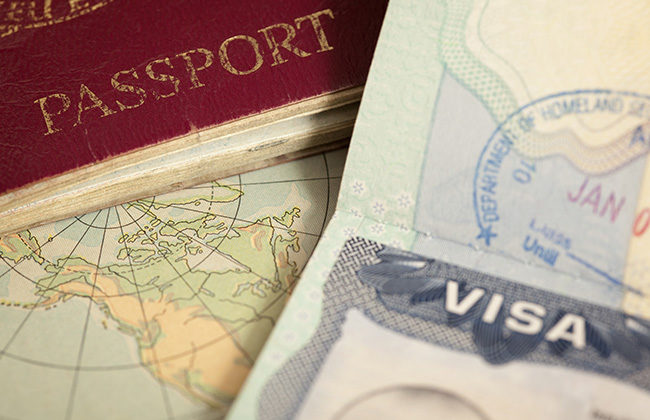
You must carry a passport that will be valid for reentry to the United States. Your passport should be valid for six months beyond your anticipated stay in the United States. Citizens of certain countries are exempt from this six-month rule. The OIA has a list of such countries.
F-1 Students
- a valid Form I-20, signed once an academic year by your advisors in the OIA.. If you are traveling to Canada the signature should not be more than 6 months old.
- a valid F-1 visa stamp in the passport updated proof of funding as listed on the I-20
- proof of registration (unofficial transcript can be obtained on Wed For Students)
NOTE: If you have F-1 Optional Practical Training you must also carry your employment authorization card, referred to as an EAD and a letter of employment (dates should not exceed dates on employment card). If you do not yet have a job or job offer contact the OIA for advice.
J-1 Exchange Visitors
- a valid Form DS-2019 signed for travel by a responsible officer of your Exchange Visitor Program*
- a valid J-1 visa stamp in the passport
- updated proof of funding as listed on the DS-2019
* If the OIA issued your DS-2019, it must be signed on the back by staff from the OIA. If your form was issued by another Exchange Visitor Program (Fulbright, LASPAU, AID) you should contact that organization directly regarding travel signatures.
H-1B and O-1 Visa Holders
- an original I-797 Approval Notice from Department of Homeland Security that is valid for a period beyond the anticipated travel
- a valid H-1B or O-1 visa stamp in the passport
- a letter verifying your current employment. The letter should include your title and salary.
Security Clearances for Some Visa Applicants
The U. S. Department of State (DOS) has stated that the process of issuing visas to some individuals will be delayed due to security clearances. At present, individuals who were born in or are citizens of the following counties should expect delays of at least six to eight weeks before a visa is issued. In some cases the delay may be of an unspecified length of time. Afghanistan, Algeria, Bahrain, Bangladesh, Djibouti, Egypt, Eritrea, Indonesia, Iran, Iraq, Jordan, Kuwait, Lebanon, Libya, Malaysia, Morocco, Oman, Pakistan, Qatar, Saudi Arabia, Somalia, Sudan, Syria, Tunisia, United Arab Emirates, Yemen, and the territories of Gaza and West Bank. This list may continue to be expanded.
Travel to Canada or Mexico
Clark students and scholars should not plan to travel to Canada or Mexico to obtain a visa stamp without first consulting with the OIA. In the past, it was routine for students and scholars to return to the United States from Canada & Mexico (and in some cases from the Caribbean) with an expired visa stamp after a visit of no more than 30 days to one of these adjacent countries. This process is known as “Automatic Visa Revalidation.” The DOS has now ruled that this benefit is no longer available to some foreign nationals, specifically, citizens of Iraq, Iran, Syria, Libya, Sudan, North Korea, and Cuba. In addition, any Third Country National (a person applying at a U.S. consulate/embassy in a country other than his own) who applies for a visa in Canada or Mexico, must have that application approved before returning to the United States. If the applicant is unable to obtain approval of the new visa application (in Canada or Mexico), s/he will not be permitted to reenter the United States. This may necessitate a trip to the individual’s home country directly from either Canada or Mexico to obtain the visa.
Sensitive Fields of Research
For students and scholars conducting research in certain technologically sensitive fields, as listed on the U. S. State Department Technology Alert List (TAL), a security clearance conducted by the U. S. consulate is required before a visa can be issued. Although the U. S. Government states that a clearance is supposed to take approximately 21 days, the turn around time can be indefinite.Visa Delays at U. S. Consulates
Under the current political and immigration climate, we recommend that you not make international travel plans without checking with the Office of Intercultural Affairs (OIA). It is recommended that you only travel outside the United States if you have all documents related to your U. S. immigration status in order. A critical document is the U. S. visa stamp in your passport. It is important to remember that obtaining a new visa stamp is never guaranteed. Now, more than ever, it is possible that you may experience delays at a U. S. embassy or consulate, regardless of your country of citizenship. Please contact the U. S. embassy or consulate at which you plan to obtain the visa ahead of time to confirm its hours of operation, application procedures, and to see if any changes in operations have been implemented. Visit www.travel.state.gov
Embassy and Consulate Closures
For security reasons the Department of State often closes consulates and embassies unexpectedly for indefinite periods of time. If you will be traveling and need to apply for a visa overseas check the website of the appropriate consulate/embassy for updates regarding the availability of visa services. www.travel.state.gov