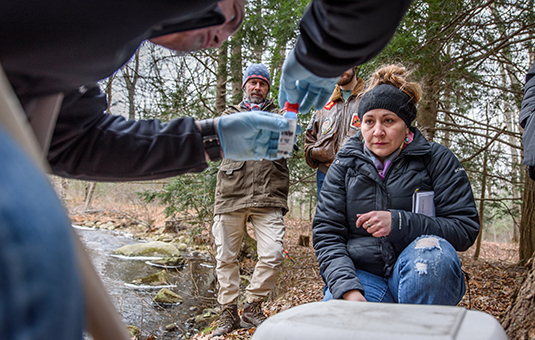

2002 BA/M.A.-ES&P student Emily Shusas takes water samples of Tatnuck Brook
HERO
Project and The Tatnuck Brook Watershed
Students
of GISDE Professor Gil Pontius wade into the water of Tatnuck Brook, scoop up a
water sample, and with a kit provided by Massachusetts Audubon Society, monitor
the water quality. They test for nitrate, pH, phosphorus, dissolved oxygen,
temperature, and in some cases, turbidity.
Back in the Clark computer labs, the students record their field data and
combine it with data from Worcester's Health Department. Through these
activities, students participate in the Human Environment Regional Observatory
(HERO) project, funded by a multi-year grant from the National Science
Foundation.
The
HERO project establishes Clark as a digital data archive for all issues on the
human/environment interface in Central Massachusetts, with an emphasis on
land-use change and global climate change, according to GISDE Coordinator Gil
Pontius. Professor Pontius, along
with Professor Billie Turner, supervises graduate and undergraduate HERO
activity, which includes researchers at the doctoral, master's, and
undergraduate levels.
"HERO
fellows become responsible for the compilation and analysis for all water
quality data for the Worcester area," says Pontius. "We have funding
for six undergraduate HERO Fellows to work every summer and throughout the
academic year. The HERO fellows are working with geographic information systems
(GIS). They all have their own research projects and contribute to the HERO data
archive."
Some
of the Hero Fellows are members of Pontius' class in "Introduction to
Computer and Quantitative Methods." In
this class, Pontius instructs all students on how to collect field data, enter
the data into a digital spreadsheet, perform statistical analysis, interpret the
results, and present the results in written and oral forms. For a final project,
the students analyze water quality data for the entire city of Worcester.
Kisco
Sinvula, who is an IDCE GISDE graduate student on a government fellowship from
Namibia, is working on a master's project in the Tatnuck Brook Watershed that
looks at land use effects on water quality, particularly turbidity caused by
erosion. "The land cover could be forest, agricultural, commercial, housing
or other. Much of data Sinvula is using has been collected by Clark students and
volunteers at the Tatnuck Brook Watershed Association and the Massachusetts
Audubon Society in Worcester." I have attended meetings of these
organizations to find out how I can help them with GIS tools," says Sinvula,
"so we can work together toward a common goal to improve the water quality
of the Tatnuck Brook. My personal goal is to use GIS tools and a global
positioning system to analyze the collected data to see if there is a
significant relationship between land use and water quality.
For example, I hope to develop a velocity model to predict the direction
and speed of water running off of particular slopes."
Sinvula
hopes that his model would indicate not only the direction the water drains but
also the amount and speed of sedimentation carried into the brook that, in turn,
affect its turbidity. Another
possible outcome of his research could be a workbook for use by planners doing
environmental assessments of proposed development in the watershed.
"The
Tatnuck Brook Watershed is a laboratory within walking distance of Clark,"
says Pontius. "My students collect data first-hand by going to sites along
the brook to document the water quality and land use. Their activity is
coordinated with the volunteer water-monitoring program of Mass Audubon Society.
The local watershed project enables students interested in community planning to
get involved as well," continues Pontius, who serves on the Board of
Directors of Tatnuck Brook Watershed Association.
In
fact, two students Leah Penniman and Mia Davis are board members of the Tatnuck
Brook Watershed Association. Penniman, along with other HERO Fellows, is
producing digital maps of the watershed from data collected by Clark students,
local volunteers, and government agencies. Penniman received highest honors for
her undergraduate thesis, "Sedimentation in the Tatnuck Brook
Watershed," which recommend how the local community group could preserve
the water bodies. She examined causes, effects, and remedies. She produced a
digital GIS database that encompasses land use, hydrography, zoning,
development, and other data for the Tatnuck Brook Watershed. She also helped the
Tatnuck Brook Watershed Association design and implement a water quality
monitoring plan that looks at turbidity and visual changes in land use.
"Getting
involved with the local politics in trying to discover what the laws are that
govern the development process was one of the highlights," says Penniman,
and collecting and counting benthic macro invertebrates as bioindicators for the
stream. I even enjoyed attending long Watershed Association meetings where
grandfathers told stories of how the Tatnuck Brook and the watershed were used
when they were boys. In all, the
project was both wonderful and exhausting!"
According
to Pontius, a major problem in the watershed is siltation. Many of the water
bodies in the watershed, such as Coes Pond, are being filled in. "There is
a lot of development in the Tatnuck Watershed," notes Pontius, "and it
affects the siltation. The potential construction at the airport is also an
issue."
Another
undergraduate HERO Fellow, ES&P major Emily Shusas, is looking at
deforestation by private landowners in Central Massachusetts as documented by
their submitted lumbering plan maps. Other HERO Fellows are mapping locations
that are vulnerable to deforestation.