On 63 acres inherited from her father in Pennsylvania, Monica Shields raises goats and sheep and supports community-based education. In central Alabama, David Horsley vows to keep the 800 acres gifted by his parents so his family can continue hunting, fishing, and enjoying it for generations.
Besides a love of nature, these two landowners have something else in common: They are paid by the Family Forest Carbon Program to manage their forests sustainably. Available in 19 states, the program — developed by two nonprofits, the American Forest Foundation and The Nature Conservancy — provides landowners with an annual income stream while also helping them improve forest health.
The Family Forest Carbon Program is one of the many initiatives that rely on a publicly available dataset developed by Geography Professor Christopher Williams and research scientist Natalia Hasler in Williams’ Biogeosciences Research Group, based in Clark’s School of Climate, Environment, and Society.
Used by land managers and policymakers across the world, the National Forest Carbon Monitoring System draws from Williams’ foundational research on the climate impacts of forests. His team applies satellite remote sensing and big-data geo-computation “to quantify the carbon emissions avoided by protecting forests, the removals of carbon with forest growth, and the important climate impacts of changing surface reflectivity (albedo) that happens with changes in tree cover,” he explains.
“The Clark team’s work is informing decision-makers about where we get the greatest climate benefit from retaining and expanding tree cover, worldwide,” says Laura Marx, climate solutions scientist for The Nature Conservancy in Massachusetts. “The dataset has taken complex carbon data and made it understandable and accessible.”
The nonprofit has used the tool as part of climate accounting and land use policy in its partnerships with state agencies across Maine, Massachusetts, and New York, Marx says. For instance, Massachusetts uses the dataset to identify “sites where solar energy provides the biggest benefits for the lowest ecological cost.”
Nationally, Williams’ team is part of a three-year, $1 million Doris Duke Foundation-funded project to reduce greenhouse gas levels by strategically managing forests. Their partners include The Nature Conservancy, Open Space Institute, Trust for Public Land, Land Trust Alliance, and American Forests. Williams also has received funding from the U.S. Climate Alliance, a coalition of states, to work with The Nature Conservancy to map areas where deforestation should be avoided to mitigate climate change.
“We’re able to map the climate benefits of forests,” he says, “but state-of-the-art data and academic rigor are most valuable when we can marry our findings in the lab with the needs of the field.”
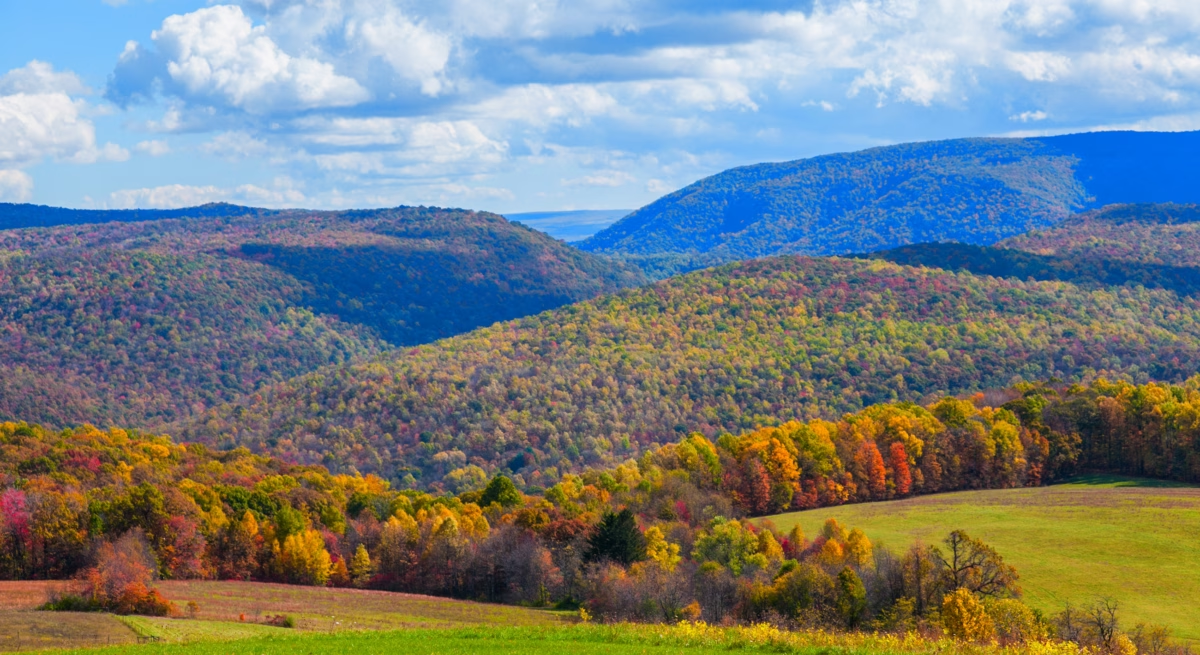
Photo at top: A sweeping forest landscape in western Pennsylvania.