
A Report of Campus Security:
October 1, 2008

This report outlines Clark University's security procedures and policies and is an articulation of the University's commitment to the safety and welfare of its students, faculty and staff. Clark University's approach to campus security is proactive, with University Police working to build a strong and interactive relationship with the students, faculty and staff they are committed to serving. Outlined below are explanations of such vital issues as the qualifications and responsibilities of Clark University Police, the University's emergency telephone network, its crime prevention and security awareness programs, and its policies with regard to the use of drugs or alcohol. Clark University encourages discussion of campus security issues and concerns. Any questions about the following report should be directed to Chief Stephen Goulet at (508) 793-7575.

The Clark University Police Department

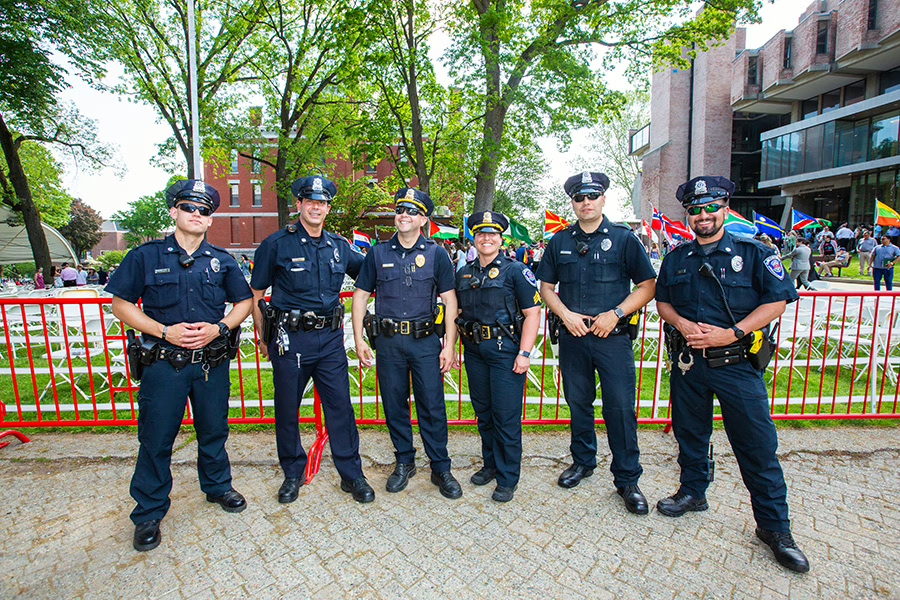
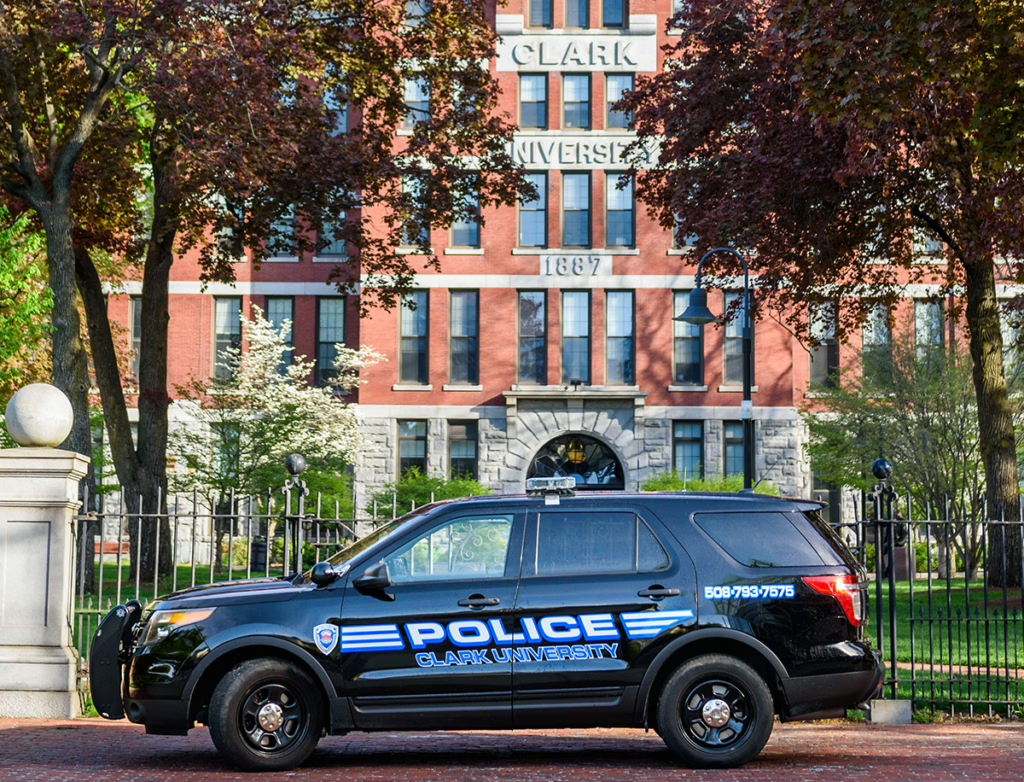
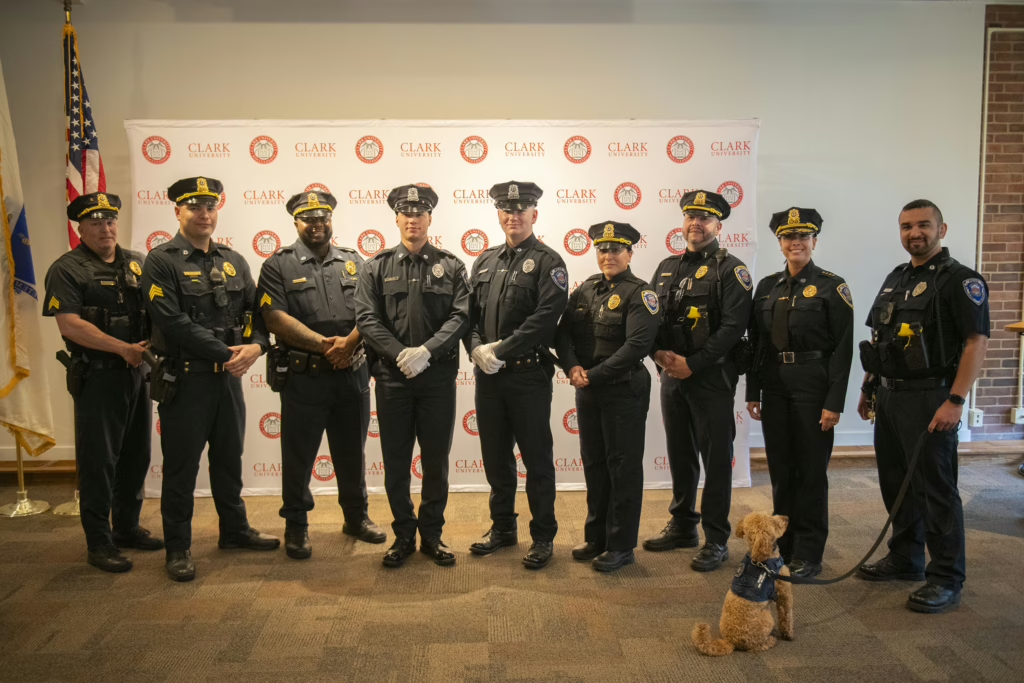
The Clark University Police Department, headed by Chief Stephen Goulet, includes 12 officers who are empowered by the Commonwealth of Massachusetts. As such, Clark University police are authorized within a limited geographic area to perform the same duties as any other police officer. They have the authority to wear firearms and to make arrests.

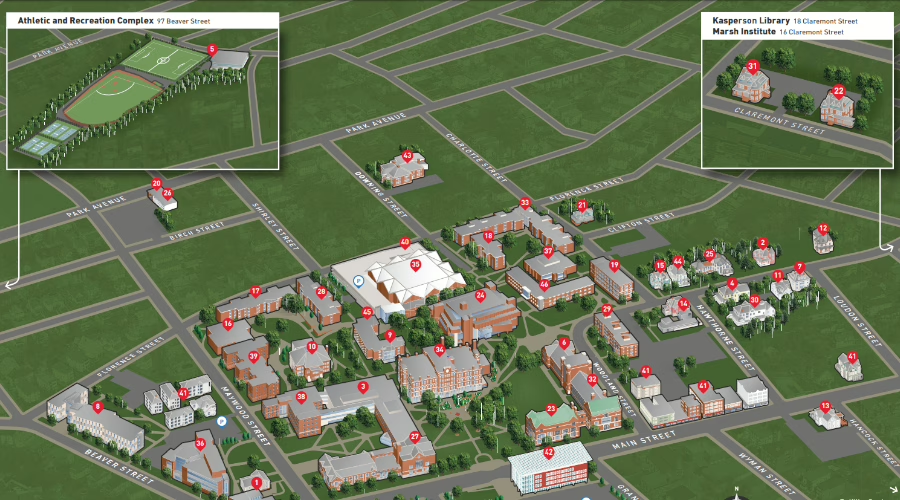
Besides the Clark University campus, Clark officers also patrol the surrounding streets. There, they work in cooperation with the Worcester City Police to protect off-campus students and property. They patrol by foot and by car 24 hours a day, 365 days a year. They are all certified in CPR and other medical emergency techniques. They also are all required by Clark University to undergo special training in such areas as crisis intervention, diversity sensitivity, firearms use, medical emergencies, victim awareness, sexual assault and domestic violence.
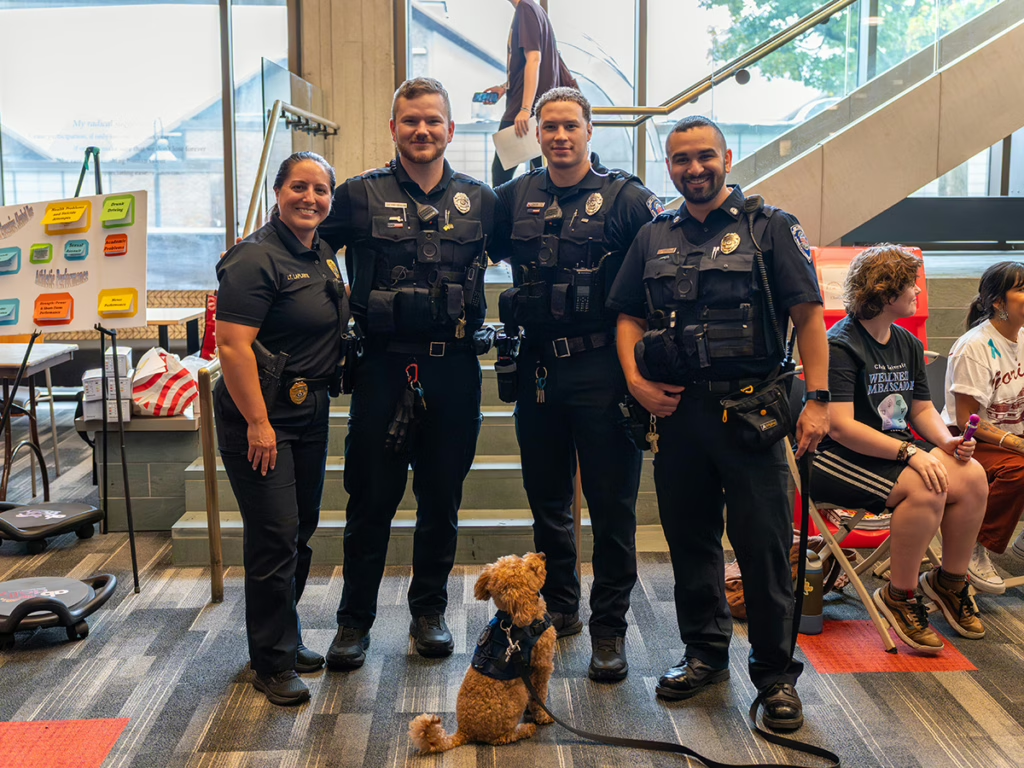
The Clark University Police urge witnesses or victims of a campus crime or emergency to contact University Police immediately at extension 7575. That message is articulated clearly in department publications and at presentations by the University's Crime Prevention Unit during orientation and at periodic residence hall meetings.

Security Services Offered by Clark University

Two student groups work closely with University Police to strengthen security on campus, including the Student Escort Service. This student organization functions to alert University Police to security issues in the University's residence facilities and in its neighborhood. The Escort Service, using two vehicles, provides all members of the Clark community with escort services from 5 p.m. to 4 a.m. during the academic year within a quarter mile of the Clark campus. The Escort Service averages about 120 escorts per night to Clark University students, faculty and staff.

The Emergency Medical Squad also functions during academic sesisons. The squad provides emergency medical response to our community.

Clark students, faculty and staff are encouraged to exercise caution appropriate to contemporary living, including using the Escort Service and avoiding walking alone at night.

Relationship With Other Police Agencies

The Clark University Police Department maintains a close relationship with the Worcester City Police and the Massachusetts State Police. The Worcester City Police often maintain an anticrime team designated for the Main South neighborhood in which Clark University is located. Clark University Police and the Worcester Police share police investigative resources, when requested, on campus and in the Main South neighborhood. Worcester Police are notified of all serious crimes reported to Clark University Police to facilitate crime solving. Clark University and the Worcester Police Department work closely to monitor any criminal activity by student organizations that may occur off campus.

Clark University's Response to Reports of Crimes or Emergencies

Clark University response procedures to reports of crimes or emergencies are designed to provide quick and effective service to Clark students, faculty and staff.

The following are among the key elements of the Clark University response:

Crime Prevention/Outreach Programs

Clark's programs for students begin at orientation and continue throughout the year in a range of sessions sponsored by the residential housing staff, University Police and student groups. All first-year and transfer students are encouraged to attend a session on safety and security, led by a crime prevention team of University Police officers. The sessions cover the kinds of precautions students should take in a city environment, reminders of common sense measures that they should follow regularly, information on sexual assault awareness and an introduction to security services that Clark provides.

University Police, working in conjunction with other campus offices, also offer occasional public promotions designed to increase use of the Escort Service.

University Police, at times, offer the Rape Aggression Defense program (RAD). RAD is a common-sense, hands-on approach to educating students about how to avoid dangerous situations and how to better protect themselves in an emergency.

University Police occasionally offer the "Second Chance" program, an effort to warn students and employees who put themselves in dangerous situations, especially walking alone at night. As part of the program, officers identify and approach people whose behavior has placed them in potentially dangerous situations. The officers identify themselves, hand out fact sheets explaining the dangers of walking alone at night and encourage people to call the Escort Service.

The chief of police maintains close contact with groups concerned about campus security issues. He meets periodically with representatives of the student newspaper and members of other student groups.

Throughout the year, every residence hall has at least one safety and security session each semester on subjects such as assault prevention, sexual assault, substance abuse or emergency procedures. Also important are programs presented by the Dean of Students office to promote awareness of alcohol and drugs as a potential threat to student safety.

Official University publications, including Synergy, the Clark University student handbook, outline University policies regulating undergraduate student conduct. Synergy is distributed to all students, both commuters and residents, and includes information about disciplinary actions that result from violations of University policy. Synergy spells out policies that prohibit the illegal use of alcohol or other drugs, disorderly conduct, harassment of others, hazing or other behavior by which a student might injure himself, herself or another.

Top

Timely Warning Policy

The campus Timely Warning is provided to give students, faculty, and staff timely notification of crimes that present an ongoing threat to the community and to heighten safety awareness. The Timely Warning also seeks information that may lead to the arrest and conviction of the offender.

Clark University Police is responsible for the Timely Warning when a crime is reported to or brought to the attention of the Clark University Police Department and that crime represents an ongoing threat to the safety of members of the campus community.

Information for Timely Warnings also comes from other law enforcement agencies or other offices. Every attempt will be made to distribute the Timely Warning within 12 hours of the times the incidents are reported; however, the release is subject to the availability of accurate facts concerning the incident. Alerts may be distributed on-campus offices, residence halls and libraries, off-campus locations, and through the Internet.

Timely Warning Procedure

The Clark University Police Department will prepare a Timely Warning whenever a report is received of a violent crime against a person or a particularly threatening crime against property that represents an ongoing threat to the safety of students, faculty or staff. Timely Warnings are sequentially numbered, starting January 1 of each year, and provide details of the crime, a description of the suspect(s) if known, information on whom to contact about the investigation and often crime prevention tips.

Timely Warnings will be distributed throughout campus via e-mail, provided to campus media and to the extent possible will include off-campus areas frequented by students.

Whenever the City of Worcester Police Department issues a news release about an off-campus crime that represents an ongoing threat to the safety of students, faculty and staff, the University Police Department will assist in publicizing the information on campus.

Information included in Timely Warnings will be:

  1. A succinct statement of the incident
  2. Possible connection to previous incidents, if applicable
  3. Physical description of suspect(s)
  4. Composite drawing of suspect(s), if available
  5. Date and time the Timely Warning is released
  6. Other relevant and important information

Sex Offender Registry Information

Students, faculty and staff members can obtain information on registered sexual offenders living in the immediate area by contacting the Worcester Police Department. General information about the Commonwealth of Massachusetts Sex Offender Registry Board can be found at www.mass.gov/sorb or by calling (978)740-6400.

You may also write them at:
Commonwealth of Massachusetts Sex Offender Registry Board
PO Box 4547
Salem, MA 01970

Emergency Telephone Network

Clark maintains a network of 61 indoor and outdoor emergency telephones. The emergency telephones have been placed in areas where members of the University community could find themselves isolated or without method of communication, and thus more vulnerable.

Outdoor emergency phones are located in the Maywood and Downing street parking lots, by the Higgins Bistro walkway facing Jonas Clark Hall, on levels of the parking garage, on Woodland Street near Carriage House, on Florence Street, at the athletic fields, outside the Downing Street School building, outside of 87 Florence St., between Goddard Library and Kneller Athletic Center, on the corner of Atwood Hall, outside of 5 Maywood Place, Downing Street between Wright and Dodd Hall, Hawthorne Street entrance to administration lot, Birch Street parking lot at Maywood and Birch streets, and near the 31 Maywood Street parking lot. They are located in yellow-colored boxes. Indoor emergency phones are red and are located throughout campus buildings and in all elevators.

To use the outdoor phone, students, faculty and staff should open the steel door and push the emergency button located inside the box to create an automatic connection to University Police that cannot be disconnected. University Police automatically know which box has been used. A microphone in the box allows University Police to hear anyone using the phone.

To use the indoor phone, students, faculty and staff should simply pick up the receiver, and the call will immediately ring in University Police on an emergency line.

The University Police Department is constantly evaluating the effectiveness of the emergency telephone system and is evaluating possible sites for additional phones.

Maintenance of campus facilities

The Physical Plant Department's staff maintains a landscape design that largely eliminates hiding places for potential intruders. Trees and bushes that interfere with lighting and visibility are routinely cut down or trimmed. The University has installed state-of-the-art high-illumination outdoor lighting that significantly improves visibility on campus. Studies of outside lighting throughout the campus remain ongoing, and new lights are added in areas where lighting is a concern.

A computer card entry security system for all University residence halls keeps them locked 24 hours a day, while still giving Clark students access to campus housing. The card system, programmed through a computer at the University Police office, opens the door for a period of seconds. The door locks again immediately when it closes. An alarm will go off at University Police if one of the outside doors is kept open for a period longer than a reasonable time for entry.

Every year ID cards are activated for all returning and first-year residential students which allows them access to their residence hall. Access is terminated at year's end. Should a card be lost or stolen, the access assigned to the card can be removed. Clark University patrols pay particular attention to checking that residence hall doors have not been propped open.

Top

Policies Regarding Alcohol and Drugs

In accordance with the laws of the Commonwealth of Massachusetts, Clark University has mandated that it is illegal for any student under the age of 21 to purchase, consume or possess alcoholic beverages. Those students who are of legal age may consume alcohol in private residence areas and at functions where approval for alcohol consumption has been obtained. Through Synergy, the student handbook, the University communicates to students, who are legally able to consume alcohol, that it is a violation of state law to serve alcohol to students who are under the legal age, or to purchase or obtain alcohol for them.

The unlawful manufacture, distribution, possession or use of a controlled substance is prohibited in or on any University property. The University is committed to providing a drug-free environment for all members of the Clark community and is in compliance with the Drug-Free Workplace Act of 1988 and the Drug-Free Schools and Communities Act of 1986. Students who violate University policy will be subject to disciplinary action. The University's disciplinary procedures are described in Synergy. Policies for administrative and staff members are outlined in the Employee Handbook for Administration and Staff.

The Dean of Students Office and Wellness Outreach Coordinators offer counseling and other services for those students recovering from or seeking to break dependence to alcohol or drugs The services include alcohol and drug assessment and education sessions, counseling and referrals for students needing more intensive therapy or treatment. Residence hall awareness programs, training for residence advisors in recognizing signs of substance abuse, substance-free housing alternatives and referrals for students needing counseling are offered through the residence halls.

Clark University is committed to promoting and retaining a capable and healthy workforce. The Clark University Employee Assistance Program was created to provide Clark employees and their families with an opportunity to identify potential problems and prevent them from becoming major obstacles in their work and personal lives. The program enables Clark employees and their families to obtain, at no cost, confidential assessment and referral services for problems such as alcoholism or drug abuse.

Policies for Campus Social Events where Alcohol is Served

Social events where alcohol is served are subject to specific regulations. An alcohol beverage permit is required for any function at which alcohol is sold.

University Police must be hired by event organizers to be on duty at on-campus, nonresidential social events where alcohol is served. These social functions are open only to members of the Clark community and their invited guests.

At these events, alcoholic beverages are served under the direction of the University. Alcoholic beverages are available only in a separate area designated for the serving and consumption of alcohol. Only those persons who are of legal drinking age and who have appropriate identification are permitted into this area. A driver's license, liquor purchasing card or passport constitute appropriate identification. Alcoholic beverages may not be removed from the designated area. Regardless of a person's age, alcoholic beverages may not be consumed in public areas as defined by state law. Hosts must serve food and nonalcoholic beverages at all functions at which alcohol is served. Nonalcoholic beverages must be featured as prominently as the alcoholic beverages.

Advertisements for any University event where alcoholic beverages are served must mention the availability of nonalcoholic beverages as prominently as alcohol. Alcohol cannot be used as an inducement to participate in a campus event. Promotional material must not make reference to the amount or price of alcoholic beverages available.

Violation of the University Alcohol Policy may result in disciplinary sanctions. A full description of policies for campus social events is outlined in Synergy, the student handbook.

Top

Definitions of Crimes:

Murder:

The willful killing of one human being by another.


Manslaughter:

The killing of another person through gross negligence, or the willful (nonnegligent) killing of one human being by another.

Sex Offenses:

Forcible:

Carnal knowledge of a person forcibly and/or against that person's will or where that person is incapable of giving consent. It includes sexual assault with object, forcible sodomy and forcible rape.

Forcible Touching:

Touching the private parts of another forcibly or against the person's will.

Nonforcible Sexual Offense:

Incest and statutory rape.

Robbery:

The taking or attempted taking of anything of value under confrontational circumstances from another person by force or threat of force or violence.

Aggravated Assault:

An unlawful attack by one person upon another wherein the offender uses a weapon or displays it in a threatening manner, or the victim suffers obvious severe or aggravated bodily injury involving apparent broken bones, loss of teeth, possible internal injury, severe laceration or loss of consciousness.

Burglary (Breaking And Entering):

The unlawful breaking and entering or attempted entry into a building or other structure with the intent to commit a felony or theft.

Arson:

Any willful or malicious burning or attempt to burn, with or without intent to defraud, a dwelling house, public building, motor vehicle or aircraft, personal property of another, etc.

Motor Vehicle Theft:

The theft or attempted theft of a motor vehicle.

Liquor-Law Violations:

Violations of laws or ordinances prohibiting the manufacture, sale, purchase, transportation, possession or use of alcoholic beverages.

Drug Related Violations:

Violations of laws prohibiting the production, distribution and/or use of certain controlled substances, and the equipment or devices utilized in their preparation or use.

Weapons Possession:

Violations of laws or ordinances prohibiting the manufacture, sale, purchase, transportation, possession, concealment or use of firearms, cutting instruments, explosives, incendiary devices or other deadly weapons.

Hate Crimes:

Those crimes based on prejudice towards race, religion, sexual orientation, ethnicity, gender or handicap.

Important Telephone Numbers:

Dean of Students - 508-793-7423
Escort Service - 508-793-7777
Health Services - 508-793-7467
Rape Crisis Center - 508-799-5700
University Police - 508-793-7575

It is the policy of Clark University that each qualified individual, regardless of race, color, sex, sexual orientation, religion, national origin, age as defined by law or handicap, shall have equal opportunity in education, employment or services of Clark University. The University encourages minorities, women, veterans, handicapped individuals and persons over 40 to apply.

Top

Statistics at Clark University

Category Venue 2005 2006 2007
Murder and non-negligent manslaughter On Campus 0 0 0
In dormitories or other residential facilities 0 0 0
In or on a noncampus building or property 0 0 0
On public property 0 0 0
Manslaughter (negligent) On Campus 0 0 0
In dormitories or other residential facilities 0 0 0
In or on a noncampus building or property 0 0 0
On public property 0 0 0

Category Venue 2005 2006 2007

Sex Offenses

Forcible On Campus 0 1 2
In dormitories or other residential facilities 0 1 2
In or on a noncampus building or property 0 0 0
On public property 0 0 0
Forcible Touching On Campus 0 0 0
In dormitories or other residential facilities 0 0 0
In or on a noncampus building or property 0 0 0
On public property 0 0 0
Nonforcible Sexual Offense On Campus 0 0 0
In dormitories or other residential facilities 0 0 0
In or on a noncampus building or property 0 0 0
On public property 0 0 0

Category Venue 2005 2006 2007
Robbery On Campus 5 1 3
In dormitories or other residential facilities 0 0 0
In or on a noncampus building or property 0 0 0
On public property 3 4 2
Aggravated Assault On Campus 5 2 4
In dormitories or other residential facilities 2 2 1
In or on a noncampus building or property 0 0 0
On public property 1 0 2
Burglary On Campus 14 27 21
In dormitories or other residential facilities 9 14 13
In or on a noncampus building or property 0 0 0
On public property 0 0 0
Arson On Campus 0 0 0
In dormitories or other residential facilities 0 0 0
In or on a noncampus building or property 0 0 0
On public property 0 0 0
Motor Vehicle Theft On Campus 2 0 0
In dormitories or other residential facilities 0 0 0
In or on a noncampus building or property 0 0 0
On public property 8 2 6

Category Venue 2005 2006 2007

Arrests/Referrals for Disciplinary Action

Liquor Law Violations On Campus 135# 310** 195**
In dormitories or other residential facilities 119 310 195
In or on a noncampus building or property 0 0 0
On public property 0 1 1
Drug-related Violations On Campus 51## 72## 68
In dormitories or other residential facilities 46 72 68
In or on a noncampus building or property 0 0 0
On public property 0 1 0
Weapons Possession On Campus 0 0 0
In dormitories or other residential facilities 0 0 0
In or on a noncampus building or property 0 0 0
On public property 0 0 1
* Figure includes one arrest made on campus.
** Arrest made on public property.
# Includes one arrest.
## Includes two arrests.

Top