IDCE HOME International Development, Community, and Environment. Meaningful problem solving for a sustainable future.
Clark University Logo  
Clark University
Clark University
Clark University Clark University
Student-Faculty Research
Clark University

IDSC Student-Faculty Research
CDP Student-Faculty Research
ES&P Student-Faculty Research
GISDE Student-Faculty Research
Clark University IDCE Home > Research > Student-Faculty Research > ES&P Student-Faculty Research

ES&P Student-Faculty Research

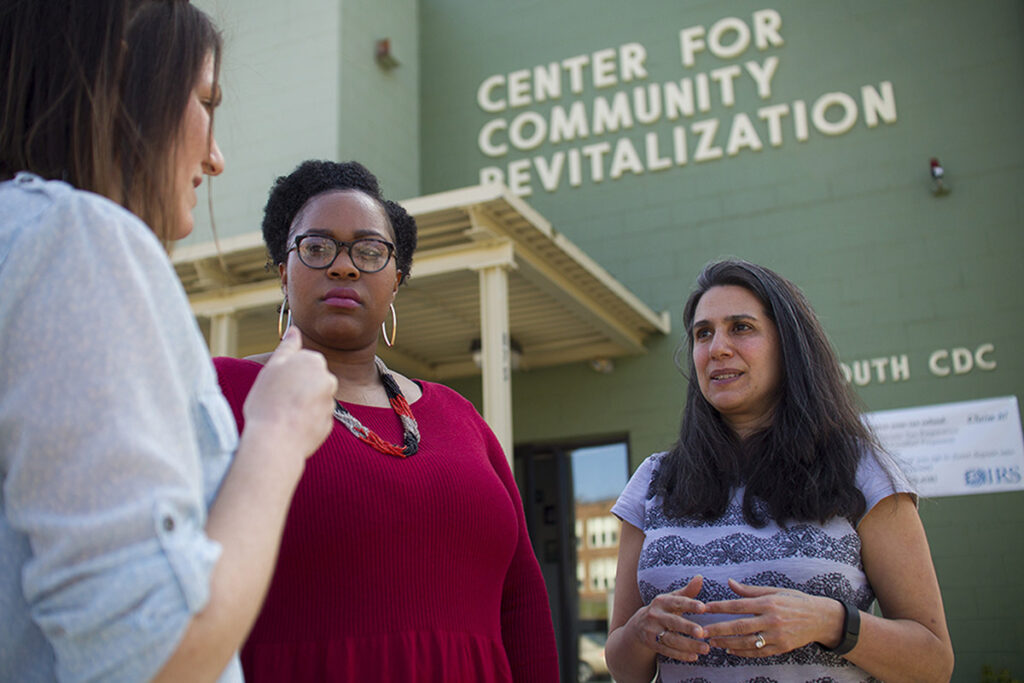
Danielle Adams (ES&P/MA ’08) and Camila Calvache (ES&P/MA ’08) worked as research assistants for the Neighborhood STRENGTH Environmental Justice Project, a project which is a partnership of four local organizations. Adams and Calvache have worked with the citizens action group Toxics Watch to help residents in Worcester’s Main South and Piedmont neighborhoods test their homes for indoor pollutants. Although in the final year of the Neighborhood STRENGTH Environmental Justice Project, the collaboration hopes to be able to continue sampling residents’ homes through a sustainable continuation of the project.

Gabriel Rand (ES&P/MA ‘09) is working on media content analysis of energy technologies research with Jennie Stephens.

Asha Singh (ES&P/MA ’09) is working with Robert Goble to develop a research proposal on uncertainty-risk analysis.

Suela John (ES&P/BA ‘10) is working as a research assistant on the Environmental Justice grant project with Tim Downs. The internship is focused on indoor environmental sampling, using indoor environmental testing to learn more about the communities at risk in the Main South and Piedmont neighborhoods.

ES&P Students Inventory Greenhouse Gas Emissions

At the invitation of Worcester Mayor Timothy P. Murray and Worcester City Council, Carissa Williams (ES&P/BA/MA '04) and Hannah Muller (ES&P/Biology/BA '04), worked with Halina Brown, to create the first comprehensive inventory of major sources of greenhouse gas emissions in Worcester. The inventory included all vehicles, residential and commercial heating, cooling, electricity, and municipal operations, as well as incineration of the city's solid waste. The purpose of this inventory was to help develop a strategy on how Worcester can reduce greenhouse gas emissions.

Students in the Field

Hanna Muller and Carissa Williams were featured by the local daily newspaper in an article titled "Worcester aims to reduce global warming emissions."

The students began the effort when Mayor Murray announced in Fall 2003 that Worcester joined the Cities for Climate Protection Campaign (CCP). CCP provides support and tools to help local governments reduce global warming emissions locally, thus mitigating climate change effects and reducing air pollution. When approached by Williams and Muller with the proposal to create the inventory, Mayor Murray not only agreed but also asked the students to become his personal advisors on this project.

The mayor was instrumental in motivating city employees to cooperate with Williams and Muller throughout the process of gathering data. Their data was obtained from utility companies, the city treasurer, the city assessor, the purchasing department, the Massachusetts Highway Department, and others.

The student's findings were highlighted on the front page of the Worcester Telegram & Gazette (April 11, 2004). Their research indicated local energy use, trends, and expected emissions from each source using conversion formulas. The students discovered that energy use in Worcester contributes emissions equivalent to about 2.1million tons of carbon dioxide each year, with each person responsible for about 12 tons of greenhouse gas emissions annually. Williams and Muller also made detailed recommendations for Worcester on how to reduce its greenhouse gas emissions in the near future, as part of the Cities for Climate Protection Campaign.

ES&P Student-Faculty Research Projects

The collaborative research projects of ES&P graduate students and faculty reflect their interdisciplinary approach to issues of environment and development. Many projects build upon partnerships between IDCE and community or governmental organizations. The following are some examples:

Professors in Action

Tim Downs is a specialist in environmental science and engineering.

Climate Change Impacts on Health in East Africa

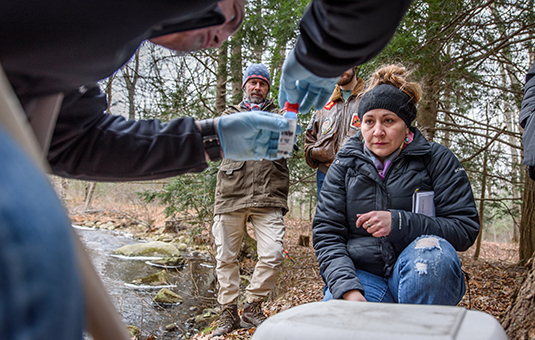
ES&P Professor Tim Downs has a technical advisory role on a project examining climate change impacts on malaria and cholera risk for marginalized communities of the Lake Victoria Region, East Africa, in collaboration with universities in Tanzania, Kenya and Uganda. Michael Marshall (ES&P/MA '04) received a Fulbright Fellowship for his proposed study to work on this project. He is using current climate change models, a Geographic Information System (GIS), and time series data to examine the relationship between precipitation and temperature change with incidences of malaria and cholera in Lake Victoria communities of Uganda. Marshall hopes that a model developed from analysis of these diseases and their sensitivity to climate variables will predict those communities at highest risk from exposure to malaria and cholera agents under different climate change scenarios.

Vulnerability to Mercury Exposure

Stella Capoccia (ES&P/MA '04) and Alex Dichter (ES&P/MA '04) worked with ES&P Professors Sam Ratick and Rob Goble and Dale Hattis at the Marsh Institute on a project supported by the Environmental Protection Agency to explore the differences in vulnerability for harm from mercury exposures. They looked at vulnerabilities caused by a lack of a capacity of coping with the exposure, in particular sensitivity due to health or age factors, and environmental exposure. Their final technical report was recently submitted to the EPA; the EPA may use the study to help develop policies to control mercury emissions at power plants, for example by requiring the use of lower mercury content fuels.

Environmental Impacts Assessment in Latin America

IDCE graduate students have worked with Tim Downs on different fieldwork projects in Latin America during the summer. Saulo Araujo (IDSC/MA '04) assessed the successes and failures of watershed management approaches, with emphasis on community participation and capacity-building needs. Alex Chen-Chiquin (ES&P/MA '04) explored the options for integrated solid waste management in his native town of Cobán, Guatemala.

Technological Innovations in Sustainable Personal Mobility

ES&P Professor Halina Brown is investigating with students new approaches to personal transportation that have lesser environmental impact than the modern automobile. Cassie Buckley (ES&P/MA '03) completed two case studies of three-wheeled electrically powered vehicles, focusing on their social acceptance and their impact on how individuals think about satisfying their need of mobility. Jamie Salo (ES&P/BA/MA '03), now pursuing a Ph.D. at Oxford University, studied the issues of developing a suitable infrastructure for cars powered by hydrogen-based fuel cells. Undergraduate Ben Rubinger (ES&P/MA '04) studied the history of the modern automobile, its impact on the society, and its likely future.

Community-based Hazard Management

The Marsh Institute's Community-based Hazard Management Project, headed by Rob Goble, has attracted IDCE students interested in strengthening community capabilities to address and manage environmental health hazards. A major goal is enhancing community knowledge of environmental health issues.

Clark University