IDCE HOME International Development, Community, and Environment. Meaningful problem solving for a sustainable future.
Clark University Logo  
Clark University
Clark University
Clark University Clark University
Important Links
Clark University
Recent News Highlights
Recent News Apply Now
Clark University
Upcoming Events
Clark University
No events scheduled
Clark University IDCE Home > Students and Alumni > Alumni Sean Griffin

jeremy_casterson1

This is the great part of working for BLM. I'm overlooking Vermillion Basin, a hotspot in the conflict between wilderness and oil and gas development.

Jeremy Casterson
IDSC/M.A. '03

1. Please describe your present professional position? Please include the URL of your organization.

I received the Presidential Management Fellowship (PMF) in 2003 and got a job as a Planning and Environmental Coordinator with the Bureau of Land Management (BLM) in Craig, Colorado. My major job duty is Project Manager for the Resource Management Plan (RMP) revision process, which is a 4-year, $2 million project. The RMP is an over-arching land use plan that guides the BLM's management of 1.3 million acres in northwest Colorado. This particular plan is forging new ground for the BLM in the areas of community participation and adaptive management. An independent community stewardship group called The Northwest Colorado Stewardship (NWCOS) is assisting the BLM in developing this plan by creating consensus recommendations for the BLM. NWCOS is made up of a many diverse interests, including ranchers, oil and gas companies, conservation organizations, as well as teachers and other interested public. To learn more about the Resource Management Plan, visit www.co.blm.gov/lsra/rmp. To learn more about NWCOS and the collaborative process, see www.nwcos.org.

2. What do you find satisfying about your position?

I like many aspects of my job. I like being able to live in a rural community in the western US. My job is extremely challenging and I'm lucky enough to work on a variety of different issues every day. The most challenging aspect has been managing the collaborative process with so many divergent views of public lands. I'm learning a lot about contentious natural resource issues in the west, ecology and range science, conflict mediation and of course, local and national politics. The best thing about my job is the folks I work with and the great organizational culture of the BLM, which makes going to work every morning a little easier.

3. How did the IDCE program at Clark University help to prepare you?

Working in rural Colorado isn’t exactly international development. My boss said my cross-cultural experience would help me out here in the bush, but since I was raised in Salmon, Idaho, this culture is nothing new to me. However, you might be surprised how often I utilize skills and knowledge that I gained through my graduate education. A few more obvious subjects that come to mind first are community participation and conflict mediation. Additionally, the IDCE program taught me to write. Believe me, I thought I could write when I entered the program. I was mistaken. After only one "Development Theory" course, my writing skills increased dramatically. I use these writing skills everyday at work. IDCE also taught me to think critically and look at issues from different perspectives, which has definitely helped me understand the needs of the different interest groups I work with. I believe any graduate course, regardless of the focus, provides you with analytical, leadership, communication, and writing skills needed to be successful in your professional life.

4. Why should prospective students enroll in the IDCE program at Clark University?

I would strongly encourage prospective students to choose IDCE because of the quality professors as well as the students in the program. Without taking anything away from the top-notch professors in the Clark IDCE program, I actually learned the most about international development from my peers. When the vast majority of IDCE graduate students have lived overseas in a developing country, the discussions in and outside of the classroom were quite eye-opening. With a heavy dose of international students and plenty RPCVs, there were many perspectives that broadened my understanding of the issues surrounding international development. Additionally, although I entered the IDCE program with a good understanding of what goes on on the ground in Africa, I had little idea of the forces that work overhead and how these larger discourses affect developing countries. Finally, the Clark IDCE program has great connections that will help you land a job. The IDCE program can plug you into programs such as the PMF program that often go under the radar at other schools.

5. Did you have an internship as part of your Clark education? If so, how did it help to connect you to your current career?

I had several opportunities at Clark. I received an internship with the United Nations Environmental Programme (UNEP) at the UN Office in Nairobi. I volunteered with the Global Environmental Outlook team there for 3 months. I also received the Fulbright Scholarship while attending Clark University. I stayed in Kenya after the UNEP internship for another year to do my graduate research. I have no doubt that the one-on-one guidance at Clark University helped me obtain both the UNEP internship and the Fulbright.

6. What was the topic of your research while at Clark University?

I studied an agroforestry system being utilized by the Kenyan government called Non-Resident Cultivation (NRC), or the "shamba system." In this system, the national Forest Service would lease ¼-acre parcels in the gazetted forest to peasant farmers. The Forest Service required that the non-resident cultivators plant tree seedlings and tend to these seedlings until they are established. In return for their labor, the cultivators are allowed to plant cash crops between the trees. The income generated from these small forest plots can be quite substantial to peasant farmers. For my publishable paper, I assessed the system and made recommendations to make it more equitable for the farmers and more efficient for the Forest Service.

jeremy_casterson2

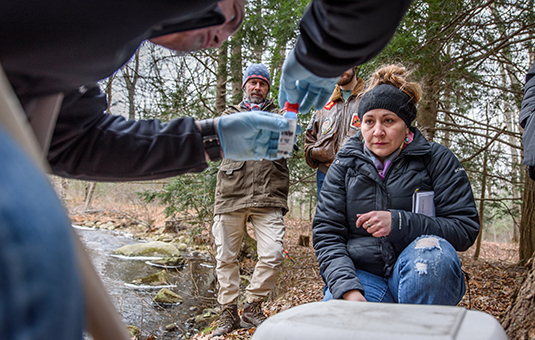
Members of the Northwest Colorado Stewardship meet in the field to discuss sagebrush habitat.

Clark University