
Jennie Stephens: Facing the Challenge of Global Climate Change

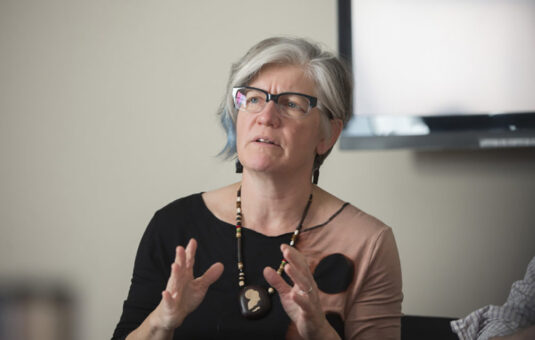
Of all the challenges facing the sustainability of the Earth’s environment, IDCE Environmental Science and Policy Professor Jennie Stephens says climate change is the greatest of them all.


“It’s so complex -- it includes all other environmental issues within it: biodiversity, water, land use, pollutants, etc.,” said Stephens. “Uncertainty is a big part of it, too. It’s known for sure that human activity has changed the atmospheric composition, but it’s not known for sure how that change is going to impact things.”


Stephens, who joined the IDCE faculty as an assistant professor in Fall 2005, traces her interest in the environment to her high school years, when she became intrigued by water issues after reading a theory that the next world war would be over water resources.


Stephens wasn’t just interested in the science of water or studying the environment, though.
 

“I’ve always liked science, but more than just science I’ve always been interested in, concerned about, and wanted to work in the field of the environment,” Stephens said. “Also from the beginning I’ve been interested in an interdisciplinary way of thinking about the environment that is not just the science and not just the policy.”
 

That interdisciplinary approach made IDCE, particularly the Environmental Science and Policy program “a good fit,” Stephens said, as it is a place where she can continue to pursue her research interests and goals of government policy change as well as fulfill her desire to continue teaching without being pigeonholed into a more traditional science department, such as chemistry or geology.
 

“There aren’t very many academic departments like IDCE that value a truly interdisciplinary approach in both teaching and research. In that sense, IDCE is really unique,” Stephens said.

A new dimension


Stephens’ course offerings, such as “Biogeochemical Cycles and Global Change” and “Climate Change, Energy and Development” add a new dimension and perspective to IDCE’s environmental faculty and program. She also will have an impact on Clark’s environmental science and policy undergraduate major. “With the increasing relevancy of environmental concerns there is great potential to increase interest in the interdisciplinary undergraduate degree focusing on the environment,” she said.


Prior to coming to IDCE, Stephens worked with Dr. John P. Holdren, director of the Science, Technology, and Public Policy Program at the Kennedy School of Government at Harvard and also taught at MIT, Tufts and Boston University. As a member of Harvard’s Energy Technology Innovation Project she researched methods of carbon capture and storage as a means to control greenhouse gasses and reduce the threats of climate change. Carbon capture and storage (CCS) is a set of technologies that can trap and capture carbon dioxide emissions from fossil fuels during combustion for underground storage. Interest in this set of technologies is growing rapidly as the awareness of the negative impacts of climate change due to increasing carbon dioxide in the atmosphere also grows.


“CCS technologies have the potential to help stabilize the atmospheric concentrations of CO2,” Stephens said. More broadly, Stephens is interested in how policy can direct and support the major changes to our energy technology infrastructure that are needed to reduce the threats of climate change.

The big picture


Stephens made the transition from an interest in water resource issues to managing carbon dioxide during her doctoral studies at the California Institute of Technology, when she found herself in a research group studying the impacts of the leakage of CO2 from a naturally-occurring underground reservoir in the Mammoth Mountain volcanic area. This work led her to the idea of storing CO2 underground. As she learned more about the environmental challenges facing the world and read more about climate change, its potential impacts, and how it relates to society’s increasing use of fossil fuels, she knew she had found a calling.

 
“The climate change issue has a lot of complicated science and hard policy questions with lots of potential and lots of challenges, perhaps more so than water issues,” Stephens said. “I’ve always been interested in areas with big-picture implications.”


“The longer we go without reducing CO2 emissions, the bigger the problem is,” Stephens said. “Even with increased conservation, increased efficiency, and increased use of renewable energy technologies with growing demand for energy, we won’t be able to stabilize the atmosphere without advanced technologies, including CCS.”


Though Stephens doesn’t advocate specifically for CCS – she wants to see more support for research, development, and deployment of all CO2 reduction technologies – she feels strongly that the climate change problem is of such a magnitude that more attention should be paid to all potential avenues to address it by both the scientific world and the governmental world.


Stephens sees her place in facing the global climate change challenge and in the future of environmental science and policy-making as multi-faceted: as an educator, an advocate, and as a scientist.


“I want to begin a new initiative exploring how public perception of energy technologies influences public policies and then I can combine my research with an education and public outreach effort,” Stephens said. “My focus on how to advance technological change to reduce CO2 is one way I can contribute to confronting the climate change challenge.”