Concentration In Depth

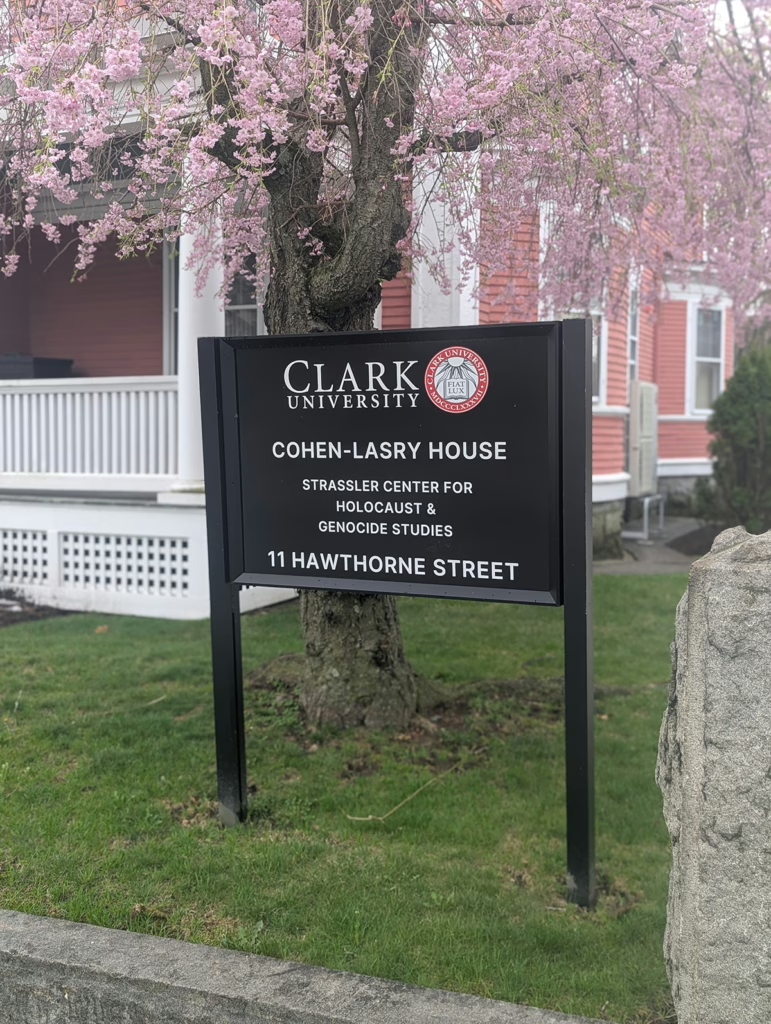
Clark University is the only college in all of the Americas and Europe to provide a broad, interdisciplinary education in Holocaust and Genocide Studies. Dr. Shelly Tenenbaum, Professor of Sociology and a participating faculty member of the Strassler Family Center for Holocaust and Genocide Studies, directs the Undergraduate Concentration in Holocaust and Genocide Studies. Under her leadership, a thoughtful and intellectually exacting undergraduate program was organized and developed. With participating faculty from Sociology (Profs. Eric Gordy and Shelly Tenenbaum), History (Profs. Debórah Dwork, Thomas Keuhne, and Simon Payaslian), Government and International Relations (Profs. Valerie Sperling and Kristen Williams), Jewish Studies (Prof. Everett Fox), Psychology (Prof. Jaan Valsiner), and Foreign Languages and Literature (Prof. Walter Schatzberg), the undergraduate concentration is an inspiring, interdisciplinary program.

The Holocaust and Genocide Studies program offers a variety courses taught by Clark faculty and visiting scholars. Some of the courses taught on regular basis by Clark faculty include, for example, “Comparative Genocide” (Prof. Tenenbaum), “Holocaust: Agency and Action” (Prof. Dwork), “Suffering and Evil in Jewish Tradition” (Prof. Fox), “Europe in the Age of Extremes: the 20th Century” (Prof. Kuehne), “The Armenian Genocide” (Prof. Payaslian), “Mass Murder and Genocide under Communism” (Prof. Sperling), “Social and Cultural Psychology of Genocides” (Prof. Valsiner), “Jews and Christians in the Ancient World” (Prof. Paul Burke), “The United Nations and International Law” (Prof. Srinivasan Sitaraman) and "Human Rights and Transitional Justice" (Prof. Eric Gordy).

The Holocaust and Genocide Studies program at Clark has invited prominent scholars to teach various courses. Professor Yehuda Bauer, preeminent scholar of the Holocaust and Senior Academic Advisor at Yad Vashem—The Holocaust Remembrance Authority in Jerusalem—was the Strassler Distinguished Visiting Professor in the fall term of 2000. Dr. Bauer taught two undergraduate courses, worked with graduate students, and offered a three-part lecture series during his semester at Clark. Professor Bauer returned to the Center in the fall 2004 semester as Robert Weil Distinguished Visiting Professor and taught the undergraduate course “The Holocaust in Historical Perspective: History of the Holocaust in a Genocide Context” and a graduate seminar on “The Holocaust in Eastern Europe: New Perspectives.” In the fall term of 2002, Professor Lawrence Langer, renowned expert on Holocaust literature and art, visited us as our Strassler Distinguished Visiting Professor and taught a course titled "Voices from the Holocaust: Testimony, Literature, Art." Professor Barbara Harff, professor of political science at the US Naval Academy, was the Strassler Distinguished Visiting Professor in the fall 2003 semester. Professor Harff taught two courses while at Clark: an undergraduate lecture/discussion course, “Genocide in the Twentieth Century: Cases, Causes, and Prevention,” and a graduate seminar, “Genocide in the Twentieth Century: Explanation and Prevention.” Professor Robert Jan van Pelt of the School of Architecture at the University of Waterloo and the leading expert on Auschwitz served as the Center's first Distinguished Visiting Professor in 1997. The Center was pleased to welcome him back as a Distinguished Visiting Professor in spring 2004. Professor Van Pelt taught two courses during his semester at Clark: a seminar on “The Perpetrators,” and a lecture course on “Germany in the Modern Age.” In spring 2003, Professor Robert Melson, professor of political science and former acting director of the Jewish Studies Program at Purdue University, spent a week on campus as Distinguished Visiting Scholar guest lecturing in undergraduate courses and meeting individually with graduate students. He has  returned to the Center as the Robert Weil Distinguished Visiting Professor to teach an undergraduate/graduate seminar on "Holocaust and Genocide in Comparative Perspective" each year until fall 2008.

The Strassler Family Center for Holocaust and Genocide Studies and the undergraduate program in Holocaust and Genocide Studies are committed to educational opportunities for our students during the summer break and beyond the boundaries of Clark University. Professor Tenenbaum and the steering committee implemented a summer internship program for undergraduate students. Generously supported by endowed gifts, these internships are awarded to competitively selected undergraduate students. The interns have worked at the Museum of Jewish Heritage: A Living Memorial to the Holocaust, in New York City; the Fortunoff Video Archive for Holocaust Testimonies at Yale University; and Facing History and Ourselves in Brookline, Massachusetts.  Summer Internship Update.

Beginning in the summer of 2000, we have been delighted to offer a special educational opportunity to study in Terezín, the Czech Republic. Foreign Languages and Literature Professor Tatyana Macaulay and Jewish Studies Professor Everett Fox took the lead in creating a course on "Prague and Theresienstadt: The European Past, the Holocaust, and Today's Research." We are indeed particularly fortunate that they were willing to do so, for while the Theresienstadt Memorial has run educational programs for European and Israeli students for some time, the directorate had repeatedly rejected requests by other American institutions of higher education. It was due entirely to Professor Tatyana Macaulay's long and close association with the Memorial that the directors accepted the proposal for a cooperative program with Clark University. This course was a unique opportunity to introduce Clark undergraduate students to the history of the Holocaust through a physical encounter with a central site of the Nazi web, and to the history of Jewish life within the extraordinarily constricted confines of the German regime. Studying at that site, students learned how an ordinary town was transformed into a transit camp and a prison, and also how the incarcerated Jews created a vibrant community in the shadow of deportation to a death camp. Theresienstadt was not an annihilation center. It had a special role in the history of the Holocaust, and it is precisely because of that role that this site is an appropriate place for undergraduate education. It is a connecting point of three central strands: the history of German occupation, the history of the destruction of European Jewry, and the history of Jewish life during the Holocaust years. Theresienstadt thus offered our students an extraordinary entry into the history of many groups of people involved in the Holocaust: the occupied citizens, the German authorities, the Jewish inmates, and the neutral nations and international welfare organizations. The success of the Terezin program prompted us to expand to include trips to Berlin and Buchenwald.
 

Phone: (508) 793-8897     E-mail: chgs@clarku.edu