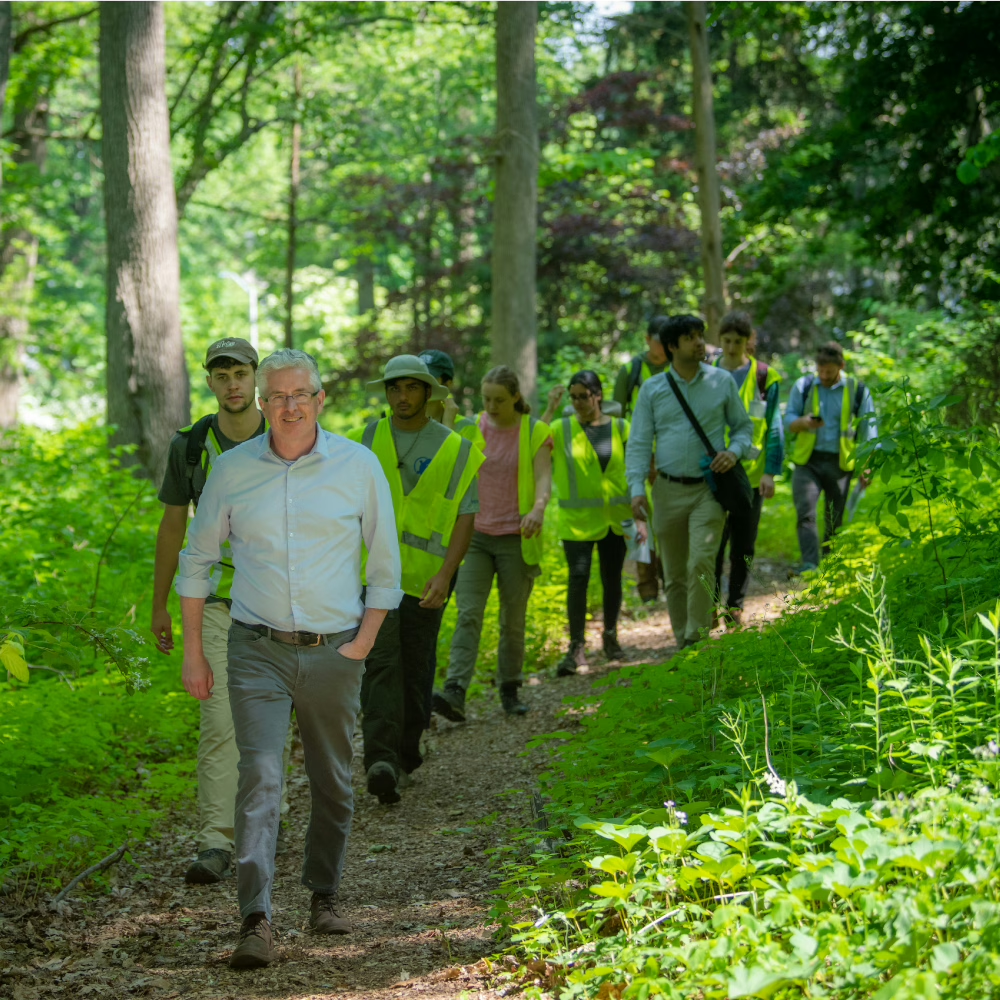

HERO Program Accomplishments:
The HERO Program, 1999 to summer 2006

The majors have included: Art History(1), Biology(3), Business Management(1), Economics(2), Environmental Science & Policy(9), Geography(22), Global Environmental Studies(4), History(1), International Development(2), Mathematics(3), Psychology(1), and Studio Arts(1). Ten HERO fellows have been double majors.

HERO fellows have made 36 presentations at professional science meetings. These meetings have included: Association of American Geographers (AAG) 2002 - 2006, New England Saint Lawrence Valley Division of AAG (NESTVAL) 2005, GIScience, Harvard Forest Symposium, Human Dimensions of Global Environmental Change, Marine Biological Laboratory Scientists Meeting, Spatial Accuracy Assessment in Natural Resources and Environmental Science, The International Environmetrics Society. In addition, we have presented to local community groups including: Massachusetts Audubon Society, City of Worcester Brownfields Symposium, and the Clark University Climate Change Symposium.

10 different HERO fellows have won awards from organizations beyond Clark. This list does not include awards presented by Clark, such as the Vouras award, which 3 different HERO fellows have won. Names of external awards include:

11 fellows have written a senior honor's thesis in conjunction with their HERO experience. These include 7 at the level of High Honors and 3 at the level of Highest Honors.

23 HERO fellows have entered graduate school. So far, 3 former HERO fellows have entered Doctoral programs. Schools include: Boston College, Boston University, Clark University, Massachusetts Institute of Technology, Pennsylvania State University, San Diego State University, Tulane University, University of California / Santa Barbara, University of British Columbia, University of Delaware, and Yale University.

17 different fellows have been co-authors on publications. The HERO program has produced 10 publications in peer-reviewed journals, 6 publications as conference proceedings, and one high-profile newspaper story. HERO has another 5 papers in review as journal papers or book chapters.
 

Publications include the following:

Peer-reviewed Journal Articles

  1. Polsky, C., J. Rogan, R.G. Pontius, and B.L. Turner II. “Research on, and with, GIS: The Massachusetts Human-Environment Regional Observatory (HERO) Program.” 2007 Council on Undergraduate Research.
     
  2. Polsky, C., R. Neff, and B. Yarnal. 2007. “Building Comparable Global Change Vulnerability Assessments: the Core Vulnerability Dataset.” Global Environmental Change.
     
  3. Jones, T.G., J. Rogan, C. Polsky and M. Song. In Press. A Quantitative Comparison of Pixel- and Object-based Classification in Metro-west Massachusetts, USA. The Massachusetts Forest Monitoring Project. International Journal of Remote Sensing.
     
  4. Pontius Jr, Robert Gilmore, Anna J Versluis and Nicholas R Malizia. 2006. Visualizing certainty of extrapolations from models of land change. Landscape Ecology in press.
     
  5. Pontius Jr, Robert Gilmore and Christopher Lippitt. 2006. Can error explain map differences over time? Cartography and Geographic Information Science in press.
     
  6. Pontius Jr, Robert Gilmore and Jeffrey Malanson. 2005. Comparison of the structure and accuracy of two land change models. International Journal of Geographical Information Science 19(2) p.243-265.
     
  7. Pontius Jr, Robert Gilmore, Diana Huffaker and Kevin Denman. 2004. Useful techniques of validation for spatially explicit land-change models. Ecological Modelling 179(4) p.445-461.
     
  8. Pontius Jr, Robert Gilmore and Nicholas R Malizia. 2004. Effect of category aggregation on map comparison. Lecture Notes in Computer Science 3234 p.251-268. in M J Egenhofer, C Freksa, and H J Miller (eds): GIScience2004.
     
  9. Pontius Jr, Robert Gilmore, Emily Shusas and Menzie McEachern. 2004. Detecting important categorical land changes while accounting for persistence. Agriculture, Ecosystems & Environment 101(2-3) p.251-268.
     
  10. Pontius Jr, Robert Gilmore, Aditya Agrawal and Diana Huffaker. 2003. Estimating the uncertainty of land-cover extrapolations while constructing a raster map from tabular data. Journal of Geographical Systems 5(3) p.253-273.
     
  11. Holden, Matthew, Christopher Lippitt, Robert Gilmore Pontius Jr and Carissa Williams. 2003. Building a database of historic land cover to detect landscape change. Biological Bulletin 205 p.257-258.
     
  12. Huffaker, Diana and Robert Gilmore Pontius Jr. 2002. Reconstruction of Historical Land Cover in the Ipswich Watershed. Biological Bulletin 203 p.253-254.
     
  13. Sorrensen, C., C. Polsky, and R. Neff, 2006. “The Human-Environment Regional Observatory (HERO) Project: Undergraduate Research Findings from Four Study Sites.” Geographical Bulletin (forthcoming).
     
  14. Hill, T. and C. Polsky, 2006. “Adaptation to Drought in the Context of Suburban Sprawl and Abundant Rainfall.” Geographical Bulletin (forthcoming).
     
  15. Hill, T. and C. Polsky. “Development and drought in suburbia: A mixed methods rapid assessment of vulnerability to drought in rainy Massachusetts.” Submitted to Environmental Hazards.
     

Book Chapters

  1. Polsky, Colin, Kate Del Vecchio, Troy Hill, Laura Merner, Sarah Assefa, and Isaac Payano. “The Mounting Risk of Drought in a Humid Landscape: Structure and Agency in Suburbanizing Massachusetts” in: HERO: The Human-Environment Regional Observatory, Brent Yarnal, ed. (in preparation) Cambridge University Press: Cambridge, U.K.
     
  2. Polsky, Colin, Rob Neff, and Brent Yarnal. “Data Collection and Analysis for a Vulnerability Observatory Network” in: HERO: The Human-Environment Regional Observatory, Brent Yarnal, ed.
     

Conference Proceedings

  1. Pontius Jr, Robert Gilmore and John Connors. 2006. Expanding the conceptual, mathematical, and practical methods for map comparison. Conference proceedings of the meeting of Spatial Accuracy 2006. Lisbon, Portugal. 16p.
     
  2. Pontius Jr, Robert Gilmore, Versluis, Anna J, and Nicholas R Malizia. 2005. Visualizing the certainty for extrapolations from models of landscape change. Conference proceedings of the meeting of Geocomputation. Ann Arbor MI. 6p.
     
  3. Pontius Jr, Robert Gilmore and Christopher Lippitt. 2004. A method to distinguish real landscape change from map error during map comparison. Conference proceedings of the joint meeting of The Fifteenth Annual Conference of The International Environmetrics Society and The Sixth Annual Symposium on Spatial Accuracy Assessment in Natural Resources and Environmental Sciences. Portland ME. 9p.
     
  4. Versluis, Anna J, Robert Gilmore Pontius Jr, Nicholas R Malizia. 2004. Visualizing the rate at which the accuracy of a land change prediction decays. Conference proceedings of the meeting of the University Consortium for Geographic Information Science. Silver Spring MD. 29p.
     
  5. Pontius Jr, Robert Gilmore and Jeffrey Malanson. 2003. Methods to compare the accuracy of different types of land use change models. Abstract in Conference proceedings of Framing Land Use Dynamics. Utrecht, The Netherlands. p.115-116.
     
  6. Pontius Jr, Robert Gilmore, Aditya Agrawal, and Diana Huffaker. 2002. Uncertainty Analysis in Land Change Modeling: Constructing a Gridded Map from Tabular Data. Conference proceedings of the Second International Conference on Geographic Information Science. Boulder CO. p.141-142.
     

Newspaper Report

  1. Assefa, Sarah, Kate Del Vecchio, Laura Merner, Isaac Payano, and Colin Polsky. “Damp Northeast Still Not Immune to Drought” The Salem News (5/19/06, p.B7).
     

Publications in Press or in Review

  1. Rogan, J., S. McCauley, T.G. Jones, R. Frazier and J. Fortier. Submitted. The Massachusetts Forest Monitoring Project. International Journal of Remote Sensing.
     
  2. Hill, T. and C. Polsky.  "Development and drought in suburbia:  A mixed methods rapid assessment of vulnerability to drought in rainy Massachusetts."  Submitted to Environmental Hazards.