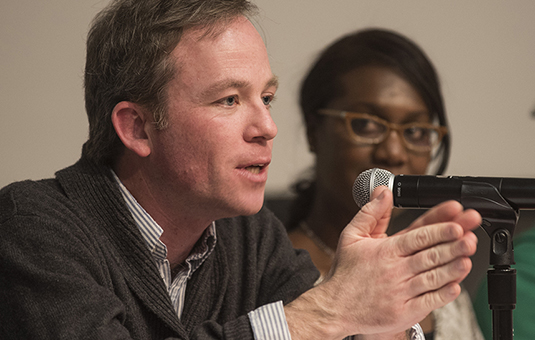
Professor Boatright teaches courses on American political behavior, political parties, campaigns and elections, interest groups, political participation, and political theory. He is currently completing work on a co-authored book on the effect of campaign finance reform on the political strategies of interest groups. In his prior book, Expressive Politics: The Issue Strategies of Congressional Challengers (published in 2004 by the Ohio State University Press) he explores the applicability of rational choice theories of electoral competition on the campaigns of congressional challengers, drawing upon interviews with candidates from the 1996 and 2000 election cycles. Professor Boatright has served as a research fellow at the Campaign Finance Institute, as an American Political Science Association Congressional Fellow, and as a research associate at the American Judicature Society. He has also published articles on congressional redistricting, the congressional budget process, and on various aspects of jury service. Current Research and Teaching
Professor Boatright’s current research interests include the effect of the Bipartisan Campaign Reform Act on the political strategies of major interest groups, communication between American and Canadian interest groups, and the politics of congressional primaries.
Selected Publications
Books Interest Group Adaptations in Elections: Pursuing Political Goals When the Context Shifts. With Michael J. Malbin, Mark J. Rozell, and Clyde Wilcox. Under Contract, University of Chicago Press.
2004. Expressive Politics: The Issue Strategies of Congressional Challengers. Columbus, OH: Ohio State University Press. Articles, Monographs, and Book Chapters
“Lessons for Canada from the American Campaign Finance Reform Experience.” In Party and Election Finance: Consequences for Democracy, ed. Lisa Young. Vancouver, BC: University of British Columbia Press, forthcoming.
2006. “Does Publicizing A Tax Credit for Political Contributions Increase Its Use? Results from a Randomized Field Experiment.” With Donald P. Green and Michael J. Malbin. American Politics Research 34: 563-82. 2006. “Adaptations and Alliances: Strategic Decisionmaking by Ongoing Interest Groups and Advocacy Organizations.” With Michael J. Malbin, Mark J. Rozell, and Clyde Wilcox. In The Election After Reform, ed. Michael J. Malbin. Lanham, MD: Rowman and Littlefield, pp. 112-138. 2005. “Can I Win Next Time? Strategic Repeat Challengers in House Races.” With Andrew J. Taylor. Political Research Quarterly 58/4: 609-617. 2005. Political Advertising Vouchers for Congressional Candidates: What Difference Could They Make? Washington, DC: The Campaign Finance Institute. 2005. “Political Contribution Tax Credits and Citizen Participation.” With Michael J. Malbin. American Politics Research.33/6: 787-817. 2004. “Static Ambition: Legislators’ Preparations for Redistricting.” State Politics and Policy Quarterly 4/4: 436-54. 2003. "BCRA's Impact on Interest Groups and Advocacy Organizations." With Michael J. Malbin, Mark J. Rozell, and Clyde Wilcox. In Life After Reform: When the Bipartisan Campaign Reform Act Meets Politics , ed. Michael J. Malbin. Lanham, MD: Rowman and Littlefield, pp. 43-60. 2003. "Biennial Budgeting Debates in Congress, 1977-2000." Journal of Public Budgeting, Accounting, and Financial Management 15/2: 275-308.
2002. "Life Cycle Factors, Status, and Civic Engagement: Issues of Age and Attitudes Toward Jury Service." With Susan Carol Losh. Justice System Journal 23: 221-234.
2001. "Generational Differences in Attitudes Towards Jury Service." Behavioral Sciences and the Law 19: 285-304.
2000. "Methodological Issues in the Study of Judicial Selection." With Kevin M. Esterling. Research on Judicial Selection 1: 73-110.
1999. "Why Citizens Don't Respond to Jury Summonses and What Courts Can Do About It." Judicature 82/4: 156-65.
1998. " 'You Don't Know Me, But Here I Am': Congressional Candidates and Party Strength." In The State of the Parties , 3rd Ed., John C. Green and Daniel Shea, eds. Lanham, MD: Rowman and Littlefield, pp. 320-36.
1998. Improving Citizen Response to Jury Summonses. Chicago: American Judicature Society.
|