
Fostering an environment of trust and respect regarding teaching, learning and advisement
The Center for Excellence in Teaching, Assessment and Learning (CETAL) offers programs and services to enhance the quality of education at Clark University.
Our vision
If we achieve our goals and live our mission, The Center for Excellence in Teaching, Assessment and Learning (CETAL) at Clark University will be a bustling hub of rich conversation and deep learning where every faculty and teaching staff employee at Clark feels welcomed and enabled to attempt innovative pedagogies. It will also be a place to make meaning from data and use it to drive instructional choices. The Center will also embrace challenges associated with teaching and learning through open, honest dialogue and reflection with peers from across campus, expanding the network of Clark colleagues beyond disciplinary boundaries, thus fostering a community of learners.
Our mission
The mission of CETAL is to play a central role in providing faculty and teaching staff with the data, resources, and instruction needed to maximize student learning on the Clark University campus. Opportunities for faculty learning will be housed in a safe environment that encourages the experimentation and risk-taking necessary to push the boundaries of what students can achieve.
Our goals
The Center of Excellence in Teaching, Assessment and Learning (CETAL) intends to:
- Foster curiosity about one’s teaching and learning with an eye towards continually iterating improving the student experience
- Include student voice in our work by including students as partners in much of the work that we do.
- Provide research-based programs and opportunities for faculty and teaching staff to hone and advance their teaching skills and styles;
- Mentor faculty at each stage of their careers;
- Actively link teaching, learning, research, and scholarship as complementary activities.
- Foster collaboration and community across schools and the region through professional and social programs.
- Create and maintain systems and documentation that allows for continuous improvement in student learning and engagement.
Our objectives
To meet our goals, CETAL will measure our success in a variety of ways. On larger initiatives, we will use student success and retention data to help us to make decisions. On smaller initiatives, we will use satisfaction data and participation rates to help guide the best use of our resources.
To deliver on our goals:
- Participants will evaluate instructional contexts and determine the most appropriate pedagogical strategies for improving student learning.
- Participants will partner with students as stakeholders whose input can guide us in better meeting the needs of learners.
- Participants will execute high-quality learning opportunities aligned to institutional, programmatic, and/or gen ed. outcomes (eg. critical thinking and writing).
- Participants will conduct highly engaging classes that utilize “best” or “good” practices.
- Participants will be able to provide, apply and reflect upon peer feedback related to instructional approaches.
- Participants will contribute to the larger body of Scholarship on Teaching and Learning by publishing and/or presenting peer-reviewed papers related to the Scholarship of Teaching and Learning.
- Participants will collaborate with peers across the University and the larger community of scholars and practitioners.
- Participants will be able to test, measure and learn from small experiments that can improve student learning and engagement.
CETAL activities
Learning partners
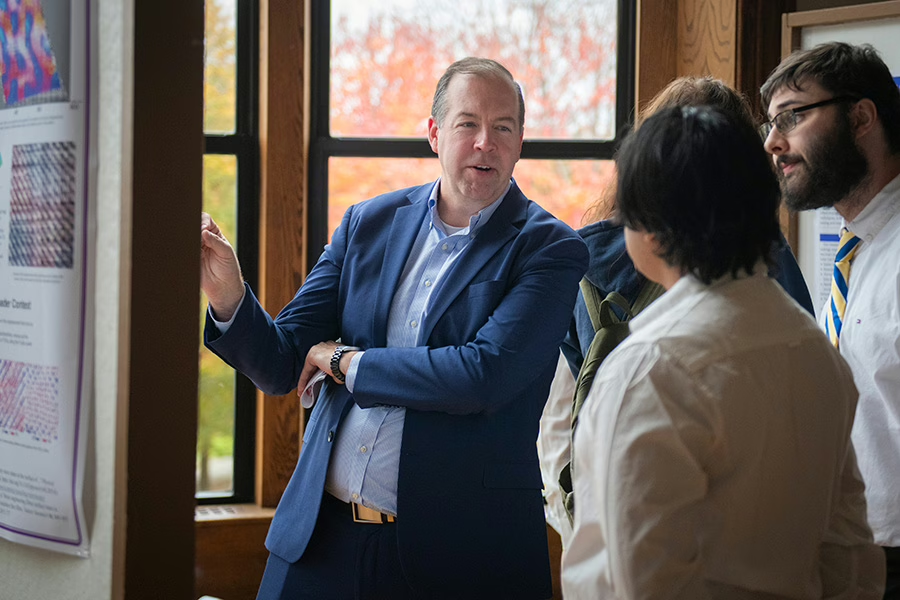
Implement a Learning Partners program where students partner in co-faciliating instruction in courses where many students struggle.
Students as research partners
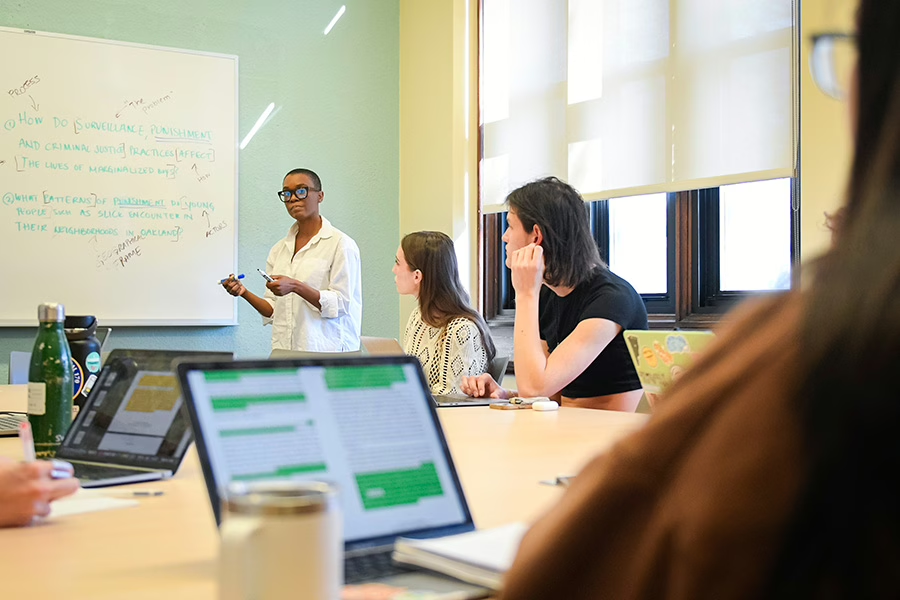
Implement a model where students partner in institutional research to dig deeper into existing data to better understand its meaning.
Department connections
Partner with departments to create and maintain on-ramps, off-ramps and support that can improve retention at the University.